Usuba
Usuba
Orange Jam
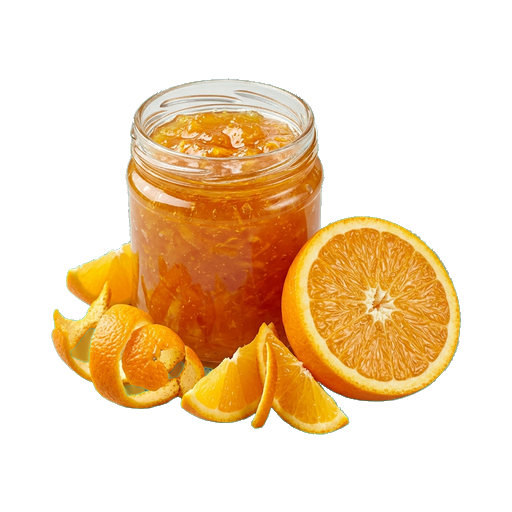
Sweet gel-like orange puree with a pronounced citrus bitterness and a fresh aroma. Used as a filling for baked goods, an addition to yogurts and cottage cheese, as well as a base for glazes and sauces for meat dishes. When choosing, pay attention to the consistency — quality jam should be homogeneous and dense, without crystallization, and when substituting with fresh orange juice, remember that you will need more liquid and the dish will be less sweet.
About
When Orange Becomes Jam
Orange jam is not just a preserve, but a concentrated taste of sunshine that works simultaneously as a sweet addition and as an independent ingredient for culinary experiments. Unlike jam with whole fruit pieces, jam has a uniform consistency with a slight jelly-like texture, which makes it a versatile helper in the kitchen.
Taste and Aroma
A good orange jam balances between the natural bitterness of the zest and the sweetness of the pulp. The aroma is bright and recognizable, but not cloying — this is important because overcooked jam loses its freshness and becomes one-dimensional. When choosing, pay attention to the color: a rich orange, sometimes with an amber tint, indicates quality processing. Cloudiness is not a flaw — it's a sign of a natural product without thickeners.
Where it works in dishes
Jam for breakfast is a classic: on toast, in yogurt, in pancakes. But its possibilities are much wider. It works great in baking as a filling for cookies, pies, and croissants. Add it to cottage cheese — you'll get a delicate dessert. Spread it on cheese — you'll get an interesting appetizer.
In more complex dishes, orange jam becomes a glaze for duck or chicken, giving the meat a shine and a sweet-tart note. Add it to a marinade or sauce — and you'll get depth of flavor without extra ingredients. Even in cocktails and hot drinks, the jam reveals itself in a new way, dissolving in the liquid and releasing its aroma.
Pairings and Harmonies
- With butter and fresh bread — a classic that never gets tired
- With dark chocolate — citrus acidity highlights the bitterness of cocoa
- With almonds and hazelnuts — nutty richness balances sweetness
- With hot spices (cinnamon, clove) — in baked goods or sauces
- With vanilla and cream — a classic trio for desserts
- With white cheeses (ricotta, mascarpone) — contrast of acidity and creaminess
How to Choose and Store
When buying, check the label: the fewer ingredients, the better. Ideally, it should contain only oranges, sugar, and sometimes lemon juice. The consistency should be thick but not rubbery — the jam should spread easily. Check the production date: fresh jam has a more vibrant flavor.
Store the closed jar in a cool place — a pantry or the lower shelf of a cabinet will work perfectly. After opening, refrigerate and use within a month. If mold appears on the jam, discard the entire jar — mold penetrates deep into jams. If it has crystallized, don't worry: melt it in a water bath or directly in a container with hot water.
Nutrition
per 100 g
- Calories
- 270 kcal
- Protein
- 0.5 g
- Fat
- 0.1 g
- Carbs
- 67 g
Measures and weight
- 1 tbsp
- 19.5 g
- 1 tsp
- 6.5 g
- 1 cup
- 325 g
Measure calculator
- Weight
- 100 g
- Calories
- 270 kcal