Usuba
Usuba
Dry breadcrumbs, white
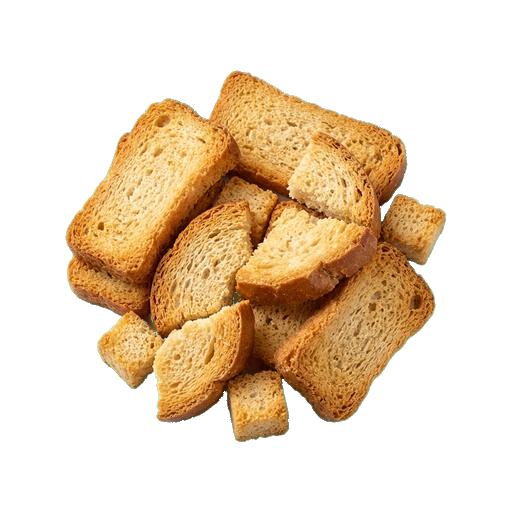
White breadcrumbs are crushed pieces of dried white bread without crust, obtained from the crumb of wheat bread. They serve as a universal breading for cutlets, fish and vegetables, and are also used as a binding component in forcemeat and dough. When choosing, it is important to pay attention to the uniformity of the grind and the absence of moisture. In recipes, they can be replaced with industrial-produced breadcrumbs or homemade dried and ground bread.
About
White breadcrumbs are a versatile kitchen helper that often remains in the shadow of more vibrant ingredients. Meanwhile, they are one of the most practical products for breading, thickening sauces, and creating a crispy crust. They are made simply: white bread is dried and ground into a uniform crumb. No additives, no color — just bread in its most neutral form.
Neutral taste is the main advantage
White breadcrumbs have almost no flavor of their own, and this is not a drawback but an advantage. They do not compete with the main ingredients of the dish, but only emphasize them. A coating of white breadcrumbs allows the taste of meat, fish, or vegetables to remain in focus, while the crust itself becomes simply a golden shell.
Texture also works in favor of white breadcrumbs. They provide a uniform, predictable result: not too coarse, not too fine. When you bread a cutlet or fish fillet, the breadcrumbs create a crispy layer that holds its shape and doesn't fall apart during frying.
Where to Use White Breadcrumbs
- Breading for cutlets, schnitzel, fish fillet and vegetables before frying
- Additive to ground meat for juiciness and fluffiness
- Thickening agent for sauces, soups and gravies
- Base for crumbs in casseroles and gratins
- Component in batter for lightness and crispness
Classic breading follows this scheme: flour — egg — white breadcrumbs. Flour dries the surface and helps the egg adhere better, egg acts as an adhesive, and breadcrumbs create the final crispy layer. This order is not accidental, and it should not be changed.
How to choose and store
When choosing, pay attention to the color — it should be truly white or light cream, without yellow and brown specks. This is a sign of quality white bread used for production. Check the packaging for moisture: crackers should be dry, without lumps and musty smell.
White crackers should be stored in an airtight container in a cool, dry place. They easily absorb moisture from the air, so a tightly sealed jar or container is your best helper. With proper storage, the product will keep for several months without losing its properties.
If crackers have become stale or absorbed moisture, they can be revived: spread them on a baking sheet and heat in the oven at 120–140 degrees for 10–15 minutes. They will regain their crispness and be like new.
White breadcrumbs are not exotic and not a trend, they are a reliable classic ingredient that works. They are cheap, have a long shelf life, are versatile, and always deliver the expected result. If you cook often, it makes sense to always keep them on hand.
Nutrition
per 100 g
- Calories
- 380 kcal
- Protein
- 11 g
- Fat
- 3 g
- Carbs
- 75 g
Measures and weight
- 1 tbsp
- 6 g
- 1 tsp
- 2 g
- 1 cup
- 100 g
Measure calculator
- Weight
- 100 g
- Calories
- 380 kcal