Usuba
Usuba
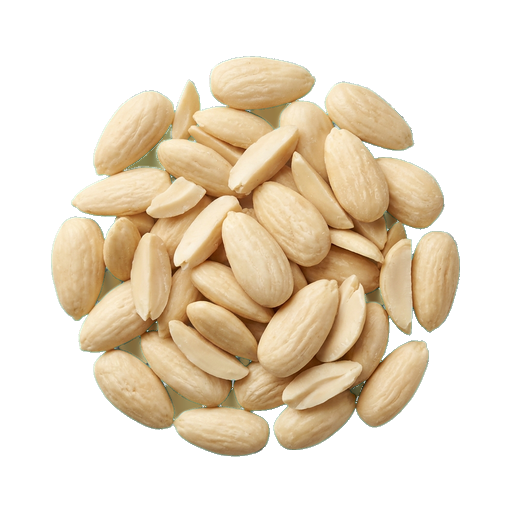
Blanched almonds
Almonds that have been treated with hot water and blanched of their thin brown skin acquire a light color and delicate texture. Such almonds quickly absorb moisture and aromas, making them ideal for creams, pastes, almond milk, and delicate pastries. When using in baking or sauces, keep in mind that blanched almonds are more delicate than raw almonds and may turn bitter more quickly when heated, so add them toward the end of cooking or use at low temperatures.
About
Blanched almonds are almond kernels without skin that have undergone heat treatment. The skin is removed intentionally to achieve a delicate, light texture and a softer, more subtle flavor. In cooking, this is one of the most convenient forms of almonds: it quickly absorbs aromas, grinds well, and distributes evenly in dough and sauces.
Taste and texture
Without the skin, almonds lose the slight bitterness that is characteristic of unpeeled nuts. Instead, you get a pure, sweet nutty flavor with a delicate oiliness. The texture is softer than whole almonds, so it crumbles more easily by hand and softens faster when soaked or heated.
Blanched almonds are ideal for pastes and creams — their smoothness allows for a uniform consistency without grittiness. In baking, they work as a standalone ingredient (almond flour, topping, filling) or as a component that adds tenderness and moisture to the dough. In sauces and cream soups, the kernels dissolve quickly, creating a creamy texture without visible particles.
Where to use it
- Almond flour for cookies, sponge cakes and gluten-free baking
- Creams and pastes — almond butter turns out more delicate than from unpeeled almonds
- Sauces for fish and poultry — ground blanched almonds provide a creamy base
- Marzipan and sweets — light color is valued in confectionery products
- Topping and decoration — whole kernels or petals look neater than those with brown skin
- Vegetable puree soups — almonds add richness of flavor and creaminess
Selection and Storage
When buying, pay attention to the color: the kernels should be evenly light, without yellow or brown spots. The smell should be fresh, nutty, without mustiness or rancidity. If almonds are sold in bulk, ask to try them — the taste should be pleasant, without bitterness or strange aftertaste.
Store blanched almonds in an airtight container in the refrigerator or freezer. Without the skin, they oxidize faster and can become rancid, so at room temperature they last a maximum of one month. In the refrigerator — up to three months, in the freezer — up to a year. Before use, take out the needed amount and immediately put the rest back to avoid condensation.
If you cook with almonds often, it makes sense to buy whole kernels and grind them in a food processor when needed — it's cheaper than ready-made almond flour and guarantees freshness. Ground almonds oxidize quickly, so it's better to prepare them right before use.
Nutrition
per 100 g
- Calories
- 579 kcal
- Protein
- 21.1 g
- Fat
- 49.9 g
- Carbs
- 21.6 g
Measures and weight
- 1 tbsp
- 9 g
- 1 tsp
- 3 g
- 1 cup
- 150 g
Measure calculator
- Weight
- 100 g
- Calories
- 579 kcal