Usuba
Usuba
Coconut Sugar
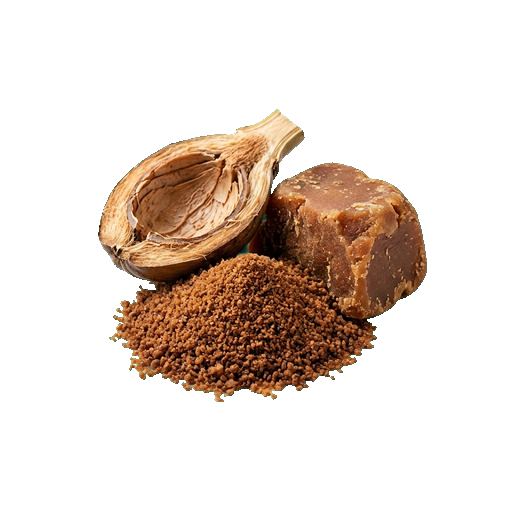
Coconut sugar is produced from the nectar of coconut palm flowers. It has a caramel flavor with subtle vanilla notes and a lower glycemic index than regular sugar. In cooking, it is used to sweeten beverages, baked goods, and desserts, as well as for making sauces and marinades. When replacing regular sugar with coconut sugar, keep in mind that it may slightly alter the color and taste of the dish, so it's better to start with small test portions.
About
Coconut sugar is not an exotic rarity, but a practical sweetener that works in the kitchen almost like regular sugar, but with its own character. It is obtained from the sap of coconut palm flower buds, which is then evaporated to a crystalline state. In taste, it resembles brown sugar with a slight caramel note, but without cloying sweetness.
Aroma and Taste
The main difference between coconut sugar and white sugar is that it is not neutral. It has a delicate sweetness with hints of caramel and vanilla — nothing sharp, just a background sweetness that doesn't overpower other flavors. This is especially noticeable in baked goods and beverages, where white sugar would be undetectable, while coconut sugar adds depth.
Role in dishes
- In baked goods — cookies, buns, cupcakes acquire a rounder flavor compared to white sugar
- In beverages — coffee, tea, cocktails become softer, without sharp sweet spikes
- In sauces and marinades — dissolves slower than white sugar, therefore requires more time for integration
- In porridge and yogurts — works as a sweetener with its own flavor, rather than just a background note
Practice of use
Coconut sugar is not fully interchangeable with white sugar. It has roughly equivalent sweetness, but the structure is different — the crystals are larger, so in recipes requiring complete dissolution (for example, in caramel or thin meringues) it may not work well. However, in cookies where crumbliness is desired, or in beverages where there is time for dissolution, it works great. If you want to replace white sugar, start with half the amount — this way you'll feel how its taste affects the result.
Pairings
- Spices — cinnamon, cardamom, ginger — coconut sugar brings them out
- Vanilla and nutty flavors — naturally complement each other
- Cocoa and chocolate — together create a softer, less bitter profile
- Sour fruits — lemon, berries — the contrast becomes more vivid
Selection and Storage
When buying, pay attention to the color — good coconut sugar is light brown, uniform, without lumps and foreign odors. If it smells like mold or mustiness, this is a sign of improper storage. The crystals should be crumbly, not clumped together into a solid mass.
- Store in a tightly sealed container — coconut sugar is hygroscopic and absorbs moisture from the air
- A cool, dry place away from sunlight — a kitchen cabinet is ideal
- If the sugar has clumped together — this is not spoilage, simply place it in an airtight container with a piece of bread for a day, it will absorb the moisture and the sugar will become loose again
Coconut sugar is not a trend, but a useful tool for those who want to add depth of flavor without extra ingredients. It requires some adaptation in recipes, but the result is worth it.
Nutrition
per 100 g
- Calories
- 375 kcal
- Protein
- 1.5 g
- Fat
- 0.2 g
- Carbs
- 94 g
Measures and weight
- 1 tbsp
- 11.3 g
- 1 tsp
- 3.8 g
- 1 cup
- 187.5 g
Measure calculator
- Weight
- 100 g
- Calories
- 375 kcal