Usuba
Usuba
Gellan
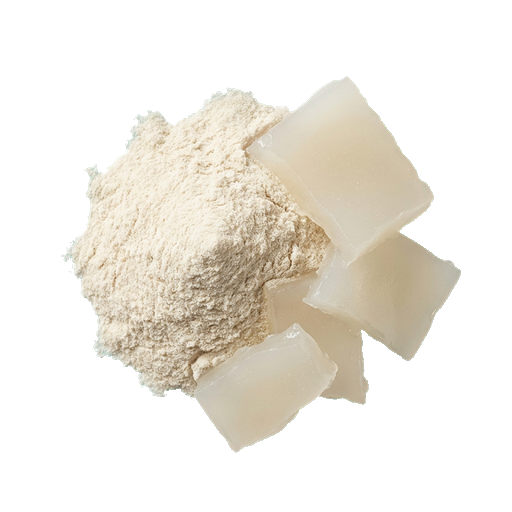
Gellan is a natural thickener and gelling agent obtained through bacterial fermentation. In cooking, it is used to create a dense consistency in sauces, jellies, marmalades, and other dishes that require stable structure. When working with gellan, it is important to remember that it forms a gel when cooled and works well in acidic environments, which is why it is often used in desserts, fruit glazes, and molecular cuisine.
About
Gellan is a polysaccharide obtained through bacterial fermentation. In cooking, it acts as a thickener and stabilizer, creating the desired consistency in sauces, beverages, and desserts. Its main advantage is that it works quickly, requires no heating, and delivers predictable results even in complex recipes.
How gellan works in dishes
Gellan forms a gel at room temperature if potassium or calcium ions are present in the mixture. This means it is ideal for creating spherification — the very technique where liquid is transformed into an elastic droplet. In ordinary sauces and soups, gellan makes the texture smooth and uniform, leaving no starchy sensation on the tongue. It can be used in both cold and hot dishes: it is stable when heated and does not lose its properties when cooled.
Dosage and Application
- For thickening sauces: 0.1–0.3% of the liquid weight (approximately 1 gram per liter)
- For creating gel: 0.3–0.5% (calcium or potassium ions are needed)
- Always mix gellan with sugar or salt before adding to liquid — this will ensure even dissolution without lumps
- Use a blender or whisk for complete dissolution
Combinations and Recipes
Gellan is versatile: it works in fruit purees, vegetable side dishes, meat sauces, and even in cocktails. It's especially good in cuisines where taste purity is valued — gellan has almost no taste of its own and doesn't mask the main ingredients. Try it in a berry sauce for dessert, in a savory sauce for fish, or in fruit jelly without gelatin.
Selection and Storage
Gellan is sold as a white powder. Store it in an airtight container in a cool, dry place — the shelf life is usually several years. A small package (25–50 grams) lasts a long time because the consumption rate is minimal. When purchasing, make sure it is pure gellan without additives if you plan to use it in precise molecular gastronomy recipes.
Practical Tips
- Gellan is not suitable for acidic environments with pH below 3 — in such cases its thickening properties weaken
- If you need a very liquid consistency, start with a minimal dose and add gellan gradually
- Gellan gel does not melt when heated, but becomes softer — this can be used in hot dishes
- For spherification, use sodium alginate with gellan or separately — both work by different principles and complement each other
Nutrition
per 100 g
- Calories
- 300 kcal
- Protein
- 0 g
- Fat
- 0 g
- Carbs
- 75 g
Measures and weight
- 1 tbsp
- 10.5 g
- 1 tsp
- 3.5 g
- 1 cup
- 175 g
Measure calculator
- Weight
- 100 g
- Calories
- 300 kcal