Usuba
Usuba
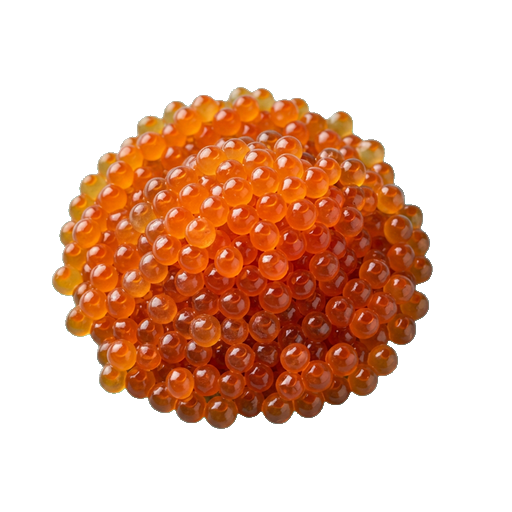
Red caviar
Red caviar consists of roe from salmon, pink salmon, chum salmon, and other Pacific fish, characterized by a distinctive salty flavor and delicate texture. It adds vibrant color and subtle fish aroma to sushi, canapés, appetizers, and festive dishes. When selecting, pay attention to the integrity of the eggs, transparency, and uniform orange hue — cloudy or clumped eggs indicate improper storage or low quality.
About
What You Need to Know About Red Caviar
Red caviar consists of roe from salmon fish: pink salmon, chum salmon, sockeye salmon, coho salmon, and Chinook salmon. Each roe berry is an elastic shell with liquid contents inside. The size of the roe varies depending on the type of fish: Chinook salmon and chum salmon produce the largest eggs, while pink salmon produces smaller ones. The color can range from light orange to saturated red-orange, depending on the type of fish and the time of harvest.
The taste of red caviar is salty, slightly sweet, with a pronounced sea aroma. The caviar beads burst on your tongue, releasing their oily contents. It is a delicacy valued for its tenderness and delicate flavor, rather than for spiciness or pungency.
How to use in cooking
Red caviar is best served with minimal processing. The classic way is on a slice of bread with butter, with a squeeze of lemon or fresh dill. Caviar works wonderfully in sushi and rolls, where it can be placed on rice or used as a filling. It beautifully garnishes cold appetizers, salads, and canapés, adding a festive touch and a savory accent to any dish.
The main rule: caviar is not cooked. It is served chilled, often with ice. Heating destroys the delicate membrane of the eggs and kills the taste. The exception is caviar as part of hot appetizers like pancakes with sour cream, but even then it is added at the last moment to preserve its structure.
Pairings and gastronomic pairs
- Butter and white bread — a classic combination where butter softens the saltiness, and bread serves as the base
- Sour cream and pancakes — caviar contrasts with acidity and richness, creating harmony
- Lemon and dill — acidity and herbaceous notes emphasize the seafood flavor of caviar
- Avocado — neutral, creamy taste works as a cushion for caviar
- Cream cheese — adds softness and creates an interesting contrast of textures
- Rice and nori in sushi — caviar here acts as a bright flavor accent
How to Choose and Store
When choosing caviar in a jar, pay attention to its appearance: the roe should be whole, uniform in size, with no cloudiness or foreign inclusions. Shake the jar slightly — the caviar should not be too liquid. The production date and ingredients on the label will tell you how fresh the product is. Caviar in vacuum packaging lasts longer than in a regular jar.
Red caviar should be stored in the refrigerator at a temperature between 0 and +4 degrees Celsius. An opened jar should be transferred to a glass container with a tight-fitting lid — this will prevent oxidation and absorption of foreign odors. A closed jar can be stored for several months, while an opened one — no more than a week. Freezing caviar is not recommended: when thawed, the roe loses its elasticity and becomes watery.
Practical kitchen tips
- Serve caviar chilled, but not icy — this way the flavor will open up more fully
- Use a non-metal spoon when spreading caviar to avoid oxidation
- Do not mix caviar with hot ingredients at the last moment before serving
- For canapés and appetizers, add caviar right before serving
- Caviar works well as a finishing touch to a dish, rather than as a main component
Nutrition
per 100 g
- Calories
- 250 kcal
- Protein
- 31 g
- Fat
- 13 g
- Carbs
- 1 g
Measures and weight
- 1 tbsp
- 15.8 g
- 1 tsp
- 5.3 g
- 1 cup
- 262.5 g
- 1 can
- 140 g
Measure calculator
- Weight
- 100 g
- Calories
- 250 kcal