Usuba
Usuba
Ground almonds
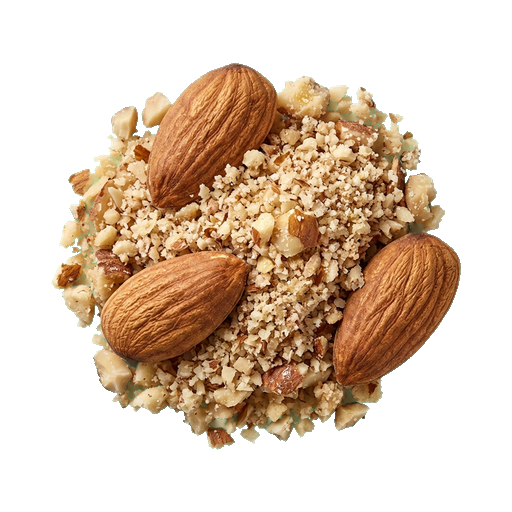
Ground almonds are almond kernels finely milled into crumbs or flour that retain their oiliness and characteristic sweet nutty flavor. Used in baking, desserts, sauces, and coatings, they add a delicate texture and deep nutty aroma to dishes. Storage requires a cool place, as the oils oxidize quickly in air, so it's important to seal the package tightly and check freshness before use.
About
Ground almonds are a ready-made ingredient that saves time in the kitchen and opens up many possibilities in baking and sweet dishes. You can use it as is or as a base for your own experiments. The main advantage is that the texture is already prepared: you don't need to grind nuts yourself in a blender or coffee grinder, risking getting nut butter instead of flour.
Texture and Taste
The degree of grinding can vary: from coarse crumbles to almost powder-like consistency. Coarse grinding is felt on the tongue, gives dishes structure and interesting texture. Fine grinding better binds ingredients and creates a smooth, delicate consistency. The taste remains pure nutty, with a subtle sweetness and oiliness. If the almonds were roasted before grinding, a deeper, caramel note appears.
Role in dishes
Ground almonds work as a truly universal ingredient. In baking, they can replace part of the flour, making cookies, cupcakes, and cakes more moist and aromatic. In porridge or yogurt, they add satiety and nutty character. They are used for coating meat and fish — resulting in a crispy crust with an interesting flavor. Even in sweet sauces and creams, they create the needed consistency and enrich the flavor profile.
Successful Pairings
- With cocoa and dark chocolate — a classic combination for cakes and pastries
- With lemon and orange — acidity contrasts with the buttery richness of nuts
- With cinnamon and cardamom — creates a warm, spicy background
- With strawberry and raspberry — berry acidity balances the nutty sweetness
- With honey and vanilla — enhances the sweet, comforting flavor
Selection and Storage
When purchasing, pay attention to the color — it should be uniform, without dark spots or signs of mold. The smell should be pleasant, nutty, without mustiness. If the product smells like rancid oil, this is a sign of oxidation — it's better not to take such almonds. Store in an airtight container in a cool, dry place or in the refrigerator. In the freezer, ground almonds last the longest — up to six months. The main thing is to protect it from moisture and air, otherwise it will quickly become rancid.
Practical Tips
- If a recipe calls for almond flour but you only have coarse ground, grind it again in a blender on low speed
- For breading meat, mix almonds with breadcrumbs and salt — you'll get an interesting texture
- Lightly toast almonds in a dry skillet before using to enhance the aroma
- For crumbly texture, add a little starch if almonds have started to clump from moisture
Nutrition
per 100 g
- Calories
- 579 kcal
- Protein
- 21.1 g
- Fat
- 49.9 g
- Carbs
- 21.6 g
Measures and weight
- 1 tbsp
- 7.5 g
- 1 tsp
- 2.5 g
- 1 cup
- 125 g
Measure calculator
- Weight
- 100 g
- Calories
- 579 kcal