Usuba
Usuba
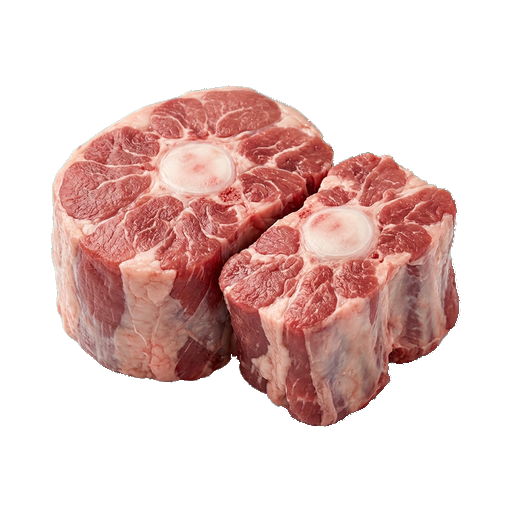
Oxtail
Veal tail is a meat and bone product rich in collagen and gelatin, making it ideal for prolonged braising and boiling. Thanks to its high content of connective tissue, when properly prepared, it becomes tender and imparts a rich, deep flavor and gelatinous consistency to dishes. Veal tail is used for preparing broths, stews, soups, and braised dishes that require a minimum of 2–3 hours of slow cooking.
About
Veal tail is one of the most underrated meat products in home cooking. It's not just a trim: the tail contains a lot of connective tissue and bone marrow, which during long cooking are transformed into a rich, viscous broth. Pieces of meat become tender and literally separate from the bone. The dish turns out satisfying and aromatic, although at first glance the ingredient looks unappealing.
Taste and aroma
Veal tail meat is tender and delicate, without a sharp smell. When cooked, it releases a powerful meaty aroma with deep notes. Bone marrow and cartilage give the broth a characteristic, almost slightly sweet flavor — this is the main difference from regular meat. Fats dissolve in the liquid, creating an oily texture that coats the tongue.
How to cook and what to pair with
Veal tail requires time — a minimum of 2–3 hours of slow simmering. It is an ideal choice for soups, stews, and braised dishes. Place the tail in cold water, bring to a boil, drain the first broth, rinse the meat and start over — this way you will get a clear, clean broth instead of a cloudy one.
- Soups and broths — a classic application, especially with potatoes, carrots, and onions
- Stews and braised dishes — meat absorbs wine, tomatoes, and spices perfectly
- Aspic — the gelatinous consistency of broth is ideal for a cold dish
- Base for sauces — concentrated broth from the tail gives depth
Works well with roots (celery, parsley, carrots), black pepper, bay leaf and thyme. Wine — red or white — enhances the meat flavor. If you're cooking an Asian dish, add ginger, star anise and soy sauce.
Selection and Storage
Look for a tail with dense, pink meat without dark spots. The bone should be white, without gray coating. A single tail usually weighs 300–600 grams. Ask the butcher to cut it into pieces of 4–5 centimeters — this way it cooks more evenly.
- In the refrigerator: up to 3 days in the coldest part
- In the freezer: up to 3 months in an airtight container
- Thaw in the refrigerator, not at room temperature
Oxtail is an investment of time that pays off with a fullness of flavor and quality broth. It is not a delicacy, but rather a forgotten helper of home cooking.
Nutrition
per 100 g
- Calories
- 200 kcal
- Protein
- 19 g
- Fat
- 14 g
- Carbs
- 0 g
Measure calculator
- Weight
- 100 g
- Calories
- 200 kcal