Usuba
Usuba
Poshekhonsky cheese
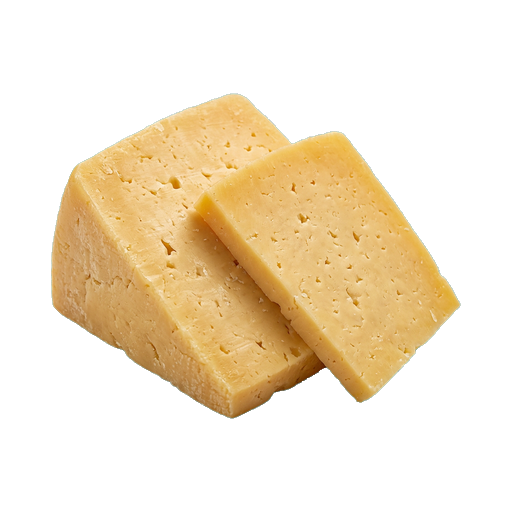
A semi-hard cheese with a dense structure and slightly sharp, mildly tangy flavor that melts well and holds its shape when heated. Traditionally used in hot dishes — soups, casseroles, sandwiches with cured meats — and is also suitable for slicing as an appetizer. When selecting, pay attention to an even color without dark spots and a pleasant milk aroma. In recipes, it can be substituted with Dutch or Russian cheese of similar density.
About
Poshekhonsky cheese is a semi-hard cheese with a dense structure and delicate creamy flavor. It occupies a middle position between sharp aged cheeses and soft young ones: firm enough to be sliced, but without requiring long maturation. This balance makes it a versatile kitchen helper — equally good in hot dishes and in cold appetizers.
Aroma and Flavor
The taste of this cheese is mild and delicate — creamy, with barely noticeable nutty notes. There is no aggressive sharpness or pungent smell. The texture is dense but not dry: when broken, small eyes (holes) are visible, which give it a slight porosity. This allows the cheese to absorb the aromas of neighboring ingredients in a dish while maintaining its own character.
Role in dishes
In hot dishes, Poshekhonsky cheese behaves perfectly: it melts evenly, does not separate, and does not become greasy. It is added to omelets, casseroles, meat rolls, and dishes with cream sauce. In the kitchen, it works as a reliable background, enhancing creaminess without overpowering the main flavors.
Served cold — on a board with appetizers, in salads, on sandwiches — cheese proves itself to be a full-fledged participant, not just a complement. A slice holds its shape well, doesn't break, and cuts conveniently.
Pairings
- Bread: black, rye, with seeds — cheese contrasts well with their density and sourness
- Vegetables: tomatoes, cucumbers, sweet peppers, herbs — light and fresh companions
- Meat: ham, smoked sausage, boiled chicken — cheese brings their flavors together into a whole
- Sauces: creamy, sour cream-based, white wine-based — enhance the cheese's dairy profile
- Drinks: light beer, white wine, kvass — natural partners to its neutral taste
Selection and Storage
When purchasing, pay attention to elasticity: the cheese should spring back slightly under your finger, but not be hard as stone. If you see cracks or the cheese looks dried out, this is a sign of improper storage. The rind should be intact, without mold or dark spots.
- Store in the refrigerator in a separate container or wrapped in parchment paper — not in plastic, so the cheese can breathe
- Optimal temperature: 4–8 degrees
- Storage time: 2–3 weeks, if the cheese is wrapped properly and does not contact strongly scented products
- Before using, take the cheese out of the refrigerator for 20–30 minutes so it can reveal its flavor
Poshekhonsky cheese is a choice for those who appreciate reliability and simplicity. It doesn't require special handling skills, doesn't cause problems when melting, and doesn't conflict with other ingredients. Ideal for everyday cooking, where you need a cheese that simply works.
Nutrition
per 100 g
- Calories
- 344 kcal
- Protein
- 26 g
- Fat
- 25 g
- Carbs
- 0 g
Measures and weight
- 1 slice
- 20 g
Measure calculator
- Weight
- 100 g
- Calories
- 344 kcal