Usuba
Usuba
Rock salt
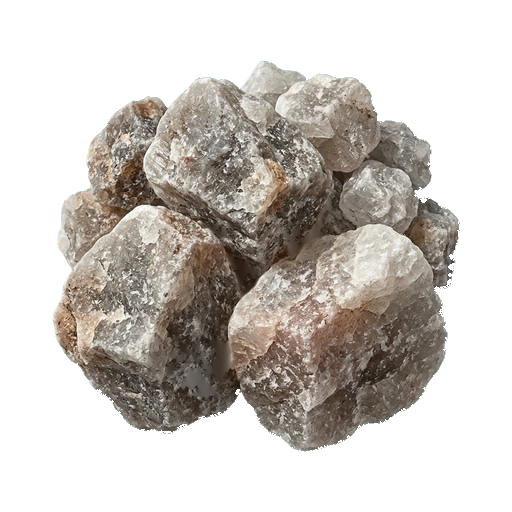
Mineral salt extracted from earth deposits is distinguished by large crystals and often contains mineral impurities that give it gray, pinkish, or brownish hues. It is used in cooking for salting, pickling, and preserving due to its large crystal size, which dissolves more slowly than table salt, allowing better control over the dish's salinity. When selecting rock salt, pay attention to its purity and absence of foreign impurities, and when substituting with regular table salt, keep in mind that the latter is saltier due to its smaller crystal size.
About
Rock salt is a mineral that is mined from the earth and used in the kitchen as a primary source of salt. Unlike sea salt, it forms in ancient dried-up sea deposits and does not require evaporation. The crystals of rock salt are larger than ordinary table salt, which is why it is often called crystalline or coarse salt.
Taste and Use
Rock salt is indistinguishable in taste from other types — a pure salty mineral without impurities. Its main advantage lies in the size of its crystals: they dissolve more slowly and provide more controlled salting. This is especially useful when curing meat, fish, or vegetables, when precise dosing is needed.
Rock salt works everywhere in the kitchen: in main dishes, when preparing broths, in marinades, and for pickling. Large crystals are convenient to grab with your fingers, so it is often kept in a separate bowl next to the stove. Some chefs prefer it for finishing salt—when the salt remains visible on the dish and adds texture.
Selection and Storage
When choosing rock salt, pay attention to the purity of the crystals — they should be transparent or white, without dark inclusions. Crystal size varies: small crystals dissolve faster, large ones hold their shape longer. Choose depending on what you're cooking.
Rock salt keeps practically indefinitely in a dry place protected from moisture. Even if it becomes slightly damp and hardens, this does not affect its quality — simply break up the lump. Store salt in an airtight jar or in a special salt shaker so it doesn't absorb odors and moisture from the air.
Rock salt is not an exotic ingredient, but a reliable helper in every kitchen. Its versatility and ease of use make it indispensable for both everyday cooking and special techniques such as salting and smoking.
Nutrition
per 100 g
- Calories
- 0 kcal
- Protein
- 0 g
- Fat
- 0 g
- Carbs
- 0 g
Measures and weight
- 1 tbsp
- 18 g
- 1 tsp
- 6 g
- 1 cup
- 300 g
Measure calculator
- Weight
- 100 g
- Calories
- 0 kcal