Usuba
Usuba
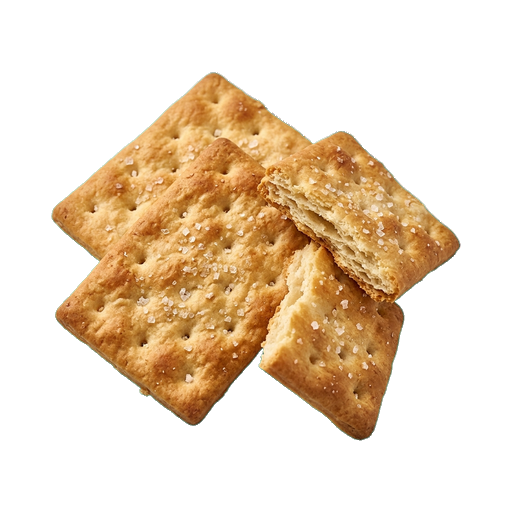
Salted crackers
Crispy crackers with a pronounced salty taste, made by baking thin dough with added salt. They serve as an excellent accompaniment to soups, salads, and beverages, and are also used as a base for canapés and appetizers. When choosing, pay attention to crispness and even color — quality crackers should be crunchy rather than soft, and store well in airtight packaging.
About
Salted crackers are a versatile kitchen helper that works both as a standalone snack and as a component of complex dishes. Crispy, dense, with a pronounced salty flavor, they embody simplicity and practicality. Their main advantage is that they require no preparation and are ready to eat at any moment.
Taste and Texture
Salted crackers deliver a bright, clean salty taste without unnecessary notes. Texture is what makes them special: crispy yet not brittle, they hold their shape when broken and don't crumble in your hands. This density allows you to use them not only as a snack, but also as a base for sandwiches or an addition to salads.
On the tongue, crackers dissolve gradually, releasing saltiness and a light wheat sweetness. If the composition contains seeds or grains, they add a nutty undertone and additional textural interest.
Role in dishes and pairings
Salted crackers work in three main scenarios. First — as a standalone snack with beer, wine, or tea. Second — as a base for canapés with pâté, cheese, smoked meats, or fish. Third — as a component in salads, where they add crunch and hold their shape better than bread.
- With soft cheeses and honey — a classic combination of sweet and salty
- With canned fish or caviar — the perfect base for simple canapés
- In soups instead of croutons — adds crunch and absorbs broth
- With avocado and lemon — fresh, light combination
- In salads instead of crackers — holds shape and doesn't get soggy quickly
Selection and Storage
When choosing crackers, pay attention to the packaging: it should be intact, without signs of moisture or grease stains. Shake the package — if you hear the sound of crumbling crumbs, this is a sign that the crackers have already started to break. A good cracker makes a clear and distinct sound when broken.
The ingredients should be simple: flour, water, salt, oil. If you see many additives and preservatives, it affects the taste and freshness. Check the production date — fresh crackers last longer and crunch louder.
Storage
Salted crackers are afraid of moisture — this is the main rule. Keep them in an airtight container at room temperature, away from sources of heat and humidity. An open package is better transferred to a glass container with a tight-fitting lid. With proper storage, crackers remain crispy for several weeks.
If the crackers have started to soften, place them in the oven for a few minutes at 150 degrees — they will regain their crunch. Store them separately from aromatic products, as crackers easily absorb foreign odors.
Nutrition
per 100 g
- Calories
- 400 kcal
- Protein
- 9 g
- Fat
- 10 g
- Carbs
- 65 g
Measures and weight
- 1 tbsp
- 4.5 g
- 1 tsp
- 1.5 g
- 1 cup
- 75 g
- 1 pcs
- 5 g
Measure calculator
- Weight
- 100 g
- Calories
- 400 kcal