Usuba
Usuba
Savoy cabbage
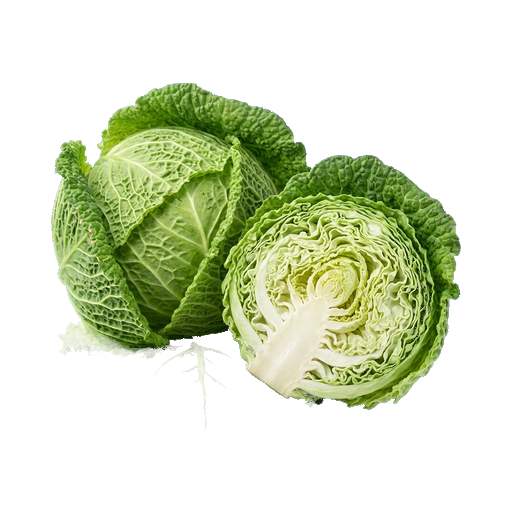
Savoy cabbage differs from white cabbage by its tender, slightly crinkled leaf structure and more delicate, subtly sweet flavor with a light bitterness. It cooks faster, absorbs sauces well, and is ideal for braising, soups, and salads, especially when you need a soft texture without a strong cabbage aroma. When selecting, pay attention to the density of the head and the freshness of the leaves without brown spots. Keep in mind that it has shorter shelf life than regular cabbage.
About
Savoy cabbage is a head with delicate, crinkled leaves that looks nothing like the familiar green cabbage. Its structure is looser, the leaves are thinner and softer, so it cooks faster and doesn't require lengthy softening. If you're looking for cabbage for salads where you need an airy texture, or for dishes where tenderness matters, this is your choice.
Taste and aroma
Savoy cabbage tastes milder and sweeter than white cabbage. It has almost none of that sharp sulfurous note that appears when cooking regular cabbage. Even raw, the leaves are not bitter and have no coarse aftertaste. This makes it ideal for those who don't like classic cabbage or are cooking for children.
Where to use it
- Fresh salads — tender leaves don't require prolonged chewing and absorb dressing well
- Soups and stews — soften quickly while maintaining shape, doesn't fall apart into mush
- Stewing and frying — leaves become tender in 10–15 minutes, perfect for side dishes
- Cabbage rolls — soft leaves roll easily and don't crack during cooking
- Side dishes for meat and fish — light texture doesn't overload the dish
How to Cook
Main rule: do not overcook. Due to thin leaves, cabbage cooks twice as fast as regular white cabbage. When stewing, 10–15 minutes over medium heat is enough, when boiling — 5–7 minutes. If you're making a salad, cut it not too thin: the leaves are fragile and may fall apart.
For cabbage rolls, dip a whole head of cabbage into boiling water for 3–4 minutes — the leaves will become soft and easily separate from the head. There is no need to disassemble it beforehand. When frying sliced cabbage, use high heat so that the leaves acquire a golden hue rather than turn into mush.
Pairings
- With butter and cream — a classic combination that emphasizes tenderness
- With bacon, ham — smoky aroma contrasts with the soft taste of cabbage
- With garlic and pepper — a simple seasoning that doesn't overpower the natural taste
- With apple and vinegar — a classic combination for a side dish with fatty meat
- With parmesan — for casseroles and side dishes with a crispy crust
Selection and Storage
When purchasing, choose heads with a dense structure, without soft spots and darkening. The leaves should be firm, not wilted. A head that is heavy for its size is a good sign. Small cracks on the upper leaves are not critical: simply remove them.
Store in the refrigerator in the vegetable compartment, wrapped in paper or in a plastic bag with air holes. This way, cabbage will keep for 1–2 weeks. Do not place it next to ethylene-producing fruits like apples — they accelerate wilting. If the head begins to wilt, soak it in cold water for an hour before cooking.
Nutrition
per 100 g
- Calories
- 27 kcal
- Protein
- 1.2 g
- Fat
- 0.2 g
- Carbs
- 5.2 g
Measures and weight
- 1 head
- 800 g
- 1 slice
- 30 g
Measure calculator
- Weight
- 100 g
- Calories
- 27 kcal