Usuba
Usuba
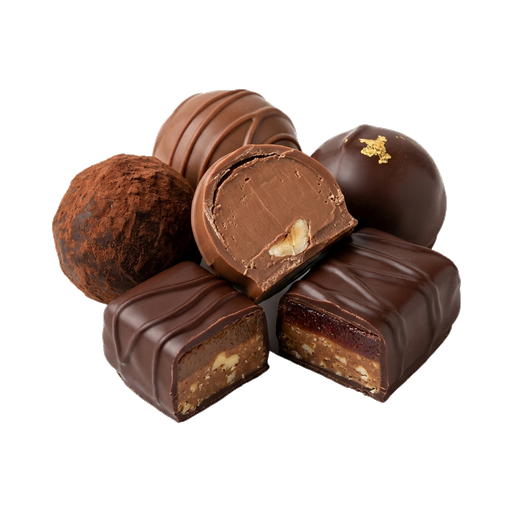
Chocolate candies
Chocolate candies are confectionery products with a chocolate shell and various fillings: from creams and ganaches to nougat and fruit purees. They add sweetness and deep cocoa flavor to desserts, are used as decoration for cakes and pastries, and also serve as an independent treat. When choosing, pay attention to the cocoa content and quality of the chocolate, as this affects the flavor profile and the ability of candies to hold their shape during temperature fluctuations.
About
Chocolate candies are not just a sweetness, but a full-fledged ingredient for a culinary professional. When you work with them in the kitchen, it's no longer just a dessert, but a tool for creating complex flavors. Melted chocolate from candies can become the base for a sauce, a filling for baked goods, or a component of cream. The main thing is to understand which candies are suitable for which task.
What types are there and how to choose them
In the kitchen you will encounter three main types. Dark chocolate — dense, with pronounced bitterness, good for sauces and ganaches where taste intensity is needed. Milk chocolate — softer and sweeter, they are ideal for creams and fillings when you want to soften other ingredients. White chocolate — the most delicate, often used for delicate creams and coatings, although technically it is not quite chocolate.
When choosing, pay attention to the cocoa percentage in dark chocolate — 50–70% will give you a good balance, 70% and above will require more careful handling of sugar in the recipe. Check that the composition doesn't contain vegetable oils instead of cocoa butter: they are cheaper, but behave differently when melting and cooling. The candies should be whole, without white coating (this is a sign of improper storage).
How to work with chocolate candies in the kitchen
The most common operation is melting. Never do this directly over heat: chocolate burns and becomes bitter. Use a double boiler — a bowl over a pot of hot water. Water should not touch the bottom of the bowl or get into the chocolate. Cut candies into small pieces — this way they melt evenly. Add a little butter (butter or vegetable oil) if the chocolate seems too thick after melting.
- Ganache — mix melted chocolate with hot cream in a 1:1 ratio, let cool to desired consistency
- Glaze — dilute melted chocolate with butter or cream to a liquid consistency, apply to finished products
- Cream — whip melted and cooled chocolate with butter and powdered sugar
- Sauce — melt with the addition of milk, cream or even water, season with salt or spices
- Filling — mix with nuts, dried fruits or other candies for layered desserts
Storage and Pairings
Store candies in a cool place (16–20 °C) in an airtight container, away from moisture and odors. A refrigerator often causes condensation, which damages the surface. With proper storage, candies retain their properties for several months. If a white coating appears on the surface — this is not spoilage, just cocoa butter crystallization, the chocolate is still suitable for use.
Dark chocolate works well with acidity (orange, raspberry, cherry) and spices (pepper, cinnamon, ginger). Milk chocolate pairs with caramel, salt, nuts, and vanilla. White chocolate suits floral aromas (rose, lavender), berries, and lemon. Remember that chocolate intensifies the bitterness of coffee and cocoa, so such combinations require balancing with sugar or dairy components.
Chocolate candies are the foundation of sweet cuisine. Learn how to choose, melt, and combine them correctly, and you will open up a huge world of possibilities for your own recipes.
Nutrition
per 100 g
- Calories
- 530 kcal
- Protein
- 5 g
- Fat
- 32 g
- Carbs
- 55 g
Measures and weight
- 1 pcs
- 15 g
Measure calculator
- Weight
- 100 g
- Calories
- 530 kcal