 Usuba
Usuba
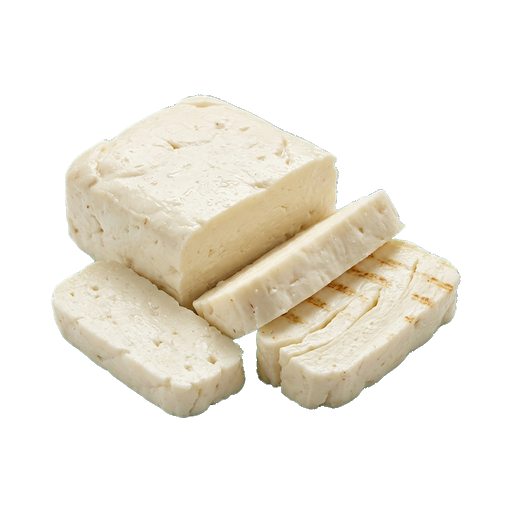
Halloumi Cheese
A semi-hard cheese with a high melting point, making it suitable for frying or grilling without melting. Halloumi has a slightly salty taste, a firm texture, and produces a characteristic squeak when bitten, due to its high casein content. In cooking, it is used as a standalone dish with lemon and mint, added to salads, appetizers, or placed in sandwiches — when heated, the cheese becomes softer while maintaining its shape.
About
Halloumi is a cheese that does not melt. Its main characteristic is that when heated, it softens but maintains its shape without spreading across the pan. This property makes it ideal for frying and grilling. Halloumi has a dense and slightly rubbery texture, a delicate taste that is slightly salty, with a slight squeak when bitten.
Taste and Aroma
Raw halloumi has a soft, almost neutral taste with barely noticeable dairy notes. When you fry it in a pan or on a grill, the cheese acquires a golden crust, and its flavor becomes more pronounced — creamy and slightly sweet undertones appear. The aroma when frying is pleasant, milky, without harshness.
How to cook and use
Halloumi is best enjoyed hot. Slice it into pieces about one centimeter thick and fry it in a dry pan or one lightly oiled — each side fries for just 1–2 minutes until a golden crust forms. The cheese can also be cooked on a grill by threading it onto skewers along with vegetables.
- Fried halloumi as a standalone dish — serve with lemon and fresh herbs
- In salads — add warm cheese to leafy greens, tomatoes and cucumbers
- On the grill with vegetables — zucchini, eggplant, pepper pair well with halloumi
- In sandwiches and open-faced sandwiches — fried halloumi holds its shape and doesn't leak
- In mezze and appetizers — as part of a Mediterranean board with olives and bread
Pairings and side dishes
Halloumi pairs well with acidity — lemon, lime, and vinegar enhance its creaminess and balance its saltiness. Fresh herbs — mint, parsley, cilantro — add freshness. Grilled vegetables, tomatoes, eggplants, and peppers are classic companions. Honey and hot sauces create an interesting contrast with the cheese's delicate flavor.
Selection and Storage
Choose halloumi with a firm, uniform texture without cracks and dark spots. The cheese should smell milky, without mustiness. In stores, halloumi is often sold in vacuum packaging or in brine — both options are good. Check the manufacturing date: fresh cheese tastes better.
Store halloumi in the refrigerator in an airtight package or container. If the cheese was in brine, keep it in that liquid — this way it will stay fresh longer. The shelf life is usually 2–3 weeks. The cheese can be frozen, but after thawing the texture will become more crumbly, so it's better to use it in cooked form.
Top tip: don't fry halloumi for too long. Overcooked cheese becomes tough and rubbery. 1–2 minutes on each side — the ideal result with a crispy crust and soft center.
Nutrition
per 100 g
- Calories
- 322 kcal
- Protein
- 22 g
- Fat
- 25 g
- Carbs
- 2 g
Measures and weight
- 1 slice
- 20 g
Measure calculator
- Weight
- 100 g
- Calories
- 322 kcal
