Usuba
Usuba
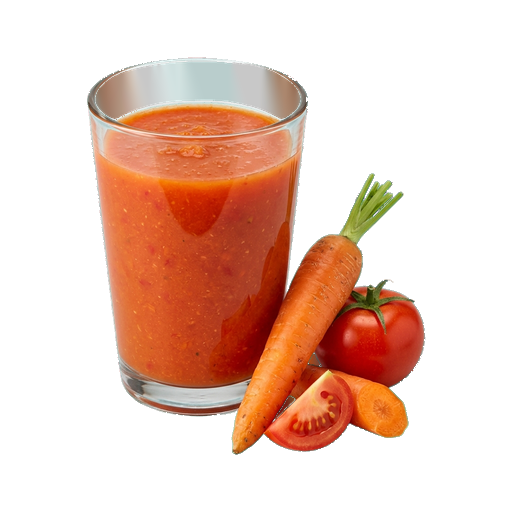
Vegetable juice
Vegetable juice is a beverage obtained from fresh vegetables through pressing or squeezing. It is used in cooking as a base for sauces, marinades, soups, and cocktails, as well as to add moisture and flavor to meat and fish dishes. When selecting vegetable juice, it is important to pay attention to the freshness of the source vegetables and the absence of additives, since the quality of the juice directly affects the taste of the finished dish.
About
Vegetable juice is concentrated flavor and nutritional value of vegetables in liquid form. Unlike smoothies or purees, juice contains only dissolved substances and is maximally easily absorbed by the body. It can be used as a standalone beverage, an addition to cocktails, or an ingredient in sauces and dressings. The main advantage: vegetable juice works where whole vegetables would be too coarse or bulky.
Taste and Aroma
The flavor profile depends on the composition. Tomato juice provides rounded acidity and a slightly sweet background. Carrot juice delivers pure natural sweetness with earthy notes. Celery juice is bitter and piquant, fresh and sharp. Blends usually balance each other: tomato with carrot becomes milder, celery with apple loses its bitterness. The aroma is always fresh, herbaceous, sometimes with a slight pungency.
Where and how to use
- Base for cold soups (gazpacho, okroshka) — juice creates the right consistency and flavor foundation
- Component of marinades and dressings — acidity and minerality of juice work as a natural preservative and flavoring agent
- Addition to meat and fish dishes — tomato juice in stews or fish juice in sauces create depth
- Base for cocktail programs — vegetable juice adds complexity and balance to alcoholic and non-alcoholic mixes
- Standalone beverage — cold or hot, salted or spiced, depending on the season and mood
How to Choose and Store
You'll find two types on the shelf: freshly squeezed (usually in the refrigerator, lasts a few days) and pasteurized (in cartons or glass, lasts for months). Fresh juice is brighter and more vibrant, but requires quick consumption. Pasteurized juice is more stable, but may be more watery. Check the ingredients: quality products contain only vegetables and salt, without additives or sugar. Keep opened juice in the refrigerator in a tightly closed container — it oxidizes quickly and loses color and flavor.
Successful Pairings
- Tomato juice + basil, black pepper, olive oil
- Carrot juice + ginger, turmeric, black pepper
- Celery juice + lemon, garlic, hot pepper
- Beet juice + horseradish, vinegar, mustard
- Vegetable juice mixes + strong alcoholic beverages (vodka, tequila, rum)
Vegetable juice is a universal tool for those who want to add depth, freshness, and nutrition to a dish without extra calories. It works both in classic recipes and in experiments. The main thing is to choose a quality product and use it within a few days after opening.
Nutrition
per 100 ml
- Calories
- 20 kcal
- Protein
- 0.8 g
- Fat
- 0.1 g
- Carbs
- 4 g
Measures and weight
- 1 tbsp
- 15 g
- 1 tsp
- 5 g
- 1 cup
- 250 g
Measure calculator
- Weight
- 100 g
- Calories
- 20 kcal