Usuba
Usuba
Adyghe Salt
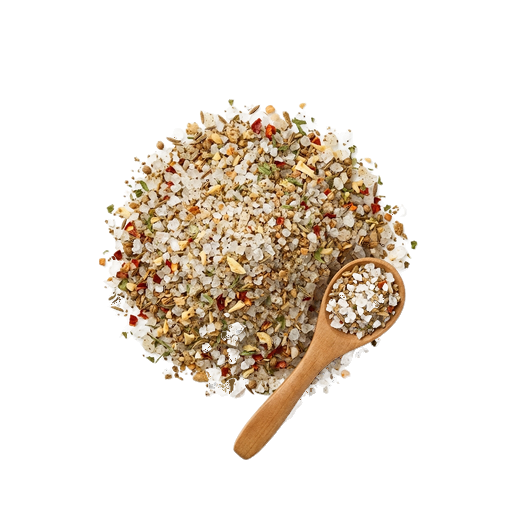
Adyghe salt is a mixture of table salt with dried herbs and spices, traditionally including coriander, cumin, red pepper, and garlic. Its distinctive sharp and aromatic flavor with a subtle bitterness makes it a versatile seasoning for meat, vegetables, and soups. When using it, keep in mind that this salt already contains spices, so avoid adding them separately to prevent overcomplicating the dish's flavor.
About
Adyghe salt is not just a seasoning, but an entire philosophy of taste. It is a mixture of sea salt with aromatic herbs and spices that transforms the simplest dish into something special. If regular salt is the foundation, then Adyghe salt is the final touch that speaks to taste and attention to detail.
Aroma and Taste
Adyghe salt usually contains dried herbs — coriander, black pepper, paprika, and sometimes garlic and onion. Each manufacturer adds their own mix, so the flavor nuances vary. The key characteristic is a sense of layering: first saltiness, then the warmth of spices, then a subtle bitterness of herbs.
The aroma is bright, but not aggressive. It doesn't overpower the taste of the main ingredient, but rather enhances it. When you sprinkle Adyghe salt on hot meat or vegetables, it reveals itself fully — the spices are activated by the heat.
Where to use
- Grilled or pan-seared meat — Adyghe salt will enhance smokiness and add depth
- Vegetables baked in the oven or over coals — potatoes, tomatoes, eggplants become more vibrant
- Fish and seafood — salt will highlight their tenderness, and spices will add contrast
- Soups and broths — add at the end of cooking to preserve the aroma of herbs
- Bread and rolls — sprinkle before baking for a crispy crust with character
- Avocado, cheese, cottage cheese — simple products become an appetizer when seasoned properly
How to Choose and Store
When buying, check the composition — the less chemistry, the better. Good Adyghe salt contains only natural ingredients. The color should be uneven: you can see pieces of herbs and spices. If the mixture is perfectly uniform and white, you're most likely looking at plain salt with flavorings.
Store in a tightly sealed jar in a cool, dry place. Moisture is the enemy of Adyghe salt: it causes clumping and loss of aroma. If the mixture contains large herb pieces, they can absorb moisture from the air over time, so an airtight seal is especially important.
Kitchen tip
Don't salt with Adyghe salt during cooking — use it as a finisher. Add it at the very end, when the dish is already on the plate or in the last minutes of preparation. This way the spices won't lose their aroma, and the salt won't dissolve completely, leaving pleasant crystals on your tongue.
Nutrition
per 100 g
- Calories
- 0 kcal
- Protein
- 0 g
- Fat
- 0 g
- Carbs
- 0 g
Measures and weight
- 1 tbsp
- 18 g
- 1 tsp
- 6 g
- 1 cup
- 300 g
Measure calculator
- Weight
- 100 g
- Calories
- 0 kcal