Usuba
Usuba
Cotton oil
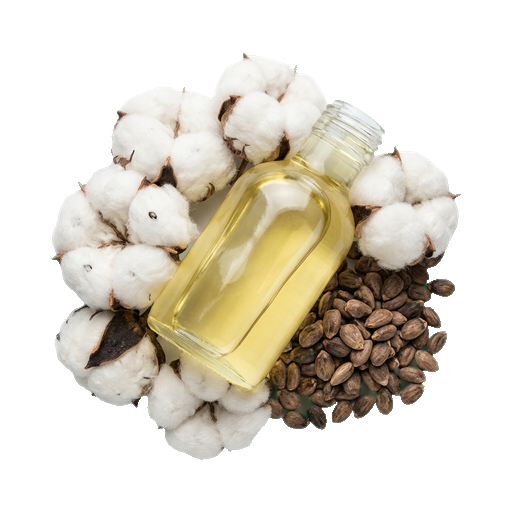
A vegetable oil with neutral flavor and high smoke point derived from cottonseed. Thanks to its stability when heated, it is ideal for frying, deep frying, and cooking at high temperatures. When choosing, pay attention to the degree of refinement — refined oil has virtually no odor or color, making it versatile for most dishes, while unrefined oil may impart a slight nutty note.
Micronutrients
per 100 ml
About
Cottonseed oil is one of the most versatile helpers in the kitchen, although many culinary professionals overlook it, preferring more fashionable oils. Meanwhile, this oil deserves attention: it is neutral, stable when heated, and works perfectly for both frying and dressings. It is obtained from cotton seeds, and thanks to its high smoke point, it becomes an ideal choice for frying and deep frying.
Taste and Aroma
Refined cottonseed oil has virtually no smell or taste — this is its main advantage. It doesn't compete with other ingredients, but supports them, allowing the natural flavors of the dish to shine through. If you're looking for an oil that won't impose its own character, this is your option.
Unrefined cottonseed oil is less common but has a more pronounced nutty undertone and a more complex aroma. It's worth using in dishes where you want to emphasize the oil note itself — for example, in dressings or as a finishing touch.
Role in Cooking
Thanks to its high smoke point (around 450°C for refined oil), cottonseed oil is ideal for high-heat frying, deep frying, and wok cooking. It does not oxidize quickly, which means stability and safety at high temperatures.
In the kitchen, cotton oil works everywhere a neutral base is needed: baking, sauces, marinades, salad dressings. Its economy makes it particularly attractive for daily use in large volumes.
Selection and Storage
- Choose refined oil for frying and high-temperature cooking
- Pay attention to transparency — quality oil should be light and uniform
- Check the production date: fresh oil is better
- Store in a dark bottle in a cool place, protected from sunlight
- Sealed oil lasts up to a year, opened oil — several months
Practical tips
Cotton oil is an excellent choice when you're cooking Asian cuisine, deep frying, or baking. Its neutrality allows other ingredients to take center stage. If a recipe calls for oil with a high smoke point and you only have cotton oil on hand, feel free to use it — you won't go wrong.
Remember that cottonseed oil, like any vegetable oil, should not be reused repeatedly for frying. If the oil has darkened or a burnt smell appears, it's time to change it. Fresh oil is the key to clean flavor and dish safety.
Nutrition
per 100 ml
- Calories
- 899 kcal
- Protein
- 0 g
- Fat
- 99.9 g
- Carbs
- 0 g
Micronutrients
per 100 ml
Macronutrients
- Fiber
- 0 g
- Sugars
- 0 g
- Saturated fat
- 23.828 g
- Monounsaturated fat
- 16.376 g
- Polyunsaturated fat
- 47.748 g
- Omega-3 (EPA + DHA)
- 0 g
- Cholesterol
- 0 mg
- Water
- 0 g
Minerals
- Sodium
- 0 mg
- Potassium
- 0 mg
- Calcium
- 0 mg
- Magnesium
- 0 mg
- Phosphorus
- 0 mg
- Iron
- 0 mg
- Zinc
- 0 mg
- Copper
- 0 mg
- Selenium
- 0 mcg
Vitamins
- Vitamin A (RAE)
- 0 mcg
- Vitamin D
- 0 mcg
- Vitamin E
- 32.48 mg
- Vitamin K
- 22.7 mcg
- Vitamin C
- 0 mg
- Vitamin B1 (thiamin)
- 0 mg
- Vitamin B2 (riboflavin)
- 0 mg
- Vitamin B3 (niacin)
- 0 mg
- Vitamin B5 (pantothenic acid)
- 0 mg
- Vitamin B6
- 0 mg
- Vitamin B9 (folate, DFE)
- 0 mcg
- Vitamin B12
- 0 mcg
Measures and weight
- 1 tbsp
- 13.8 g
- 1 tsp
- 4.6 g
- 1 cup
- 230 g
Measure calculator
- Weight
- 100 g
- Calories
- 977 kcal