Usuba
Usuba
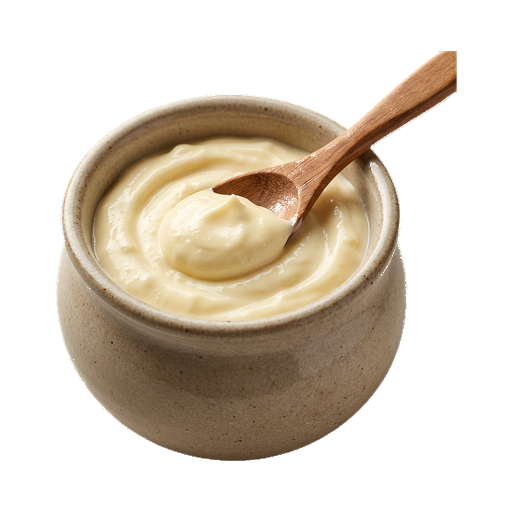
Homemade Mayonnaise
An emulsion made from egg yolk, oil, and acid, prepared by hand or with a blender until it reaches a creamy consistency. Homemade mayonnaise differs from store-bought versions with its more intense flavor, soft texture, and absence of preservatives, but requires fresh ingredients and careful preparation to prevent the emulsion from breaking. Used as a standalone sauce, a base for other dressings, or an addition to salads, sandwiches, and cold dishes.
About
Homemade mayonnaise is a completely different product than its store-bought counterpart. When you make it yourself, you control every component: the quality of the oil, the freshness of the eggs, the amount of salt and acid. The result turns out more delicate, with a delicate texture and a real flavor that doesn't overpower the dish, but complements it.
Taste and Texture
Homemade mayonnaise is distinguished by its soft, creamy consistency that literally melts on your tongue. The taste depends on which oil you use — light refined oil will provide a neutral base, while cold-pressed oil will add subtle nutty notes. Lemon juice or vinegar brings freshness, and mustard adds a slight piquancy.
The main difference from the industrial version is the absence of preservatives and thickeners. This means that homemade mayonnaise is more delicate to handle, but in return it is honest in its composition and taste.
Where to use
Homemade mayonnaise is versatile. It is ideal for sandwiches and canapés, where its delicate texture is not lost but becomes an advantage. Use it in salads — olivier, herring under a fur coat, potato salad. It works great as a base for sauces: add garlic and herbs for aioli, mix with mustard for a spicier version.
- Dressing for cold appetizers and vegetable salads
- Base for sauces for fish and seafood
- Component for meat pâtés and terrines
- Glaze for buns and pies before baking
Preparation and Storage
Making mayonnaise is simple, but it requires attention. All components should be at room temperature — cold ingredients won't mix into a uniform emulsion. Add oil literally drop by drop at the beginning, constantly whisking. When the mixture starts to thicken, you can pour the oil in a thin stream. If the mayonnaise suddenly "breaks" and separates, start over with one egg and slowly introduce the spoiled mixture.
Homemade mayonnaise can be stored in the refrigerator for up to a week in an airtight glass jar. Without preservatives, it is more vulnerable to microbes, so use clean dishes and do not leave it at room temperature. If you are preparing a large batch, it is better to divide it into portions — this will reduce the risk of spoilage.
Variations and experiments
The basic recipe is easy to transform according to your preferences. Add garlic puree for aioli, fresh herbs for a herbal version, hot peppers for spice. Mix with tomato paste for pink mayonnaise for seafood or with Worcestershire sauce for a more pronounced flavor. Experiment with different oils — nut oil will give an interesting twist, though it should be used in smaller quantities due to its rich taste.
Homemade mayonnaise is an investment in quality and taste. Yes, it requires a bit more attention than opening a jar, but the result is worth it. Once you feel the difference, it will be hard to go back to store shelves.
Nutrition
per 100 ml
- Calories
- 680 kcal
- Protein
- 0.3 g
- Fat
- 75 g
- Carbs
- 0.4 g
Measures and weight
- 1 tbsp
- 14.3 g
- 1 tsp
- 4.8 g
- 1 cup
- 237.5 g
Measure calculator
- Weight
- 100 g
- Calories
- 716 kcal