Usuba
Usuba
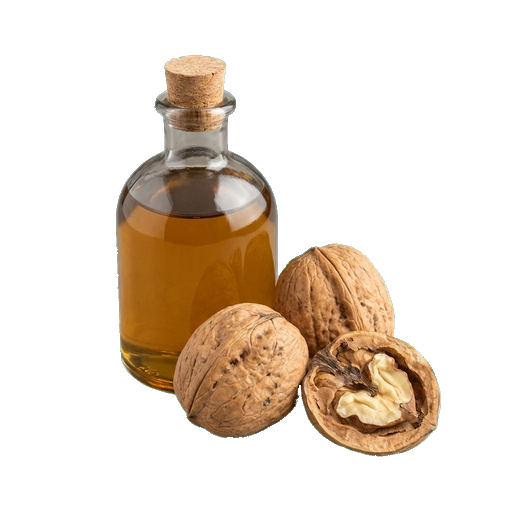
Walnut oil
Walnut oil is extracted from ripe walnut kernels using cold pressing and retains its characteristic nutty flavor with a subtle bitterness and woody notes. Due to its high content of polyunsaturated fats, the oil oxidizes quickly and requires storage in a cool place in a dark container, otherwise the bitterness becomes unpleasant. It is used in salad dressings, added to finished dishes and baked goods, but is not suitable for frying — it should be used only cold or at low temperatures.
Micronutrients
per 100 ml
About
Aroma and Taste
Walnut oil is a concentrated taste of the nut itself, but even more expressive and deep. On the palate, you feel a slight bitterness that doesn't irritate but complements. The aroma is nutty, somewhat woody, with barely noticeable sweet notes. This oil doesn't tolerate indifference: either you'll love it immediately, or you'll need to get used to it. Good oil should smell fresh and pleasant, without any mustiness or rancidity.
Role in Dishes
This oil works not as a base, but as an accent. A few drops in a finished dish — and it transforms. Add it to warm pumpkin or mushroom soup a minute before serving, and the flavor becomes more complex. On salads with fresh vegetables, walnut oil reveals new facets, especially if the salad has an acidic element — lemon, vinegar, or a sour cream-based dressing.
It pairs perfectly with honey and cheese — try this simple combination on a slice of bread. It goes well with cinnamon, ginger, and nutmeg in sweet dishes. On meat and fish, walnut oil is more delicate: use it in sauces for the finished dish rather than during cooking.
Selection and Storage
Look for cold-pressed oil — this guarantees that the oil has retained all its aromatic and flavor properties. The color should be golden or light brown, and transparent. If the oil is cloudy or has a dark brown tint, this may indicate improper storage or oxidation.
Walnut oil is finicky: it oxidizes quickly in air and loses its qualities in light. Keep it in a dark bottle, tightly sealed, in a cool place — storing it in the refrigerator will extend the oil's life for months. Use an opened bottle within a month or two. Do not heat the oil — this will destroy its flavor and benefits. Add it only to finished dishes or use it for dressings.
Walnut oil is not an everyday product, but rather a finishing touch that makes an ordinary dish more interesting. A small bottle will last a long time if you use it consciously: a few drops here, a few drops there. This oil teaches you to cook with wisdom, not with quantity.
Nutrition
per 100 ml
- Calories
- 899 kcal
- Protein
- 0 g
- Fat
- 99.9 g
- Carbs
- 0 g
Micronutrients
per 100 ml
Macronutrients
- Fiber
- 0 g
- Sugars
- 0 g
- Saturated fat
- 8.372 g
- Monounsaturated fat
- 20.976 g
- Polyunsaturated fat
- 58.236 g
- Omega-3 (EPA + DHA)
- 0 g
- Cholesterol
- 0 mg
- Water
- 0 g
Minerals
- Sodium
- 0 mg
- Potassium
- 0 mg
- Calcium
- 0 mg
- Magnesium
- 0 mg
- Phosphorus
- 0 mg
- Iron
- 0 mg
- Zinc
- 0 mg
- Copper
- 0 mg
- Selenium
- 0 mcg
Vitamins
- Vitamin A (RAE)
- 0 mcg
- Vitamin D
- 0 mcg
- Vitamin E
- 0.37 mg
- Vitamin K
- 13.8 mcg
- Vitamin C
- 0 mg
- Vitamin B1 (thiamin)
- 0 mg
- Vitamin B2 (riboflavin)
- 0 mg
- Vitamin B3 (niacin)
- 0 mg
- Vitamin B5 (pantothenic acid)
- 0 mg
- Vitamin B6
- 0 mg
- Vitamin B9 (folate, DFE)
- 0 mcg
- Vitamin B12
- 0 mcg
Measures and weight
- 1 tbsp
- 13.8 g
- 1 tsp
- 4.6 g
- 1 cup
- 230 g
Measure calculator
- Weight
- 100 g
- Calories
- 977 kcal