Usuba
Usuba
Palm oil
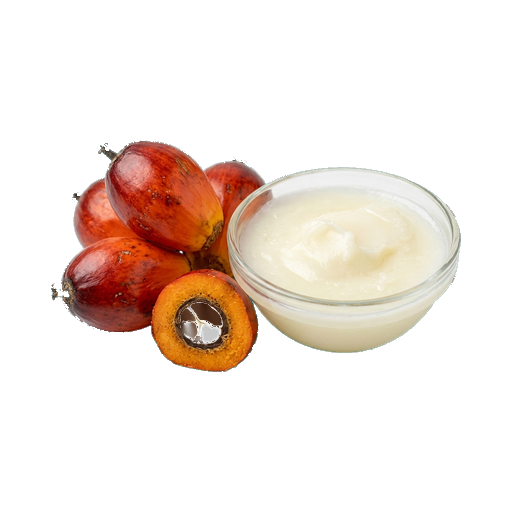
A vegetable oil with a high melting point, derived from the flesh of oil palm fruits. It has a neutral taste and dense consistency at room temperature, making it convenient for frying, baking, and confectionery production. When choosing, it's worth noting that refined oil is better suited for cooking, while unrefined oil has a subtle fruity aroma and can be used in salads or sauces.
Micronutrients
per 100 ml
Minerals
About
Palm oil is one of the most controversial ingredients in modern cuisine. It is extracted from the fruits of the oil palm and remains solid or semi-solid at room temperature. In cooking, it is valued for its high smoke point, versatility, and accessibility, but it is used cautiously and not everywhere. Let's figure out how to use it and when it is truly useful in the kitchen.
Properties and behavior in cooking
The main advantage of palm oil is its stability at high temperatures. It does not smoke or oxidize when frying in deep fryer or in a pan, which makes it popular in industrial food production. The oil has virtually no taste or smell, so it does not overpower the taste of the main ingredients of the dish.
The structure of palm oil allows you to create the desired consistency in confectionery products and sauces. When cooled, it hardens, which helps achieve a crispy crust when frying and stable texture in creams and fillings. However, in home cooking, it is used less frequently than in the food industry.
Where it is used
- Deep frying and high-temperature frying — oil withstands multiple uses without degradation
- Production of cookies, crackers and puff pastry — provides crispness and structure
- Confectionery creams and glazes — gives the required consistency at room temperature
- Ready-made sauces and mayonnaise — stabilizes emulsion
- Meat semi-finished products and canned goods — prevents oxidation and extends shelf life
Selection and Storage
If you are buying palm oil for your home kitchen, pay attention to the degree of refinement. Refined oil is light, odorless, and ready to use. Unrefined oil has an orange tint and a slight nutty aroma, but requires more careful handling when heating.
Store the oil in a tightly sealed container in a cool place, protected from light. At temperatures below 24 degrees, it will solidify — this is normal. Before use, you can slightly warm it to restore fluidity. The shelf life is usually 1–2 years, but it is best to use it within a year after opening the package.
In home cooking, palm oil is not an essential ingredient. Its primary place is in professional kitchens and in recipes that require its stability at high temperatures. For most everyday tasks, olive oil, sunflower oil, or coconut oil will work fine.
Nutrition
per 100 ml
- Calories
- 892 kcal
- Protein
- 0 g
- Fat
- 99 g
- Carbs
- 0 g
Micronutrients
per 100 ml
Macronutrients
- Fiber
- 0 g
- Sugars
- 0 g
- Saturated fat
- 45.356 g
- Monounsaturated fat
- 34.04 g
- Polyunsaturated fat
- 8.556 g
- Omega-3 (EPA + DHA)
- 0 g
- Cholesterol
- 0 mg
- Water
- 0 g
Minerals
- Sodium
- 0 mg
- Potassium
- 0 mg
- Calcium
- 0 mg
- Magnesium
- 0 mg
- Phosphorus
- 0 mg
- Iron
- 0.01 mg
- Zinc
- 0 mg
- Copper
- 0 mg
- Selenium
- 0 mcg
Vitamins
- Vitamin A (RAE)
- 0 mcg
- Vitamin E
- 14.66 mg
- Vitamin K
- 7.4 mcg
- Vitamin C
- 0 mg
- Vitamin B1 (thiamin)
- 0 mg
- Vitamin B2 (riboflavin)
- 0 mg
- Vitamin B3 (niacin)
- 0 mg
- Vitamin B5 (pantothenic acid)
- 0 mg
- Vitamin B6
- 0 mg
- Vitamin B9 (folate, DFE)
- 0 mcg
- Vitamin B12
- 0 mcg
Measures and weight
- 1 tbsp
- 13.8 g
- 1 tsp
- 4.6 g
- 1 cup
- 230 g
Measure calculator
- Weight
- 100 g
- Calories
- 970 kcal