Usuba
Usuba
Barley flour
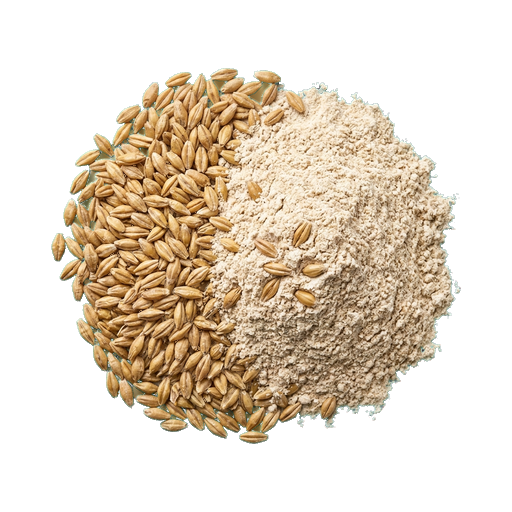
Barley flour is made from ground barley and has a slightly sweet, nutty flavor with a delicate hint of bitterness. It contains less gluten than wheat flour, so baked goods made from it turn out denser and moister, requiring the addition of binding ingredients for better structure. The flour is used in bread baking, for pancakes, cookies and porridges, as well as a thickener for soups and sauces; when replacing wheat flour, it's worth noting that barley flour absorbs more liquid.
Micronutrients
per 100 g
Minerals
About
Barley flour is ground barley grains that give baked goods a dense structure and a subtle nutty flavor. It is less sticky than wheat flour, so bread made from it turns out more crumbly, while pancakes and fritters become airier. It is not just an alternative, but an independent ingredient with its own character.
Aroma and taste
Barley flour has a soft nutty undertone — not sharp, but rather cozy, almost slightly sweet. The flavor depends on the degree of processing: light flour is more delicate, dark flour gives a more pronounced malt note. This flour works well in sweet baked goods, where its delicacy complements the filling or fruits, and in breads, where it creates an interesting texture.
Role in dishes
Barley flour is rarely used in its pure form — it is usually mixed with wheat flour in a ratio of 10 to 50 percent. Such a mix preserves the structure of the dough but adds depth of flavor. In bread, it adds moisture and helps it stay fresh longer. In cookies and cupcakes, the flour gives a crumbly texture, and in pancakes — lightness and an interesting flavor.
Practical Combinations
- With honey and cinnamon — a classic trio for cookies and cupcakes
- With rye flour in bread — creates a complex, multi-layered flavor
- With butter and nuts in oatmeal cookies — enhances the nutty motif
- With dark chocolate in brownies — contrasts with bitterness
- In pancakes with berries — berries become brighter against the neutral flour background
Selection and Storage
When purchasing, pay attention to the color: light flour indicates delicate processing, dark flour indicates more intensive processing. The packaging should be hermetic, without signs of moisture. Barley flour oxidizes faster than wheat flour, so store it in a tightly closed container in a cool place — ideally in the refrigerator. Shelf life is about four months at room temperature, in the refrigerator — up to six months.
- Transfer to a glass jar with a tight lid
- Label the purchase date — this way you won't lose track of the expiration date
- Keep away from direct sunlight
- If you notice a musty smell — the flour has oxidized, it's better not to use it
Barley flour is a tool for those who want to add new flavor notes to baking without complicated manipulations. Start with small additions to your usual recipes, and you will quickly feel how it changes the dish for the better.
Nutrition
per 100 g
- Calories
- 354 kcal
- Protein
- 10.6 g
- Fat
- 1.6 g
- Carbs
- 77 g
Micronutrients
per 100 g
Macronutrients
- Fiber
- 12.79 g
- Water
- 9.899 g
Minerals
- Sodium
- 20.33 mg
- Potassium
- 366.6 mg
- Calcium
- 35.56 mg
- Magnesium
- 88.04 mg
- Phosphorus
- 234.4 mg
- Iron
- 3.3 mg
- Zinc
- 2.14 mg
- Copper
- 0.39 mg
- Manganese
- 1.18 mg
- Selenium
- 13.1 mcg
Vitamins
- Vitamin B1 (thiamin)
- 0.23 mg
- Vitamin B2 (riboflavin)
- 0.15 mg
- Vitamin B3 (niacin)
- 5.94 mg
- Vitamin B6
- 0.2 mg
Measures and weight
- 1 tbsp
- 9 g
- 1 tsp
- 3 g
- 1 cup
- 150 g
Measure calculator
- Weight
- 100 g
- Calories
- 354 kcal