Usuba
Usuba
Brown Sugar
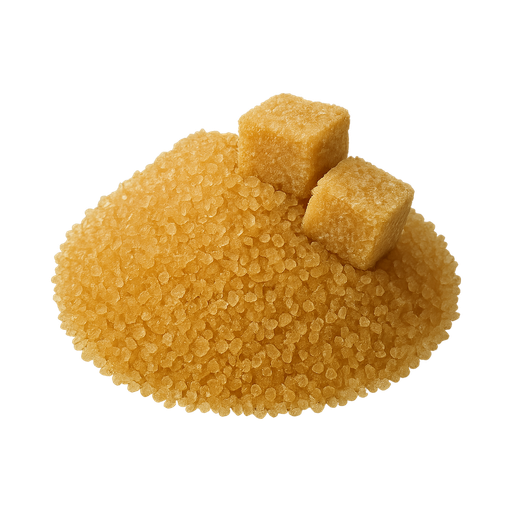
Yellow sugar is unrefined or partially refined granulated sugar containing molasses, which gives it a characteristic creamy or brownish tint and a soft caramel flavor. In cooking, it is used like regular sugar for sweetening baked goods, beverages, and desserts, but thanks to the presence of molasses, it adds a subtle depth of flavor to dishes and a more moist texture. When substituting white sugar, keep in mind that yellow sugar may slightly change the color and sweetness intensity of the finished dish.
Micronutrients
per 100 g
Minerals
About
Yellow sugar is cane sugar that has not undergone complete refining. It retains molasses particles that give it a characteristic color and moisture. In the kitchen, it works quite differently from ordinary white sugar: it adds depth of flavor, retains moisture better in baked goods, and creates a more interesting caramel when exposed to heat.
Aroma and Taste
The main difference between yellow sugar and white sugar is the subtle notes of caramel and a slight bitterness. It is not pure sweetness, but sweetness with character. Thanks to molasses, it smells softer, warmer, almost like cookies. Such sugar does not simply sweeten a dish, but adds volume and roundness to its flavor profile.
Where to use
Brown sugar reveals itself in baking, especially in cookies, gingerbread, and cupcakes. Its moisture helps the dough stay softer longer. In sauces, marinades, and glazes, it creates a more complex flavor than white sugar. Try it in caramel, in porridge, in spiced compotes — anywhere you need depth, not just sweetness.
Successful Pairings
- With spices: cinnamon, nutmeg, cloves, ginger — brown sugar enhances their warmth
- With cocoa and chocolate — adds roundness and reveals bitterness more gently
- With acidity: lemon, orange, cranberry — contrast works perfectly
- With salt — enhances both components, creates intrigue
- With vanilla and almond — classic trio for cookies and cakes
Selection and Storage
When purchasing, make sure the sugar is granulated, without lumps or hardened pieces. Some moisture is normal, but if it has turned into a solid block, it means storage conditions were violated. The color should be uniform, ranging from light brown to a more saturated shade.
Brown sugar requires an airtight container — it absorbs moisture more easily than white sugar. Store in a cool, dry place, away from strong-smelling products. If it does harden, place a piece of bread or apple next to it for an hour or two — the moisture will distribute evenly, and the sugar will become crumbly again.
Practical tip
If a recipe calls for white sugar but you only have brown sugar, feel free to use it. The dish's flavor will improve. However, remember: brown sugar is slightly more moist, so if you're making something where consistency is critical (such as meringue or caramel), slightly reduce the amount of liquid in the recipe.
Nutrition
per 100 g
- Calories
- 387 kcal
- Protein
- 0 g
- Fat
- 0 g
- Carbs
- 97.3 g
Micronutrients
per 100 g
Macronutrients
- Fiber
- 0 g
- Sugars
- 97.02 g
- Saturated fat
- 0 g
- Monounsaturated fat
- 0 g
- Polyunsaturated fat
- 0 g
- Omega-3 (EPA + DHA)
- 0 g
- Cholesterol
- 0 mg
- Water
- 1.34 g
Minerals
- Sodium
- 28 mg
- Potassium
- 133 mg
- Calcium
- 83 mg
- Magnesium
- 9 mg
- Phosphorus
- 4 mg
- Iron
- 0.71 mg
- Zinc
- 0.03 mg
- Copper
- 0.05 mg
- Manganese
- 0.06 mg
- Selenium
- 1.2 mcg
Vitamins
- Vitamin A (RAE)
- 0 mcg
- Vitamin D
- 0 mcg
- Vitamin E
- 0 mg
- Vitamin K
- 0 mcg
- Vitamin C
- 0 mg
- Vitamin B1 (thiamin)
- 0 mg
- Vitamin B2 (riboflavin)
- 0 mg
- Vitamin B3 (niacin)
- 0.11 mg
- Vitamin B5 (pantothenic acid)
- 0.13 mg
- Vitamin B6
- 0.04 mg
- Vitamin B9 (folate, DFE)
- 1 mcg
- Vitamin B12
- 0 mcg
Measures and weight
- 1 tbsp
- 12 g
- 1 tsp
- 4 g
- 1 cup
- 200 g
Measure calculator
- Weight
- 100 g
- Calories
- 387 kcal