Usuba
Usuba
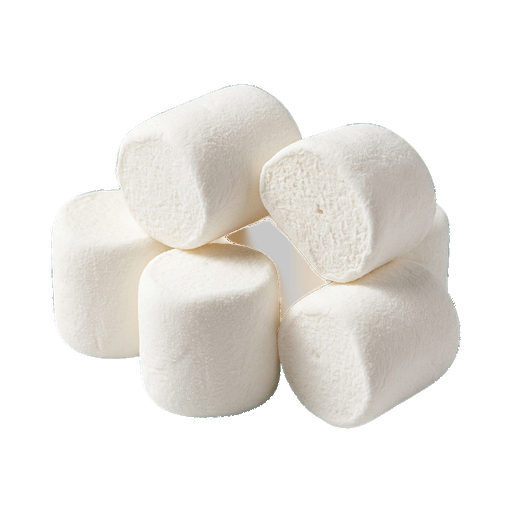
Marshmallow
Marshmallow is an airy confectionery product made from whipped gelatin or agar with sugar and starch, coated with powdered sugar or cocoa. It is used as a standalone treat, added to hot chocolate, coffee, desserts, and baked goods to impart a delicate texture and sweetness. When selecting marshmallow, pay attention to the composition — quality marshmallow contains a minimum of artificial additives, and during storage it is important to keep it away from moisture to prevent it from sticking together.
Micronutrients
per 100 g
Minerals
About
Marshmallow is an airy sweetness that looks like a cloud and melts in your mouth. Its structure consists of whipped gelatin or agar mixed with sugar and starch. The finished product resembles foam frozen in the shape of cubes or bars. It's not just candy — it's a texture that changes the sensation of a sweet dish.
Taste and texture
Marshmallow has a delicate, almost neutral sweet taste. All the attention here is on the sensations: lightness, airiness, and the ability to dissolve quickly. The surface is often dusted with starch or coconut flakes, which adds a slight roughness. When heated, marshmallow softens and becomes sticky — this is a key property for use in hot beverages and desserts.
Where to Use Marshmallows
- In hot chocolate and coffee — marshmallow melts and creates a creamy texture
- As part of desserts — as a layer in cakes, combined with chocolate and cookies
- On the grill or over fire — marshmallow browns on the outside and melts inside
- In smoothies and milkshakes — adds airiness and sweetness without a harsh taste
- As a standalone treat — on its own or combined with nuts and dried fruits
Selection and Storage
When choosing marshmallow, pay attention to the packaging — it should be airtight. The product should not be sticky or hard as a stone. Good marshmallow is easily compressed with a finger and returns to its shape. Store it in a cool, dry place, away from moisture — in an airtight container marshmallow will stay fresh for several weeks. High humidity is the enemy of this product, making it sticky and lumpy.
Successful Combinations
- Chocolate — a classic combination that enhances both flavors
- Vanilla and caramel — complement marshmallow's sweetness with soft aromas
- Coconut and almond — add texture and nutty notes
- Coffee — contrasts with marshmallow, creating an interesting balance
- Cookies and crackers — serve as a base for creating layered desserts
Marshmallow is not a primary ingredient, but a helper that transforms familiar dishes. Its main task is to add a sense of lightness, airiness, and festivity. Experiment with temperature and combinations, and you will discover new possibilities of this simple yet magical product.
Nutrition
per 100 g
- Calories
- 318 kcal
- Protein
- 2 g
- Fat
- 0.1 g
- Carbs
- 78 g
Micronutrients
per 100 g
Macronutrients
- Fiber
- 0.1 g
- Sugars
- 57.56 g
- Saturated fat
- 0.056 g
- Monounsaturated fat
- 0.08 g
- Polyunsaturated fat
- 0.047 g
- Omega-3 (EPA + DHA)
- 0 g
- Cholesterol
- 0 mg
- Water
- 16.4 g
Minerals
- Sodium
- 80 mg
- Potassium
- 5 mg
- Calcium
- 3 mg
- Magnesium
- 2 mg
- Phosphorus
- 8 mg
- Iron
- 0.23 mg
- Zinc
- 0.04 mg
- Copper
- 0.1 mg
- Manganese
- 0.01 mg
- Selenium
- 1.7 mcg
Vitamins
- Vitamin A (RAE)
- 0 mcg
- Vitamin D
- 0 mcg
- Vitamin E
- 0 mg
- Vitamin K
- 0 mcg
- Vitamin C
- 0 mg
- Vitamin B1 (thiamin)
- 0 mg
- Vitamin B2 (riboflavin)
- 0 mg
- Vitamin B3 (niacin)
- 0.08 mg
- Vitamin B5 (pantothenic acid)
- 0.01 mg
- Vitamin B6
- 0 mg
- Vitamin B9 (folate, DFE)
- 1 mcg
- Vitamin B12
- 0 mcg
Measures and weight
- 1 pcs
- 5 g
Measure calculator
- Weight
- 100 g
- Calories
- 318 kcal