Usuba
Usuba
Molasses
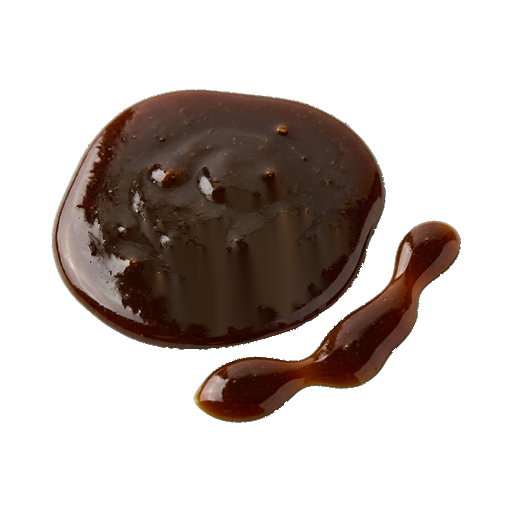
Molasses is a viscous syrup obtained from the processing of starch or sugar, with a mild sweet taste and dark brown color. It is used in baking, confectionery, and sauces to add moisture, plasticity to the dough, and a deep caramel note. When substituting molasses with other syrups, keep in mind that it is less sweet than honey or corn syrup, so you may need to adjust the amount of sugar in the recipe.
Micronutrients
per 100 g
Minerals
About
What is molasses and how to use it
Molasses is a viscous syrup obtained from starch processing. It is often confused with honey or invert syrup, but it is a completely independent ingredient with its own character. In taste, it is less sweet than sugar, with a barely perceptible malt undertone. The consistency is dense, almost like liquid honey, but without its floral aroma. In cooking, molasses works as a binding agent, thickener, and source of soft, unobtrusive sweetness.
Taste and Aroma
The main difference between molasses and other syrups is its neutrality. It doesn't overpower the dish's own flavor, but delicately supports it. The sweetness is muted, almost imperceptible against other ingredients. Some detect a slight starchy, somewhat herbal undertone. There is practically no aroma — neither bright nor intrusive notes. This makes molasses ideal for dishes where sweetness is needed without flavor competition.
Where molasses is indispensable
In baking, molasses helps keep dough soft longer — cakes, cookies, and gingerbread don't go stale as quickly. It's added to sauces and marinades to give them the desired consistency and a subtle sweetness. In candies and toffees, molasses is one of the main ingredients, responsible for chewiness and smooth texture. It's also used in the production of sausages and meat products as a stabilizer.
- Cookies and gingerbread — for softness and long-term storage
- Sauces and glazes — for viscosity and shine
- Candies and toffee — as the main component
- Porridges and desserts — for delicate sweetness
- Marinades — for balance of acidity and sweetness
How to choose and store
Molasses is sold in plastic containers or glass jars. Pay attention to the consistency — it should be uniform, without lumps or separation. The color varies from light yellow to amber depending on the degree of processing. Check the production date: fresh molasses works better. The label should indicate that this is molasses, not a mixture with other syrups.
Store molasses in an airtight container in a cool, dry place — it is sensitive to moisture and sudden temperature fluctuations. When stored properly, it will not spoil for years. If the molasses has thickened or crystallized, place the jar in warm water for a few minutes — the consistency will be restored. Keep opened packaging in the refrigerator to prevent fermentation and mold.
What to use as a substitute if you don't have it on hand
There is no ideal substitute, but you can adapt the recipe. Honey will add its own aroma, but it works if that's not critical. Corn syrup works similarly, but is more expensive and less accessible. A mixture of sugar with a small amount of water will provide sweetness, but won't give the necessary viscosity and softness. Invert syrup is closest in properties, but also has its own flavor. If the recipe allows for experimentation — try it, but remember that each substitute will change the final result.
Molasses is a practical ingredient for those who value stability and reliability in baking. It's not the star of the recipe, but its faithful helper that works quietly and effectively. If you often make cookies, candies, or complex sauces, molasses should be on your shelf.
Nutrition
per 100 g
- Calories
- 316 kcal
- Protein
- 0 g
- Fat
- 0 g
- Carbs
- 79 g
Micronutrients
per 100 g
Macronutrients
- Fiber
- 0 g
- Sugars
- 74.72 g
- Saturated fat
- 0.018 g
- Monounsaturated fat
- 0.032 g
- Polyunsaturated fat
- 0.05 g
- Omega-3 (EPA + DHA)
- 0 g
- Cholesterol
- 0 mg
- Water
- 21.87 g
Minerals
- Sodium
- 37 mg
- Potassium
- 1464 mg
- Calcium
- 205 mg
- Magnesium
- 242 mg
- Phosphorus
- 31 mg
- Iron
- 4.72 mg
- Zinc
- 0.29 mg
- Copper
- 0.49 mg
- Manganese
- 1.53 mg
- Selenium
- 17.8 mcg
Vitamins
- Vitamin A (RAE)
- 0 mcg
- Vitamin D
- 0 mcg
- Vitamin E
- 0 mg
- Vitamin K
- 0 mcg
- Vitamin C
- 0 mg
- Vitamin B1 (thiamin)
- 0.04 mg
- Vitamin B2 (riboflavin)
- 0 mg
- Vitamin B3 (niacin)
- 0.93 mg
- Vitamin B5 (pantothenic acid)
- 0.8 mg
- Vitamin B6
- 0.67 mg
- Vitamin B9 (folate, DFE)
- 0 mcg
- Vitamin B12
- 0 mcg
Measures and weight
- 1 tbsp
- 21 g
- 1 tsp
- 7 g
- 1 cup
- 350 g
Measure calculator
- Weight
- 100 g
- Calories
- 316 kcal