Usuba
Usuba
Potato flour
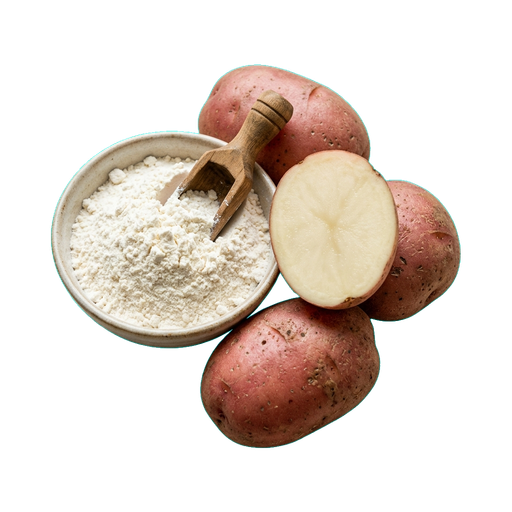
Potato starch flour is a starchy powder obtained from dried and ground potatoes, with a neutral flavor and dense texture. In baking and cooking, it is used as a thickener for sauces, gravies, and soups, and is also added to dough to impart softness and moisture to baked goods. When substituting wheat flour, potato starch flour should be used in smaller quantities, as it contains more starch and less protein, which affects dough structure and requires an additional binding agent.
Micronutrients
per 100 g
Minerals
About
Potato flour is a fine powder made from dried and ground potatoes, often confused with starch, although they are not the same thing at all. Unlike starch, potato flour retains the entire cellular structure of the potato: proteins, fiber, minerals, and vitamins. This makes the flour more nutritious and gives it completely different properties when cooking.
Taste and texture in finished dishes
Potato flour brings a delicate, subtle potato flavor — not bold, but rather a background note. It absorbs moisture more actively than wheat flour, so the dough becomes denser and more moist. If used on its own, baked goods will be crumbly, almost friable, with a light, crumbling crumb. That's why it's usually mixed with other flours — this way the structure becomes more balanced.
Where to use it
Potato starch works in dishes where softness and delicate texture are needed. It is added to cookies to make them crumbly, to sponge cakes for airiness, and to breading for a crispier crust. It is excellent in pancakes and fritters — they become fluffier. For gluten-free baking, it is one of the standard ingredients, as the starch contains no gluten and maintains structure well when properly combined with other components.
- Cookies and gingerbread — adds crumbliness
- Sponge cakes and cupcakes — makes the crumb more airy
- Breading — gives a crispy golden crust
- Pancakes and fritters — increases fluffiness
- Gluten-free baking — main component of the mixture
Proportions and Combinations
Potato flour is rarely used alone. Typically, its share in the mixture is 15–30% of the total flour amount. The rest is wheat flour or other bases. If gluten-free baking is needed, potato flour is combined with rice, corn, buckwheat, or special blends. Remember: the more potato flour you use, the more crumbly and less elastic the dough will become.
Selection and Storage
When purchasing, pay attention to the color — it should be white or light cream, without gray or yellow tints. Flour should not clump. Check the packaging date: potato flour can oxidize over time and lose its properties. Store it in an airtight container in a cool, dry place, away from direct sunlight. With proper storage, flour maintains its quality for about a year.
Potato flour is not a universal substitute for wheat flour, but rather a special ingredient for specific purposes. Its value lies in helping you achieve the desired texture and is suitable for those looking for gluten-free options. Experiment with small additions to your usual recipes and see which result you like best.
Nutrition
per 100 g
- Calories
- 330 kcal
- Protein
- 0.3 g
- Fat
- 0.1 g
- Carbs
- 80 g
Micronutrients
per 100 g
Macronutrients
- Fiber
- 5.401 g
- Water
- 8.281 g
Minerals
- Sodium
- 47.66 mg
- Potassium
- 1269 mg
- Calcium
- 44.12 mg
- Magnesium
- 73.65 mg
- Phosphorus
- 197.3 mg
- Iron
- 11.97 mg
- Zinc
- 0.9 mg
- Copper
- 0.23 mg
- Manganese
- 0.68 mg
- Selenium
- 1.4 mcg
Vitamins
- Vitamin B1 (thiamin)
- 0.2 mg
- Vitamin B2 (riboflavin)
- 0.12 mg
- Vitamin B3 (niacin)
- 5.63 mg
- Vitamin B6
- 0.58 mg
Measures and weight
- 1 tbsp
- 10.5 g
- 1 tsp
- 3.5 g
- 1 cup
- 175 g
Measure calculator
- Weight
- 100 g
- Calories
- 330 kcal