Usuba
Usuba
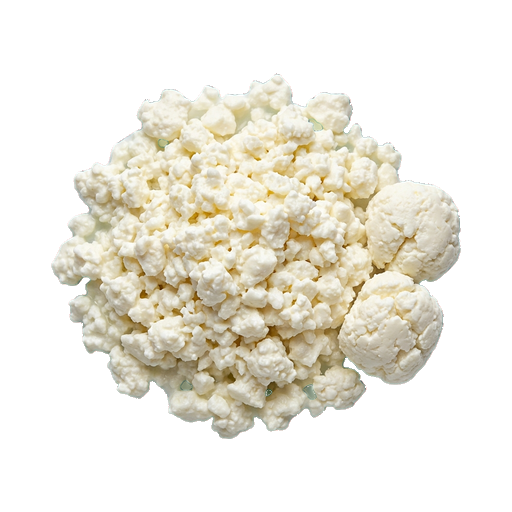
Cottage cheese
Cottage cheese curds is a fermented dairy product with a characteristic grainy structure, consisting of cottage cheese curds in a creamy or sour cream glaze. It has a moister and more tender consistency compared to regular cottage cheese, while retaining a pleasant fermented dairy flavor with a subtle creaminess. This cottage cheese is well-suited for standalone consumption, adding to sweet and savory dishes, and is ideal for making cottage cheese casseroles and desserts thanks to its soft structure.
Micronutrients
per 100 g
About
Granular cottage cheese is a type of cottage cheese with a distinctly granular structure, where protein curds remain as separate grains and are not compressed into a dense mass. It occupies a middle ground between liquid cottage cheese and dense cottage cheese: loose enough that a spoon easily passes through it, but structured enough that each grain is felt on the tongue. This texture is the result of a special production method, where the cottage cheese grain is not pressed, but simply allowed to drain of whey.
Taste and Texture
Grainy cottage cheese tastes softer and more delicate than curd with grains, but noticeably denser than kefir. It retains a pure milk flavor without acidity if fresh. Each granule is slightly moist, almost melting in your mouth, yet does not dissolve completely — it is this contrasting texture that makes it pleasant on its own, with condensed milk or honey.
How to use it
Cottage cheese with grains is versatile. It's convenient to eat with a spoon as a standalone breakfast, sweetened or salted to taste. It holds its shape well in casseroles — it doesn't spread like soft cottage cheese, but doesn't require additional binder either. In cheese pancakes, it gives a lighter structure than pressed cottage cheese. It can be added to cottage cheese creams and mousses, where a light, airy consistency is needed.
- For breakfast dishes — with condensed milk, berries, nuts or fruits
- For casseroles and puddings — holds its shape, stays tender
- For cottage cheese pancakes — gives an airy texture
- For cottage cheese creams and mousses — mixes easily
- For pie fillings — doesn't flow, but stays soft
Selection and Storage
When buying, check the production date — fresh granular cottage cheese should be moist, but not wet, with a pleasant milk smell. If cottage cheese smells acidic or has a yellow tint, this is a sign of aging. Such cottage cheese is usually stored in the refrigerator for 3–5 days in a closed container. If cottage cheese starts to dry out and the curds stick together — use it for casseroles or syrniki, not for a plain dish.
Cottage cheese with a grainy texture requires fewer manipulations during cooking than pressed cottage cheese: it doesn't need to be pushed through a sieve or mashed. If a recipe requires a smooth consistency, you can lightly stir it with a fork or blender, but in most cases its natural structure is exactly what you need.
Nutrition
per 100 g
- Calories
- 101 kcal
- Protein
- 17 g
- Fat
- 3 g
- Carbs
- 3 g
Micronutrients
per 100 g
Macronutrients
- Saturated fat
- 2.601 g
- Monounsaturated fat
- 0.916 g
- Cholesterol
- 18 mg
- Water
- 78.1 g
Minerals
- Sodium
- 349.8 mg
- Potassium
- 123.6 mg
- Calcium
- 88.27 mg
- Magnesium
- 9.19 mg
- Phosphorus
- 154 mg
- Iron
- 0 mg
- Zinc
- 0.45 mg
- Copper
- 0 mg
- Manganese
- 0 mg
- Iodine
- 45.7 mcg
Vitamins
- Vitamin K
- 0.2 mcg
- Vitamin B1 (thiamin)
- 0.05 mg
- Vitamin B3 (niacin)
- 0.14 mg
- Vitamin B6
- 0.05 mg
- Vitamin B12
- 0.7 mcg
Measures and weight
- 1 tbsp
- 13.5 g
- 1 tsp
- 4.5 g
- 1 cup
- 225 g
Measure calculator
- Weight
- 100 g
- Calories
- 101 kcal