Usuba
Usuba
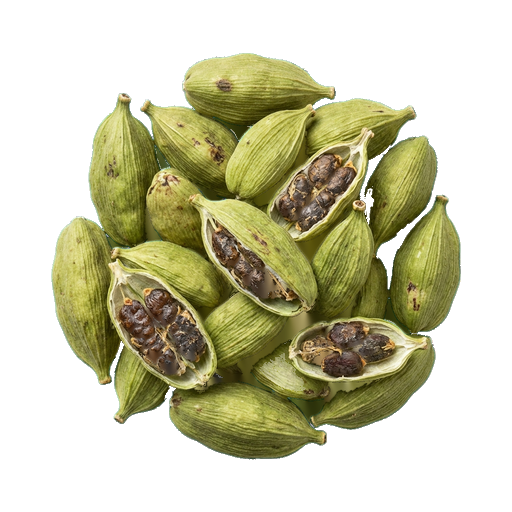
Cardamom seeds
Cardamom seeds are a spice with a warm, slightly sweet flavor and a bright aroma with hints of eucalyptus and flowers, used in both sweet and savory dishes. They are added as whole pods or ground seeds to baked goods, beverages, rice dishes and meat stews, as well as to spice blends and marinades. When choosing, prefer green or black pods with a dense texture — they retain their aroma longer than already ground seeds, which quickly lose volatile oils.
Micronutrients
per 100 g
Minerals
About
The aroma that transforms the dish
Cardamom seeds are small black granules inside pods that work like a concentrated flavor-wizard. When you crush or lightly heat the pod, a scent emerges that is simultaneously floral, minty, and slightly spicy, with a barely perceptible sweetness. It's not just a spice that adds flavor; it's an ingredient that transforms how you perceive the entire dish.
On the tongue, cardamom imparts warmth without aggression. The taste is complex: there's a slight bitterness, a hint of camphor, but all of this is enveloped in a pleasant sweetness. If you place a whole pod in a beverage or dish, you'll get a mild, barely perceptible effect. If you crush the seeds and add them during cooking — the aroma becomes brighter, and the taste deeper.
Where cardamom reveals itself fully
Cardamom is equally good in sweet and savory dishes, but works differently each time. In baked goods and desserts, it adds sophistication without overpowering the main flavor. In spicy dishes, cardamom becomes a binding element that unites different spices into one harmonious whole.
- Hot beverages: tea, coffee, hot chocolate — cardamom adds aroma and a subtle spice without overpowering the main flavor
- Baked goods: buns, cookies, gingerbread — seeds open up in the oven heat, filling the house with aroma
- Rice and grains: pilaf, risotto, porridge — whole pods add delicate aroma that can be easily removed before serving
- Spicy dishes: curry, stewed meat, soups — cardamom softens the heat and adds depth
- Compotes and jams — spice enhances fruit flavor and adds elegance
Which spices does cardamom work with in tandem
Cardamom gets along easily with cinnamon, cloves, black pepper, and ginger. Together they create classic spice blends that are recognized at first sniff. With coriander and cumin, cardamom adds floral notes, making the dish more sophisticated. Even with salt and black pepper, cardamom finds common ground, adding unexpected depth to simple dishes.
How to Choose and Store
Choose firm, closed pods without cracks or spots — these are signs of freshness. Green pods are usually more aromatic than brown ones. If a pod feels light and empty, the aroma has already faded. It's best to buy cardamom in whole pods rather than ground: this way the aroma lasts longer.
Store the pods in an airtight jar in a dark, cool place — away from sunlight and heat. Whole pods will retain their aroma for several months, while crushed seeds quickly lose their potency, so it's best to grind them directly before use. If cardamom starts to smell musty or has lost its aroma — it's time to replace it.
Practical Kitchen Tips
- For beverages, add a whole pod to boiling water a minute before serving — it won't overcook but will release all its aroma
- For baking, crush the pod and wipe out the seeds with a fork, then lightly grind in a mortar — this way the spice will distribute evenly
- If you're cooking a spicy dish, add cardamom at the beginning so it opens up together with other spices
- For compotes and jams, use whole pods — this way they'll be easier to remove before serving
Nutrition
per 100 g
- Calories
- 311 kcal
- Protein
- 10.8 g
- Fat
- 6.7 g
- Carbs
- 68.5 g
Micronutrients
per 100 g
Macronutrients
- Fiber
- 28 g
- Saturated fat
- 0.68 g
- Monounsaturated fat
- 0.87 g
- Polyunsaturated fat
- 0.43 g
- Cholesterol
- 0 mg
- Water
- 8.28 g
Minerals
- Sodium
- 18 mg
- Potassium
- 1119 mg
- Calcium
- 383 mg
- Magnesium
- 229 mg
- Phosphorus
- 178 mg
- Iron
- 13.97 mg
- Zinc
- 7.47 mg
- Copper
- 0.38 mg
- Manganese
- 28 mg
Vitamins
- Vitamin A (RAE)
- 0 mcg
- Vitamin D
- 0 mcg
- Vitamin C
- 21 mg
- Vitamin B1 (thiamin)
- 0.2 mg
- Vitamin B2 (riboflavin)
- 0.18 mg
- Vitamin B3 (niacin)
- 1.1 mg
- Vitamin B6
- 0.23 mg
- Vitamin B12
- 0 mcg
Measures and weight
- 1 tbsp
- 10.5 g
- 1 tsp
- 3.5 g
- 1 cup
- 175 g
- 1 pcs
- 0.5 g
Measure calculator
- Weight
- 100 g
- Calories
- 311 kcal