Usuba
Usuba
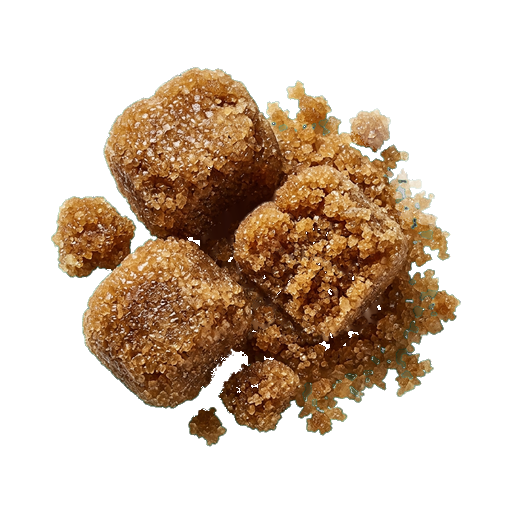
Brown soft sugar
Brown soft sugar is refined sugar colored with molasses, which gives it a moist texture and caramel aroma with light notes of molasses. Due to its hygroscopic nature, it tends to clump during storage, so it requires airtight packaging and can harden quickly when exposed to air. In baking, sauces, and marinades, this sugar adds depth of flavor and helps maintain dough softness, and if needed, it can be replaced with regular white sugar with a small addition of honey or molasses.
Micronutrients
per 100 g
Minerals
About
Brown soft sugar is regular white sugar mixed with molasses. It is the molasses that gives it moisture, a soft consistency, and a characteristic caramel tint. Unlike white sand sugar, it doesn't crumble but rather sticks to the spoon — and that's its main advantage in the kitchen.
Aroma and Taste
Brown sugar smells of caramel and molasses — deeply, warmly, almost autumnally. To taste, it is sweeter than white sugar, although it contains the same amount of sugar. This sweetness seems more rounded, less sharp, with a slight burnt flavor. That is precisely why it works in baking not simply as a sweetener, but as a flavor ingredient.
Role in dishes
Brown sugar is indispensable in cookies, cupcakes, pies, and brownies. Thanks to its moisture, it makes baked goods softer and stickier inside, keeping them fresh longer. In porridge, compotes, and sauces, it adds depth and a subtle caramel note. It is used in meat marinades, spiced beverages, and cake frostings.
Pairings
- Spices: cinnamon, ginger, nutmeg, cloves — together they create a cozy, festive flavor
- Butter and eggs — the foundation of cookies and cupcakes with brown sugar
- Vanilla, cocoa, chocolate — enhance its caramel notes
- Soy sauce, garlic, pepper — in Asian marinades and sauces
- Citrus fruits, bananas, apples — in compotes and fruit desserts
Selection and Storage
When buying sugar, choose one that crumbles easily in your hand but doesn't turn to powder. If it's too hard and lumpy, this is a sign of improper storage. At home, keep it in an airtight container, away from moisture and heat. If the sugar has hardened, place a piece of bread or apple next to it for a few hours — the moisture will soften it.
Important note: brown sugar cannot be completely replaced with white sugar in recipes if it is specifically required. Baked goods will turn out drier and less aromatic. However, white sugar can be used if brown sugar is not available — just add a little honey or molasses to approximate the flavor and texture.
Nutrition
per 100 g
- Calories
- 380 kcal
- Protein
- 0 g
- Fat
- 0 g
- Carbs
- 98 g
Micronutrients
per 100 g
Macronutrients
- Fiber
- 0 g
- Sugars
- 97.02 g
- Saturated fat
- 0 g
- Monounsaturated fat
- 0 g
- Polyunsaturated fat
- 0 g
- Omega-3 (EPA + DHA)
- 0 g
- Cholesterol
- 0 mg
- Water
- 1.34 g
Minerals
- Sodium
- 28 mg
- Potassium
- 133 mg
- Calcium
- 83 mg
- Magnesium
- 9 mg
- Phosphorus
- 4 mg
- Iron
- 0.71 mg
- Zinc
- 0.03 mg
- Copper
- 0.05 mg
- Manganese
- 0.06 mg
- Selenium
- 1.2 mcg
Vitamins
- Vitamin A (RAE)
- 0 mcg
- Vitamin D
- 0 mcg
- Vitamin E
- 0 mg
- Vitamin K
- 0 mcg
- Vitamin C
- 0 mg
- Vitamin B1 (thiamin)
- 0 mg
- Vitamin B2 (riboflavin)
- 0 mg
- Vitamin B3 (niacin)
- 0.11 mg
- Vitamin B5 (pantothenic acid)
- 0.13 mg
- Vitamin B6
- 0.04 mg
- Vitamin B9 (folate, DFE)
- 1 mcg
- Vitamin B12
- 0 mcg
Measures and weight
- 1 tbsp
- 12 g
- 1 tsp
- 4 g
- 1 cup
- 200 g
Measure calculator
- Weight
- 100 g
- Calories
- 380 kcal