Usuba
Usuba
Whole wheat flour
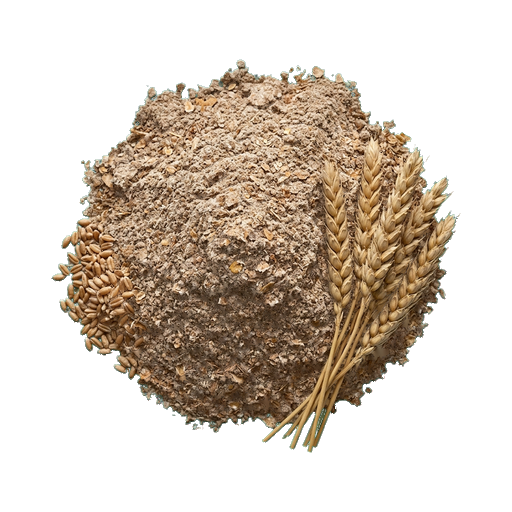
Whole wheat flour is a wheat flour with large particles of bran and germ that give it a dark color and rich bread flavor. It absorbs more liquid than white flour, so the dough becomes denser, and baked goods have a pronounced texture and better structure. This flour is used for bread, rolls, and cookies when a more nutritious and coarse crumb is needed; when replacing regular flour, increase the amount of liquid in the recipe by 10–15 percent.
Micronutrients
per 100 g
Minerals
About
Coarse flour is a product that retains bran particles and grain germ. Unlike finely ground flour, it remains coarse-grained with visible flecks of the husk. This flour works quite differently: it absorbs more moisture, distributes more slowly in the dough, and gives a completely different texture to finished bread or baked goods.
Taste and texture
Coarse flour has a pronounced nutty, slightly sweet taste — this is a result of the presence of grain germ. Its texture is noticeably grainy, with a slight grittiness on the tongue. When you bite into bread made from such flour, you feel small granules that create an interesting contrast with the soft crumb. This characteristic appeals to those who appreciate bread not for its smoothness, but for its character.
Where and how to use it
Coarse flour is indispensable in bread baking — it gives that very dense crumb with an interesting structure that fans of rye and whole grain bread are looking for. It is often mixed with white flour to add character to ordinary loaves or rolls. Pancakes and fritters made from such flour turn out more fluffy and aromatic.
- Rye and wheat bread, especially mixed with white flour
- Pancakes, small pancakes, cheese pancakes — turn out fluffier and more aromatic
- Cookies and gingerbreads — adds texture and depth of flavor
- Breading for cutlets or fish — gives a crispier crust
- Homemade pasta
Proportions and Special Techniques
The main thing to remember: coarse flour requires more liquid than regular flour. If you substitute white flour with coarse flour one to one in a recipe, the dough may turn out too dry. Add liquid gradually, adjusting based on consistency. For bread, it is recommended to mix coarse flour with white flour in a ratio of 20 to 50 percent — this depends on the desired density and taste.
Selection and Storage
When choosing, pay attention to the color — it should be uniform, without lumps and signs of moisture. Good whole grain flour smells fresh, with a light nutty aroma. If the smell is musty or moldy, the flour has already started to spoil.
Store whole grain flour in an airtight container in a cool, dry place. Due to the presence of grain germ, it contains more fat than white flour, so it oxidizes faster. At room temperature, it keeps for 2–3 months, in the refrigerator — up to six months, in the freezer — up to a year. Do not leave an open package in the cupboard for long — flour absorbs moisture and odors.
Whole grain flour is not just a substitute for white flour, it's a different ingredient with its own character. It demands respect for its unique qualities, but in return it gives bread depth, aroma, and that very pleasant texture that stays in your memory.
Nutrition
per 100 g
- Calories
- 320 kcal
- Protein
- 11 g
- Fat
- 2 g
- Carbs
- 60 g
Micronutrients
per 100 g
Macronutrients
- Fiber
- 10.6 g
- Water
- 9.44 g
Minerals
- Sodium
- 3 mg
- Potassium
- 376 mg
- Calcium
- 38 mg
- Magnesium
- 136 mg
- Phosphorus
- 352 mg
- Iron
- 3.86 mg
- Zinc
- 3.24 mg
- Copper
- 0.45 mg
- Manganese
- 3.56 mg
- Selenium
- 23.6 mcg
Vitamins
- Vitamin B1 (thiamin)
- 0.5 mg
- Vitamin B2 (riboflavin)
- 0.13 mg
- Vitamin B3 (niacin)
- 5.55 mg
- Vitamin B6
- 0.27 mg
Measures and weight
- 1 tbsp
- 9 g
- 1 tsp
- 3 g
- 1 cup
- 150 g
Measure calculator
- Weight
- 100 g
- Calories
- 320 kcal