Usuba
Usuba
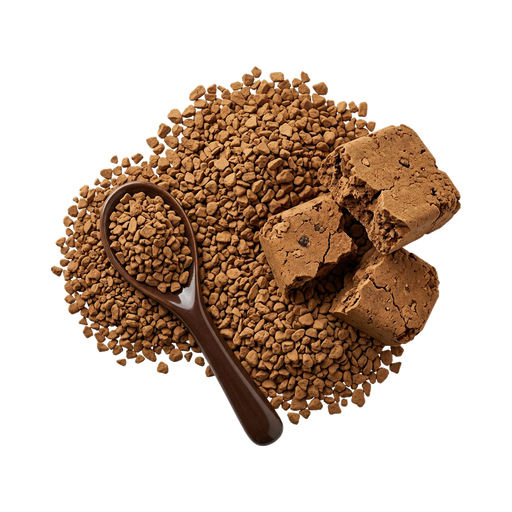
Instant coffee
Instant coffee is made by drying strongly brewed coffee extract, which allows you to quickly prepare a beverage without a coffee maker. Simply add hot water to a cup, and the coffee is ready in seconds, though its taste is usually less rich and aromatic than freshly ground coffee. When choosing, pay attention to granules or powder without lumps and off-odors, and when storing, keep the jar in a dry place so the coffee doesn't absorb moisture and lose its properties.
Micronutrients
per 100 g
Minerals
About
Instant coffee is a concentrated form of coffee beverage that saves time and space in the kitchen. It is made from regular coffee by removing water, leaving only the most active substances. The result is granules or powder that instantly dissolve in hot water. For those who are in a hurry in the morning or travel frequently, it is a lifesaver. However, it is worth understanding that the flavor profile differs from freshly brewed coffee: it is simpler, sometimes with a slight bitterness.
Taste and Aroma
Instant coffee provides a smoother, more uniform taste without the liveliness inherent to freshly ground beans. The aroma is also more modest — it dissipates quickly and doesn't fill the kitchen with that magical haze. In return, you get a predictable result in your cup: no surprises, no over-extraction. For connoisseurs, this is a drawback; for practical people, it's a plus.
Where to use
- Quick breakfast or a snack at work — just hot water and you're done
- Base for coffee cocktails and desserts — tiramisu, coffee ice cream, mousses
- Glazes and creams for baked goods — adds depth of flavor without extra liquid
- Marinades and sauces — especially for meat dishes, where coffee enhances the pungency
- Cold brew coffee — dissolves in cold water in a few minutes
Pairings
Instant coffee works well with milk and cream — they soften its harshness and make the drink creamier. Sugar or honey help round out the bitterness. In baking, coffee pairs with chocolate, cinnamon, cardamom, and vanilla. In cooking — with beef, pork, dark chocolate, and spicy spices.
Selection and Storage
When buying, pay attention to the production date — fresh coffee always tastes better. Granulated coffee is usually more aromatic than powdered coffee. Avoid packages with lumps and foreign odors. Store in an airtight container in a cool, dry place — moisture is the enemy of instant coffee. It's best to use an opened jar within a month before the coffee absorbs odors from the air.
Instant coffee is not a competitor to fresh coffee, but a practical helper in the kitchen. Use it for what it was created for: quick drinks and culinary experiments.
Nutrition
per 100 g
- Calories
- 0 kcal
- Protein
- 12 g
- Fat
- 0.3 g
- Carbs
- 0 g
Micronutrients
per 100 g
Macronutrients
- Fiber
- 0 g
- Sugars
- 0 g
- Saturated fat
- 0.197 g
- Monounsaturated fat
- 0.041 g
- Polyunsaturated fat
- 0.196 g
- Omega-3 (EPA + DHA)
- 0 g
- Cholesterol
- 0 mg
- Water
- 3.1 g
Minerals
- Sodium
- 37 mg
- Potassium
- 3535 mg
- Calcium
- 141 mg
- Magnesium
- 327 mg
- Phosphorus
- 303 mg
- Iron
- 4.41 mg
- Zinc
- 0.35 mg
- Copper
- 0.14 mg
- Manganese
- 1.71 mg
- Selenium
- 12.6 mcg
Vitamins
- Vitamin A (RAE)
- 0 mcg
- Vitamin D
- 0 mcg
- Vitamin E
- 0 mg
- Vitamin K
- 1.9 mcg
- Vitamin C
- 0 mg
- Vitamin B1 (thiamin)
- 0.01 mg
- Vitamin B2 (riboflavin)
- 0.07 mg
- Vitamin B3 (niacin)
- 28.17 mg
- Vitamin B5 (pantothenic acid)
- 0.1 mg
- Vitamin B6
- 0.03 mg
- Vitamin B9 (folate, DFE)
- 0 mcg
- Vitamin B12
- 0 mcg
Measures and weight
- 1 tbsp
- 9 g
- 1 tsp
- 3 g
- 1 cup
- 150 g
Measure calculator
- Weight
- 100 g
- Calories
- 0 kcal