Usuba
Usuba
Agar-agar
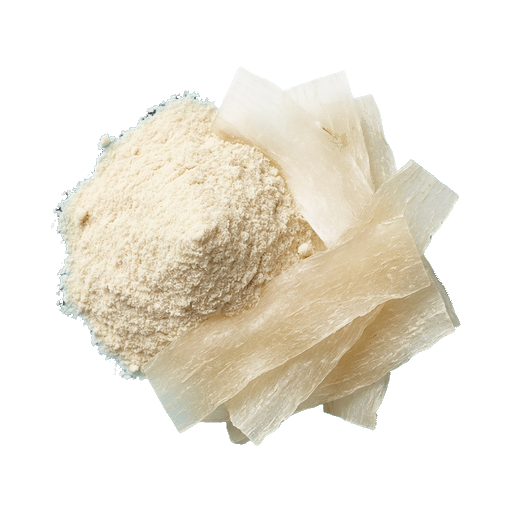
Agar-agar is a gelling agent of plant origin derived from red seaweed, used to give desserts, jellies, and mousses a firm consistency. Unlike gelatin, it does not require refrigeration to set and solidifies at room temperature, making it convenient for preparing dishes in hot climates. When choosing agar-agar, pay attention to product purity — high-quality agar-agar has a light color and contains no impurities. When substituting gelatin, keep in mind that agar-agar works in smaller quantities and requires boiling for complete dissolution.
Micronutrients
per 100 g
Minerals
About
Agar-agar is a natural gelling agent derived from red and brown seaweed. In cooking, it works as a reliable alternative to gelatin, but with its own characteristics that should be considered when working with it. The main difference: agar-agar sets at room temperature and holds its shape much more firmly than gelatin.
How agar-agar works
Agar-agar is sold as a powder, flakes, or strips. It needs to be dissolved in hot liquid — milk, juice, broth, or water — and then cooled. Already at 35–40 degrees, the mixture begins to thicken, solidifying completely at room temperature. This is convenient: you don't need to wait for a refrigerator and can work with the jelly right on the table.
Important note: agar-agar cannot simply be stirred into cold liquid. It must be brought to a boil to fully activate its gelling properties. If you simply pour hot water over it, it may not set properly.
Where to use it
Agar-agar is versatile: suitable for fruit jellies, panna cotta, mousses, glazes, and even vegan desserts as a gelatin substitute. It is valued in Asian cuisine for preparing traditional dishes. It holds its shape well in hot weather — jelly won't melt even on a hot table.
- Transparent jellies and mousse-jellies
- Glazes for cakes and pastries
- Vegan desserts (gelatin substitute)
- Creamy layers in cakes
- Sauces and garnishes with jelly-like consistency
Dosage and Practical Tips
Standard proportion: 1 teaspoon of agar-agar (or 2 grams) per 200 milliliters of liquid gives a delicate, slightly movable jelly. If you want a firmer jelly, add half a teaspoon. Remember that agar-agar gives a more elastic consistency than gelatin, so don't overdo it, otherwise the jelly will become rubbery.
Acidic juices and purees (lemon, strawberry, pineapple) can weaken the gelling properties, so use a little more agar for them. If cooking with milk, keep in mind that milk fat also affects setting — you may need to increase the amount slightly.
Selection and Storage
Agar-agar is sold in sections with dried fruits, spices, or in Asian cuisine stores. Choose pure agar without additives and colorants — the powder should be uniform in color without lumps. It stores for years in a dry place protected from moisture and sunlight, so you can safely buy it in bulk.
Ready-made agar jelly can be stored in the refrigerator for up to a week, and at room temperature it will remain firm for several days if not exposed to temperature fluctuations. This is convenient for preparing in advance.
Nutrition
per 100 g
- Calories
- 26 kcal
- Protein
- 0.4 g
- Fat
- 0 g
- Carbs
- 7.6 g
Micronutrients
per 100 g
Macronutrients
- Fiber
- 7.7 g
- Sugars
- 2.97 g
- Saturated fat
- 0.061 g
- Monounsaturated fat
- 0.027 g
- Polyunsaturated fat
- 0.102 g
- Omega-3 (EPA + DHA)
- 0.087 g
- Cholesterol
- 0 mg
- Water
- 8.68 g
Minerals
- Sodium
- 102 mg
- Potassium
- 1125 mg
- Calcium
- 625 mg
- Magnesium
- 770 mg
- Phosphorus
- 52 mg
- Iron
- 21.4 mg
- Zinc
- 5.8 mg
- Copper
- 0.61 mg
- Manganese
- 4.3 mg
- Selenium
- 7.4 mcg
Vitamins
- Vitamin A (RAE)
- 0 mcg
- Vitamin D
- 0 mcg
- Vitamin E
- 5 mg
- Vitamin K
- 24.4 mcg
- Vitamin C
- 0 mg
- Vitamin B1 (thiamin)
- 0.01 mg
- Vitamin B2 (riboflavin)
- 0.22 mg
- Vitamin B3 (niacin)
- 0.2 mg
- Vitamin B5 (pantothenic acid)
- 3.02 mg
- Vitamin B6
- 0.3 mg
- Vitamin B9 (folate, DFE)
- 580 mcg
- Vitamin B12
- 0 mcg
Measures and weight
- 1 tbsp
- 9 g
- 1 tsp
- 3 g
- 1 cup
- 150 g
Measure calculator
- Weight
- 100 g
- Calories
- 26 kcal