Usuba
Usuba
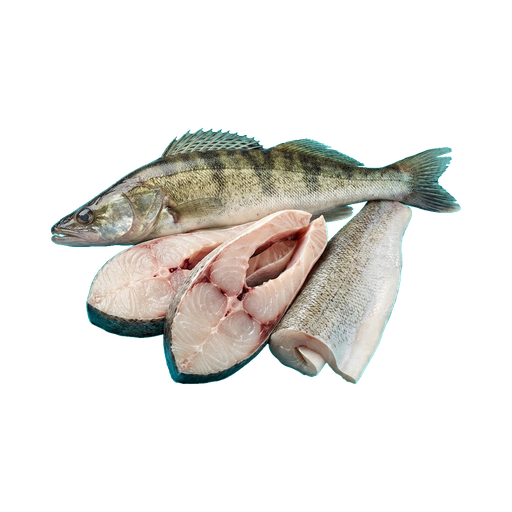
Pike-perch
Pike-perch is a freshwater fish with white, tender meat and minimal bones, making it convenient for culinary preparation. The fish has a delicate, slightly sweet flavor without a pronounced fishy smell, so it absorbs the aromas of spices and sauces well. Pike-perch is ideal for baking, boiling, frying, and smoking, and its firm consistency allows for cooking steaks and fillets that do not fall apart during heat treatment.
Micronutrients
per 100 g
Minerals
About
Pike perch is a fish valued in cuisine for its tender, slightly sweet meat and minimal bones. Being a predator, its muscle tissue is dense and holds its shape well during any cooking method. Thanks to this, pike perch is equally excellent when pan-fried, baked in the oven, or grilled — the fish doesn't fall apart and doesn't become mushy.
Taste and aroma
Pike perch meat is white, almost transparent in its raw form, with a delicate flavor. It doesn't smell "fishy" in the traditional sense — the aroma is fresh, light, and almost neutral. During cooking, a subtle sweetness unfolds, which harmonizes well with both classic sauces and spicy seasonings. Pike perch contains little fat, making it an ideal choice for those watching their calorie intake.
How to cook and what to pair with
- Pike perch fillet absorbs marinades well — try a combination of lemon, olive oil, and herbs. Fish cooks quickly: a 2 cm thick fillet fries for 4–5 minutes on each side.
- A whole fish can be baked with vegetables in foil or on a baking sheet. Leave space inside for steam circulation so the meat stays juicy.
- Pike perch works great in fish soup and broths thanks to its firm meat, which won't fall apart during long cooking.
- Smoking pike perch gives a tender result: the fish doesn't dry out and acquires a pleasant golden color.
Pike perch pairs well with lemon, dill, parsley, and garlic. Try serving it with potatoes, rice, or vegetable side dishes. Sauces based on cream, white wine, or tomato don't overpower the delicate flavor of the fish, but rather complement it.
Selection and Storage
- Fresh pike-perch should smell like the sea or a lake, but not have a strong "fishy" odor. Gills are bright red, eyes are clear and bulging.
- The meat is firm: if you press with your finger, the dent should disappear. If an indentation remains, the fish is no longer fresh.
- Fillets are best stored in the refrigerator for no more than 2 days. A whole carcass can be frozen for 3–4 months.
- Before cooking, thaw the fish in the refrigerator, not at room temperature — this way it will retain its moisture and structure.
Pike perch is a versatile fish for everyday cooking. It's easy to prepare, cooks quickly, and rarely disappoints. If you're looking for a fish that tastes great on its own without complex sauces and manipulations, pike perch is an excellent choice.
Nutrition
per 100 g
- Calories
- 84 kcal
- Protein
- 18.4 g
- Fat
- 1.3 g
- Carbs
- 0 g
Micronutrients
per 100 g
Macronutrients
- Fiber
- 0 g
- Saturated fat
- 0.249 g
- Monounsaturated fat
- 0.294 g
- Polyunsaturated fat
- 0.447 g
- Omega-3 (EPA + DHA)
- 0.311 g
- Cholesterol
- 86 mg
- Water
- 79.31 g
Minerals
- Sodium
- 51 mg
- Potassium
- 389 mg
- Calcium
- 110 mg
- Magnesium
- 30 mg
- Phosphorus
- 210 mg
- Iron
- 1.3 mg
- Zinc
- 0.62 mg
- Copper
- 0.18 mg
- Manganese
- 0.8 mg
- Selenium
- 12.6 mcg
Vitamins
- Vitamin A (RAE)
- 21 mcg
- Vitamin C
- 0 mg
- Vitamin B1 (thiamin)
- 0.27 mg
- Vitamin B2 (riboflavin)
- 0.16 mg
- Vitamin B3 (niacin)
- 2.3 mg
- Vitamin B5 (pantothenic acid)
- 0.75 mg
- Vitamin B6
- 0.12 mg
- Vitamin B9 (folate, DFE)
- 15 mcg
- Vitamin B12
- 2 mcg
Measures and weight
- 1 pcs
- 500 g
Measure calculator
- Weight
- 100 g
- Calories
- 84 kcal