Usuba
Usuba
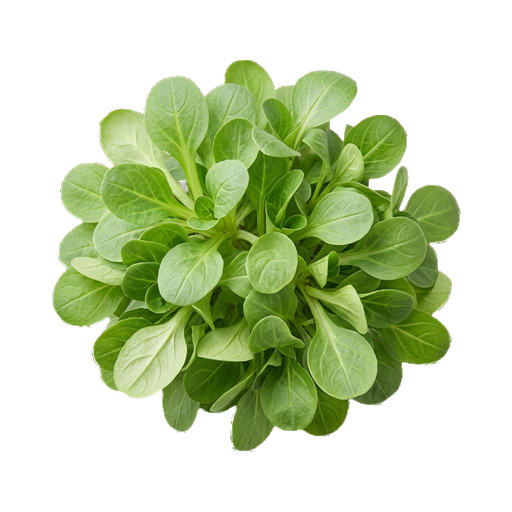
Corn salad
Tender leafy salad with small rounded leaves of light green color and a slightly sweet, subtly nutty flavor. Corn lettuce maintains its shape well, doesn't become wilted, and is perfect for salads, sandwiches, and side dishes thanks to its crispy structure. When selecting, pay attention to the firmness of the leaves and the absence of dark spots — store the salad in the refrigerator in an airtight container to maintain freshness.
Micronutrients
per 100 g
Minerals
About
Corn is a delicate leafy salad with a fragile structure and subtle flavor. Its thin, almost transparent leaves are gathered in a loose head that easily falls apart into individual leaves. Unlike dense cabbage varieties, corn requires careful handling, but it is this very fragility that makes it ideal for fresh salads, where texture is important.
Taste and Aroma
Corn lettuce has a mild, subtle flavor with a light sweetness. It's not a salad that dominates the dish — rather, it serves as a delicate base, allowing other components of the dish to shine. The leaves have virtually no bitterness, making corn lettuce a versatile choice for those who prefer delicate tastes.
How to use in the kitchen
Corn is most often used raw. Its delicate leaves are ideal for light salads with a minimalist composition — a good oil, lemon juice, and a pinch of salt are enough. Salad works well as a base for denser ingredients: smoked fish, cheese, nuts, or crispy croutons.
Successful combinations
- With peas, corn and light butter dressing
- With smoked salmon, avocado and citrus dressing
- With goat cheese, walnuts and honey mustard
- With chicken, tomatoes and simple vinaigrette
- With seafood and spicy Asian sauces
Selection and Storage
When purchasing, pay attention to the density of the head — it should be firm, but not hard. The leaves should not have dark spots or a slimy coating. Cabbage is stored in the refrigerator in a plastic container or bag with holes for air circulation. Storage time is usually 5–7 days, but it is better to use it within 2–3 days after purchase, while the leaves are at their most crisp and juicy.
Getting Ready to Use
Corn should be washed carefully without crushing the leaves. Separate the head into individual leaves, rinse them under cold water, and let the moisture drain. If the leaves are very wet, pat them dry with a soft towel. It is best to cut the salad immediately before serving to avoid darkening of the cut edges. For salad, leaves are often left whole or torn by hand — this preserves their delicate texture.
Corn is a salad for those who appreciate simplicity. Don't overload it with heavy dressings and numerous ingredients. Let the delicacy of the leaves be the main star of the dish.
Nutrition
per 100 g
- Calories
- 17 kcal
- Protein
- 1.2 g
- Fat
- 0.2 g
- Carbs
- 3.2 g
Micronutrients
per 100 g
Macronutrients
- Cholesterol
- 0 mg
- Water
- 92.8 g
Minerals
- Sodium
- 4 mg
- Potassium
- 459 mg
- Calcium
- 38 mg
- Magnesium
- 13 mg
- Phosphorus
- 53 mg
- Iron
- 2.18 mg
- Zinc
- 0.59 mg
- Copper
- 0.13 mg
- Manganese
- 0.36 mg
- Selenium
- 0.9 mcg
Vitamins
- Vitamin A (RAE)
- 355 mcg
- Vitamin D
- 0 mcg
- Vitamin C
- 38.2 mg
- Vitamin B1 (thiamin)
- 0.07 mg
- Vitamin B2 (riboflavin)
- 0.09 mg
- Vitamin B3 (niacin)
- 0.42 mg
- Vitamin B5 (pantothenic acid)
- 0.04 mg
- Vitamin B6
- 0.27 mg
- Vitamin B9 (folate, DFE)
- 14 mcg
- Vitamin B12
- 0 mcg
Measures and weight
- 1 head
- 150 g
- 1 bunch
- 100 g
Measure calculator
- Weight
- 100 g
- Calories
- 17 kcal