Usuba
Usuba
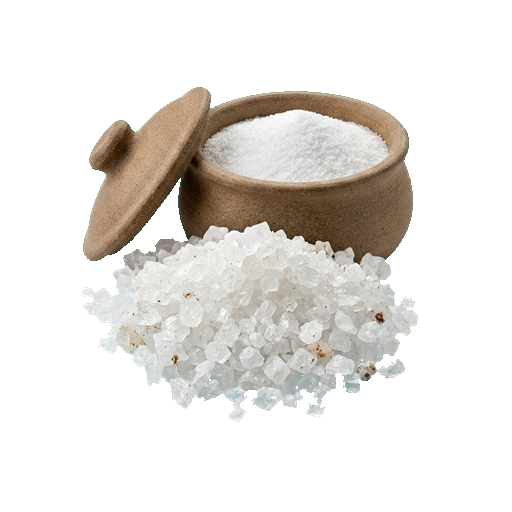
Salt
Salt is a mineral preservative and flavor enhancer that is essential to almost every dish. It suppresses bitterness, intensifies the natural aromas of products, and helps retain moisture in meat and vegetables. When choosing salt, it's important to consider the type: table salt dissolves quickly and suits most dishes, sea salt contains more trace minerals, and coarse crystalline salt is convenient for final garnishing and adds an interesting texture.
Micronutrients
per 100 g
About
Salt is not just a seasoning, but the foundation of taste in cooking. It enhances the natural aromas of ingredients, suppresses bitterness, and makes a dish more voluminous and interesting. Without it, even the highest quality ingredients sound dull and incomplete.
When and How to Salt
The moment when you add salt affects the result. In hot water for pasta or porridge, salt is added at the beginning of cooking — it dissolves evenly and penetrates inside the grains or pasta. Salt is added to meat and fish either 15–20 minutes before cooking or immediately before frying to retain the juices inside. Salads and cold dishes are salted at the last moment, otherwise vegetables will start to release moisture.
The main rule: it's better to under-salt than to over-salt. An over-salted dish is difficult to save, but you can always add a pinch of salt. Everyone's taste buds are different, so rely on your own feelings and gradually find the right amount.
Which salt to choose
Several types of salt are useful in the kitchen. Regular table salt is a workhorse, versatile and affordable. Sea salt contains trace elements and has a slightly more complex flavor, great for finishing dishes. Coarse rock salt is convenient for salting and preserving. Iodized salt is beneficial for health, but can impart a slightly bitter taste when heated — it's better to add it to finished dishes.
- Table salt — for everyday cooking and boiling
- Sea salt — for garnishing dishes and more subtle flavor notes
- Coarse rock salt — for curing meat, fish, and preservation
- Smoked or flavored salt — for experiments and special recipes
Storage and Practical Tips
Salt is practically eternal — when stored properly, it does not spoil. Keep it in a dry place, protected from moisture and direct sunlight. In a glass jar with a tight lid or in its original packaging, salt will retain its flowability and won't clump. If salt has clumped anyway, add a few grains of rice to the container — they will absorb excess moisture.
It's convenient to keep a small salt shaker or bowl of salt near your work surface in the kitchen — this way you can easily pinch the amount you need with your fingers and feel its weight. This helps develop intuition and not rely solely on teaspoons. For precise dosing in recipes, remember: one level teaspoon is approximately 5–6 grams of salt.
Salt is not an enemy, but a helper. It reveals flavor rather than masks it. The key is to know how to listen to it and not overdo it.
Nutrition
per 100 g
- Calories
- 0 kcal
- Protein
- 0 g
- Fat
- 0 g
- Carbs
- 0 g
Micronutrients
per 100 g
Macronutrients
- Fiber
- 0 g
- Sugars
- 0 g
- Saturated fat
- 0 g
- Monounsaturated fat
- 0 g
- Polyunsaturated fat
- 0 g
- Omega-3 (EPA + DHA)
- 0 g
- Cholesterol
- 0 mg
- Water
- 0.2 g
Minerals
- Sodium
- 38758 mg
- Potassium
- 8 mg
- Calcium
- 24 mg
- Magnesium
- 1 mg
- Phosphorus
- 0 mg
- Iron
- 0.33 mg
- Zinc
- 0.1 mg
- Copper
- 0.03 mg
- Manganese
- 0.1 mg
- Selenium
- 0.1 mcg
Vitamins
- Vitamin A (RAE)
- 0 mcg
- Vitamin D
- 0 mcg
- Vitamin E
- 0 mg
- Vitamin K
- 0 mcg
- Vitamin C
- 0 mg
- Vitamin B1 (thiamin)
- 0 mg
- Vitamin B2 (riboflavin)
- 0 mg
- Vitamin B3 (niacin)
- 0 mg
- Vitamin B5 (pantothenic acid)
- 0 mg
- Vitamin B6
- 0 mg
- Vitamin B9 (folate, DFE)
- 0 mcg
- Vitamin B12
- 0 mcg
Measures and weight
- 1 tbsp
- 15 g
- 1 tsp
- 5 g
- 1 cup
- 250 g
Measure calculator
- Weight
- 100 g
- Calories
- 0 kcal