Usuba
Usuba
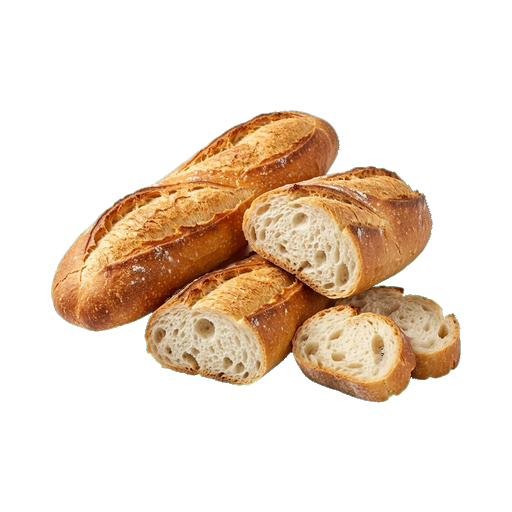
French bread
Classic bread with a crispy golden crust and fluffy white crumb inside, achieved through high water content in the dough and proper fermentation. It has a neutral, slightly sweet flavor with subtle sourdough notes, making it versatile for any dish — from simple sandwiches to soup accompaniments. When selecting, pay attention to the crust's elasticity and the hollow sound when tapped, and when storing, keep the bread in paper or cloth to maintain a crispy crust.
Micronutrients
per 100 g
Minerals
About
French bread is not just baking, but a certain style, recognizable by its crispy crust and airy crumb inside. It is made from simple ingredients: flour, water, salt, and starter or yeast. The secret lies in the technique: long fermentation, proper oven temperature, and steam at the initial baking stage. The result is bread with contrasting texture, which holds its shape and doesn't go stale for a day or two.
Aroma and Taste
The aroma of fresh French bread is a combination of wheat, slightly nutty notes with a subtle tanginess, if sourdough starter was used in the dough. The taste is balanced: not sweet, slightly salty, with a delicate aftertaste. The crust crackles when bitten, and the crumb is dense but not heavy, with good porosity.
Role in dishes and pairings
- Base for sandwiches and subs — dense crumb holds filling, doesn't get soggy
- Complement to soups and stews — bread absorbs broth, adds satiety
- Component for breadcrumbs and croutons — dries well, gives a crispy crust
- Snack with butter, cheese and sausage — simple combination that always works
- Base for bruschetta and croutons — sliced, fried in oil or baked in the oven
Selection and Storage
When buying bread, pay attention to its weight — it should be heavy, not light. The crust should be crack-free with an even brown color. Tap on the crust — the sound should be crisp, which is a sign of proper baking. Fresh bread has a pleasant aroma, without musty or sour smells.
Store preferably at room temperature, wrapped in paper or a linen bag — this will keep the crust crispy. In polyethylene, bread will quickly become moist. If you need to keep it longer, place it in the freezer — when thawed at room temperature, the bread will restore its properties. Sliced bread becomes stale faster than a whole loaf.
Practical tip
If bread has dried out slightly, don't rush to throw it away. Lightly spray it with water, wrap it in foil, and heat it in the oven at 180°C for about five minutes — the bread will regain its softness. For sandwiches and open-faced sandwiches, cut bread with a sharp knife using back-and-forth motions rather than downward strokes — this way the crumb won't get crushed.
Nutrition
per 100 g
- Calories
- 265 kcal
- Protein
- 9 g
- Fat
- 1.5 g
- Carbs
- 50 g
Micronutrients
per 100 g
Macronutrients
- Fiber
- 2.2 g
- Sugars
- 4.62 g
- Saturated fat
- 0.529 g
- Monounsaturated fat
- 0.362 g
- Polyunsaturated fat
- 0.855 g
- Omega-3 (EPA + DHA)
- 0 g
- Cholesterol
- 0 mg
- Water
- 33 g
Minerals
- Sodium
- 602 mg
- Potassium
- 117 mg
- Calcium
- 52 mg
- Magnesium
- 32 mg
- Phosphorus
- 105 mg
- Iron
- 3.91 mg
- Zinc
- 1.04 mg
- Copper
- 0.15 mg
- Manganese
- 0.58 mg
- Selenium
- 28.6 mcg
Vitamins
- Vitamin A (RAE)
- 0 mcg
- Vitamin D
- 0 mcg
- Vitamin E
- 0.21 mg
- Vitamin K
- 0.7 mcg
- Vitamin C
- 0 mg
- Vitamin B1 (thiamin)
- 0.71 mg
- Vitamin B2 (riboflavin)
- 0.43 mg
- Vitamin B3 (niacin)
- 4.82 mg
- Vitamin B5 (pantothenic acid)
- 0.46 mg
- Vitamin B6
- 0.11 mg
- Vitamin B9 (folate, DFE)
- 170 mcg
- Vitamin B12
- 0 mcg
Measures and weight
- 1 slice
- 30 g
Measure calculator
- Weight
- 100 g
- Calories
- 265 kcal