Usuba
Usuba
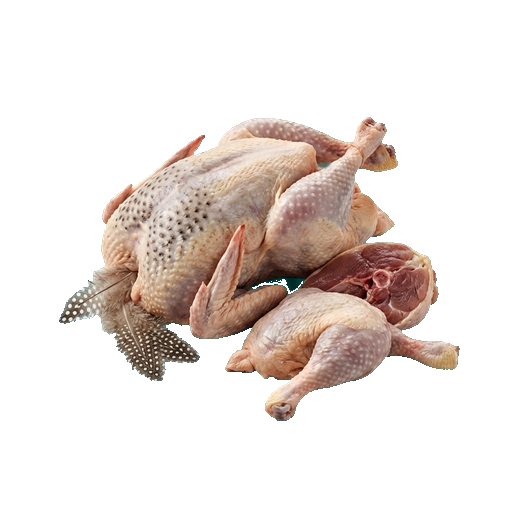
Guinea fowl
Guinea fowl is a domestic bird with dense, tender meat that tastes like game with a subtle bitterness. Guinea fowl meat contains less fat than chicken and is well-suited for frying, stewing, and grilling. When selecting the bird, pay attention to skin elasticity and the absence of odor, and cook guinea fowl slightly longer than chicken to make the meat more tender and juicy.
Micronutrients
per 100 g
Minerals
About
Guinea fowl is a bird that occupies a middle ground between chicken and game. Its meat is dark, dense, with a pronounced game flavor, but at the same time less fatty than duck or goose. In the kitchen, guinea fowl is valued for its versatility: it is excellent in festive dishes, in everyday recipes, and in experiments with unusual flavors.
Taste and Aroma
Guinea fowl meat has a rich, slightly piquant flavor with hints of game. It's not a sharp piquancy, but rather a deep, noble one. The aroma is more intense than chicken meat, but milder than pheasant or quail. Because of this, guinea fowl easily absorbs spices and sauces while maintaining its own distinctive character.
How to cook
A whole bird is best roasted in the oven at a moderate temperature — the meat cooks evenly and remains juicy. Fillets can be fried in a pan, braised in wine, or grilled. Important note: guinea fowl meat is drier than chicken, so do not overcook or dry it out — monitor the temperature inside the bird.
- Whole bird (1.2–1.5 kg): baking at 180–190 °C for 50–60 minutes
- Breast fillet: pan-frying 6–8 minutes or baking 12–15 minutes
- Legs and thighs: stewing in sauce 40–50 minutes for tenderness
Combinations and Dishes
Guinea fowl pairs well with classic sauces: red wine, creamy mustard sauces, and berry reductions. Its meat appreciates herbs — thyme, rosemary, juniper. On the table, guinea fowl is suited alongside potatoes, mushrooms, greens, and grilled vegetables. It looks excellent on a festive menu, but is equally good for a simple family dinner.
Selection and Storage
When purchasing, pay attention to the skin color — it should be light, without dark spots. The meat should be firm and odorless. Store fresh guinea fowl in the refrigerator for no more than 3–4 days, in the freezer for up to 6 months. If the bird is frozen, thaw it slowly on the lower shelf of the refrigerator to preserve juiciness.
Practical Tips
- Remove the poultry from the refrigerator 20–30 minutes before cooking to let it warm up to room temperature
- You can hide butter with herbs under the skin — this will help retain moisture
- Let the cooked poultry rest for 10 minutes before carving — the meat will be more tender
- Bones and trimmings make a rich, aromatic broth
Nutrition
per 100 g
- Calories
- 110 kcal
- Protein
- 23 g
- Fat
- 1.5 g
- Carbs
- 0 g
Micronutrients
per 100 g
Macronutrients
- Fiber
- 0 g
- Saturated fat
- 1.77 g
- Monounsaturated fat
- 2.43 g
- Polyunsaturated fat
- 1.41 g
- Omega-3 (EPA + DHA)
- 0.04 g
- Cholesterol
- 74 mg
- Water
- 68.9 g
Minerals
- Sodium
- 67 mg
- Potassium
- 193 mg
- Calcium
- 11 mg
- Magnesium
- 22 mg
- Phosphorus
- 153 mg
- Iron
- 0.84 mg
- Zinc
- 1.13 mg
- Copper
- 0.04 mg
- Manganese
- 0.02 mg
- Selenium
- 16.3 mcg
Vitamins
- Vitamin A (RAE)
- 28 mcg
- Vitamin C
- 1.3 mg
- Vitamin B1 (thiamin)
- 0.06 mg
- Vitamin B2 (riboflavin)
- 0.1 mg
- Vitamin B3 (niacin)
- 7.67 mg
- Vitamin B5 (pantothenic acid)
- 0.88 mg
- Vitamin B6
- 0.38 mg
- Vitamin B9 (folate, DFE)
- 5 mcg
- Vitamin B12
- 0.3 mcg
Measures and weight
- 1 pcs
- 1800 g
Measure calculator
- Weight
- 100 g
- Calories
- 110 kcal