Usuba
Usuba
Chum salmon
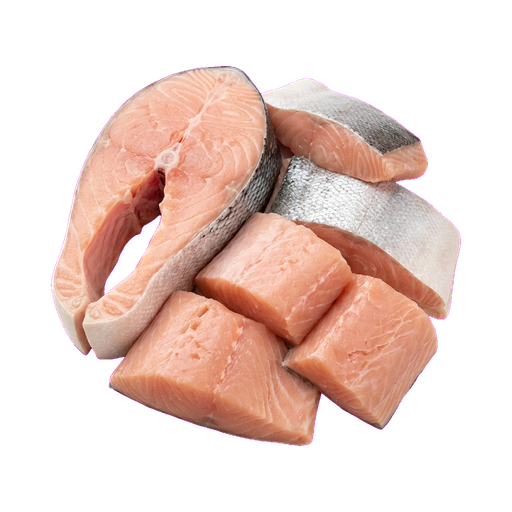
Chum salmon is a Pacific salmon fish with tender white or light pink meat that becomes firmer when cooked and holds its shape well. Its meat has a mild, delicate flavor with barely noticeable sweetness and contains less fat than pink salmon or coho salmon, making dishes from chum salmon less heavy. The fish is versatile — suitable for boiling, baking, smoking, and salting, and pairs well with lemon, dill, and butter.
Micronutrients
per 100 g
Minerals
About
Chum salmon is a beautiful and noble fish of the salmon family, valued for its tender meat and versatility in the kitchen. Its orange-pink flesh is dense but not fatty, with a delicate flavor that doesn't overpower other ingredients in the dish. It is precisely this balance that makes chum salmon one of the most convenient fish for everyday meals.
Taste and Aroma
Chum salmon meat is distinguished by a soft, slightly sweet taste with a barely noticeable mineral note. The aroma is unobtrusive, fishy, but not sharp. The texture is fibrous and tender at the same time — with proper heat treatment, the fish does not fall apart but holds its shape. Chum salmon roe is large, with a pleasant firmness, and is often used in sushi and sandwiches.
Role in dishes
Chum salmon is excellent prepared almost any way: it can be baked, fried, boiled, grilled, or used raw in ceviche and sushi. The fillet doesn't require lengthy cooking — just 10–15 minutes at 180 degrees is enough to make the fish tender and juicy.
Pairs well with
- Lemon and lime emphasize the freshness of fish
- Fresh herbs (dill, parsley, cilantro) don't compete with the delicate flavor
- Creamy sauces and sour cream create a soft contrast
- Grilled vegetables (zucchini, bell pepper, tomatoes) — the perfect side dish
- White wines (sauvignon blanc, pinot grigio) harmonize with the tenderness of the meat
Selection and Storage
When selecting chum salmon, pay attention to the color of the meat — it should be bright orange or pink, without gray spots. Fresh fish has a pleasant, marine smell, without ammonia notes. Fillets should not be slimy or sticky. Whole fish is checked by the eyes: they should be transparent and shiny, gills — bright red.
In the refrigerator, chum salmon is stored for 2–3 days on the coldest shelf, wrapped in parchment or in an airtight container. If you need to keep it longer, freeze it: at minus 18 degrees, fish maintains its quality for up to three months. Thaw in the refrigerator, not at room temperature — this way the meat will remain juicy.
Chum salmon is the choice of those who want to cook fish often and without unnecessary hassle. It forgives minor cooking mistakes and always turns out delicious.
Nutrition
per 100 g
- Calories
- 138 kcal
- Protein
- 22 g
- Fat
- 5.6 g
- Carbs
- 0 g
Micronutrients
per 100 g
Macronutrients
- Fiber
- 0 g
- Saturated fat
- 0.84 g
- Monounsaturated fat
- 1.541 g
- Polyunsaturated fat
- 0.898 g
- Omega-3 (EPA + DHA)
- 0.627 g
- Cholesterol
- 74 mg
- Water
- 75.38 g
Minerals
- Sodium
- 50 mg
- Potassium
- 429 mg
- Calcium
- 11 mg
- Magnesium
- 22 mg
- Phosphorus
- 283 mg
- Iron
- 0.55 mg
- Zinc
- 0.47 mg
- Copper
- 0.06 mg
- Manganese
- 0.02 mg
- Selenium
- 36.5 mcg
Vitamins
- Vitamin A (RAE)
- 30 mcg
- Vitamin E
- 1.09 mg
- Vitamin C
- 0 mg
- Vitamin B1 (thiamin)
- 0.08 mg
- Vitamin B2 (riboflavin)
- 0.18 mg
- Vitamin B3 (niacin)
- 7 mg
- Vitamin B5 (pantothenic acid)
- 0.75 mg
- Vitamin B6
- 0.4 mg
- Vitamin B9 (folate, DFE)
- 4 mcg
- Vitamin B12
- 3 mcg
Measure calculator
- Weight
- 100 g
- Calories
- 138 kcal