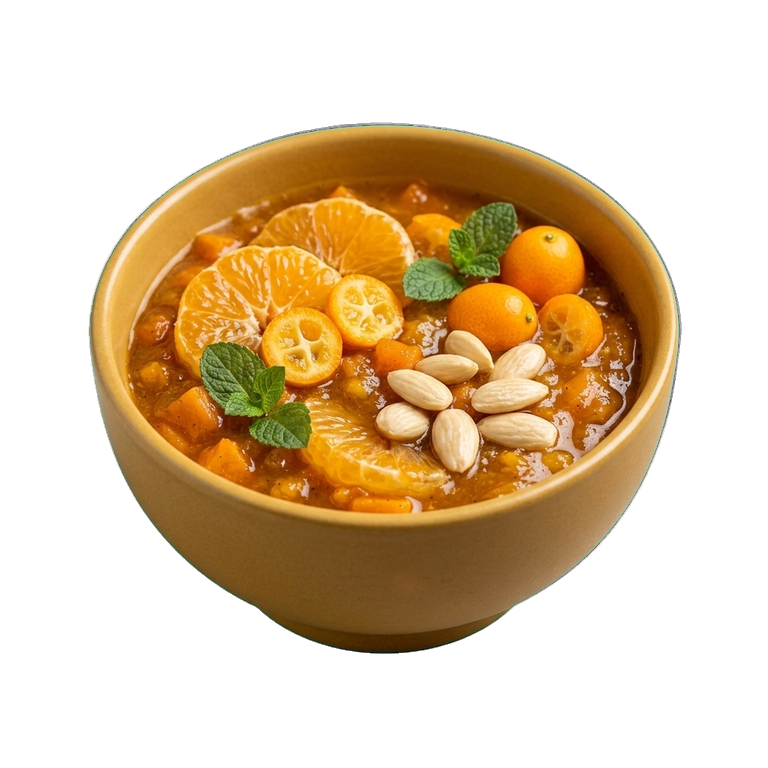
Usuba
Usuba
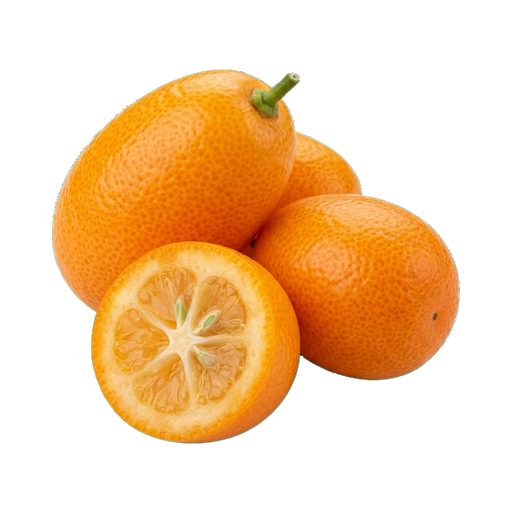
Kumquat
A miniature citrus with tart flesh and sweet edible skin that is eaten together with the fruit. Its bright sweet-and-sour flavor with a subtle bitterness is used in desserts, beverages, sauces for meat and fish, as well as for garnishing dishes. When selecting, look for firm fruits without damage, and remember that kumquat has a short shelf life and is best used within a week of purchase.
Micronutrients
per 100 g
Minerals
About
Kumquat is a miniature citrus fruit that can easily be mistaken for a large berry. Its main feature is that it is eaten whole, including the thin, slightly sweet skin, while the flesh inside is sour and juicy. This creates an interesting contrast of flavors in a single bite and makes kumquat a convenient ingredient for cooks who value practicality.
Aroma and Flavor
Kumquat smells like an orange, but the scent is more subtle and delicate. The taste of the skin offers sweetness with a slight bitterness, while the flesh provides pure acidity with floral notes. If you cut a kumquat in half, inside you will find several small seeds and a fibrous structure similar to a regular orange, but in miniature. This duality of taste makes it versatile: it works for both sweet and spicy dishes.
Role in dishes
In cooking, kumquat works as an accent rather than a main ingredient. It is sliced thinly and added to salads for crunch and citrus freshness, boiled with sugar into compotes and syrups, or used to garnish desserts and cocktails. Whole fruits look good on the table and immediately catch the attention of guests.
Pairings
- With seafood — kumquat emphasizes the freshness of fish and shrimp
- With poultry — added to sauces for duck or chicken for piquancy
- With chocolate — the fruit's acidity contrasts with the bitterness of dark chocolate
- With ginger and cinnamon — create an aromatic mix for beverages and baked goods
- With honey and spices — the base for glazes and marinades
Selection and Storage
Choose kumquats with smooth, shiny skin without dents or soft spots. The fruit should be heavy for its size — this is a sign of juiciness. A slightly soft kumquat tastes better than a hard one, but don't pick completely soft specimens. At room temperature, kumquats keep for a week, in the refrigerator — for two to three weeks in a plastic container or bag. Before use, rinse under water and dry.
Kumquat is convenient to slice with a sharp knife crosswise to get thin semicircles. If you need only the flesh without the skin, cut the fruit in half and scrape out the contents with a spoon. For compotes and jams, kumquat requires less sugar than regular citrus fruits, because its skin is already sweet. Try cooking whole fruits with a cinnamon stick and a star anise — you'll get a fragrant syrup for soaking cakes or serving with ice cream.
Nutrition
per 100 g
- Calories
- 71 kcal
- Protein
- 1.9 g
- Fat
- 0.9 g
- Carbs
- 15.9 g
Micronutrients
per 100 g
Macronutrients
- Fiber
- 6.5 g
- Sugars
- 9.36 g
- Saturated fat
- 0.103 g
- Monounsaturated fat
- 0.154 g
- Polyunsaturated fat
- 0.171 g
- Omega-3 (EPA + DHA)
- 0 g
- Cholesterol
- 0 mg
- Water
- 80.85 g
Minerals
- Sodium
- 10 mg
- Potassium
- 186 mg
- Calcium
- 62 mg
- Magnesium
- 20 mg
- Phosphorus
- 19 mg
- Iron
- 0.86 mg
- Zinc
- 0.17 mg
- Copper
- 0.1 mg
- Manganese
- 0.14 mg
- Selenium
- 0 mcg
Vitamins
- Vitamin A (RAE)
- 15 mcg
- Vitamin D
- 0 mcg
- Vitamin E
- 0.15 mg
- Vitamin K
- 0 mcg
- Vitamin C
- 43.9 mg
- Vitamin B1 (thiamin)
- 0.04 mg
- Vitamin B2 (riboflavin)
- 0.09 mg
- Vitamin B3 (niacin)
- 0.43 mg
- Vitamin B5 (pantothenic acid)
- 0.21 mg
- Vitamin B6
- 0.04 mg
- Vitamin B9 (folate, DFE)
- 17 mcg
- Vitamin B12
- 0 mcg
Measures and weight
- 1 pcs
- 10 g
Measure calculator
- Weight
- 100 g
- Calories
- 71 kcal