 Usuba
Usuba
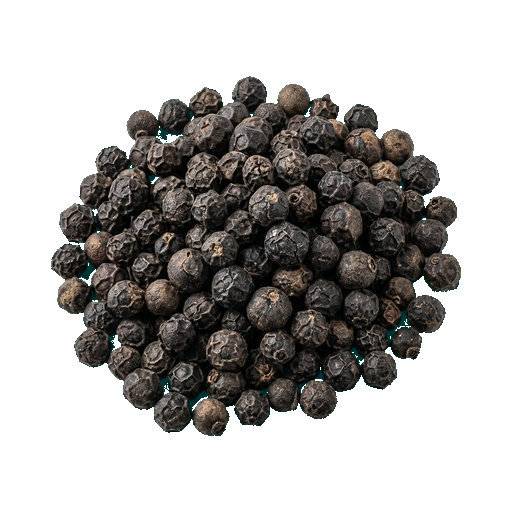
Black pepper
Whole dried peppercorns with a sharp, pungent taste and characteristic spicy aroma. Used in marinades, brines, meat and fish dishes, and added to soups and broths during cooking. When selecting, prefer dense peppercorns of dark color — they guarantee freshness and flavor intensity. Store pepper in an airtight container away from light and moisture.
Micronutrients
per 100 g
Minerals
About
Peppercorns are dried berries of the pepper plant that contain the entire spectrum of spicy flavor. Unlike ground pepper, peppercorns retain essential oils much longer, so each time they are added to a dish, they release a fresh, vibrant aroma. This is the main tool in the kitchen for those who want to control the intensity of spice and achieve predictable results.
Aroma and Flavor
Peppercorns offer a sharp, slightly burning spice with woody and floral notes. The flavor unfolds gradually — first comes the heat, then more subtle nuances emerge. If you crush the peppercorns with your finger before adding them, the aroma becomes even more pronounced and will fill the entire dish.
Where and how to use
Peppercorns are versatile: they are added to marinades, soups, stews, when cooking meat and fish, in sauces and even in desserts. For marinades and broths, peppercorns are added whole — they release flavor more slowly and won't cloud the liquid. In finished dishes, they are often left in, as they are pleasant to the touch and add texture. If a more intense spice is needed, the peppercorns are lightly crushed or finely chopped before adding.
- In marinades for vegetables and meat — the main ingredient
- In meat broths and soups — added together with bay leaf and clove
- In preserving — protects against fermentation and adds pungency
- In fish dishes — softens fish smell without overpowering the taste
- In creamy sauces — contrasts with the tenderness of cream
Selection and Storage
Choose dark peppercorns, almost black, dense and without cracks. Bruised or wrinkled pepper loses its oils and flavor. When squeezed in your hand, the peppercorn should make a characteristic crunch — this is a sign of freshness and dryness.
Store peppercorns in an airtight container in a dark, cool place, away from light and moisture. When stored properly, peppercorns retain their aroma for up to two years. Check the smell before using — if the pepper smells musty or has lost its pungency, it's time to replace it. Ground pepper loses its properties faster, so it's better to grind peppercorns directly before use in a special grinder or mortar.
Peppercorns are an investment in flavor quality. One kilogram lasts a long time, and is used slowly, so one package will last for a while. Once you learn to feel how many peppercorns are needed for each dish, cooking will become more precise and interesting.
Nutrition
per 100 g
- Calories
- 251 kcal
- Protein
- 10.4 g
- Fat
- 3.3 g
- Carbs
- 64.8 g
Micronutrients
per 100 g
Macronutrients
- Fiber
- 25.3 g
- Sugars
- 0.64 g
- Saturated fat
- 1.392 g
- Monounsaturated fat
- 0.739 g
- Polyunsaturated fat
- 0.998 g
- Omega-3 (EPA + DHA)
- 0 g
- Cholesterol
- 0 mg
- Water
- 12.46 g
Minerals
- Sodium
- 20 mg
- Potassium
- 1329 mg
- Calcium
- 443 mg
- Magnesium
- 171 mg
- Phosphorus
- 158 mg
- Iron
- 9.71 mg
- Zinc
- 1.19 mg
- Copper
- 1.33 mg
- Manganese
- 12.75 mg
- Selenium
- 4.9 mcg
Vitamins
- Vitamin A (RAE)
- 27 mcg
- Vitamin D
- 0 mcg
- Vitamin E
- 1.04 mg
- Vitamin K
- 163.7 mcg
- Vitamin C
- 0 mg
- Vitamin B1 (thiamin)
- 0.11 mg
- Vitamin B2 (riboflavin)
- 0.18 mg
- Vitamin B3 (niacin)
- 1.14 mg
- Vitamin B5 (pantothenic acid)
- 1.4 mg
- Vitamin B6
- 0.29 mg
- Vitamin B9 (folate, DFE)
- 17 mcg
- Vitamin B12
- 0 mcg
Measures and weight
- 1 tbsp
- 9.8 g
- 1 tsp
- 3.3 g
- 1 cup
- 162.5 g
- 1 pcs
- 0.5 g
Measure calculator
- Weight
- 100 g
- Calories
- 251 kcal
