Usuba
Usuba
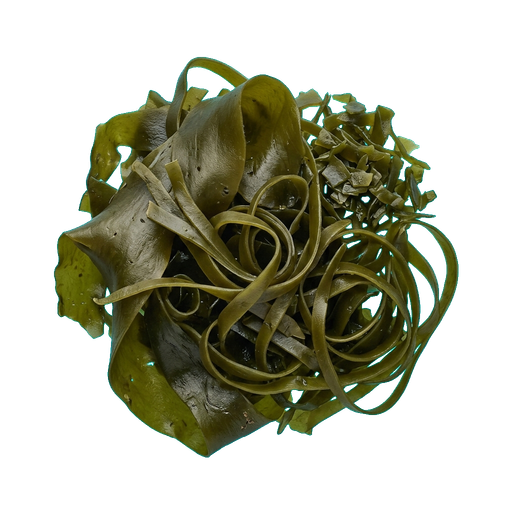
Wakame seaweed
Wakame is a brown seaweed with a soft texture and a slightly sweet, iodine-rich flavor. Used in Japanese cuisine for soups, salads, and side dishes, it is commonly found in miso soup and sesame salad. When selecting, look for dark green or brown leaves without damage; before using, soak the seaweed in water for several minutes to soften it and develop its flavor.
Micronutrients
per 100 g
Minerals
About
Wakame is a type of seaweed that has become familiar in Asian cuisine and is gradually gaining popularity in European restaurants and home kitchens. It is valued for its delicate texture, subtle salty flavor, and versatility. The seaweed is easily rehydrated in water and cooks quickly, making it simple to work with, even if you're encountering it for the first time.
Taste and Aroma
Wakame has a soft, slightly sweet taste with a pronounced saltiness. It's not a sharp sea bitterness, but rather a delicate mineral note that is well-felt on the tongue. The aroma of the seaweed is fresh, marine, without obtrusive fishy notes. When wakame is soaked, it becomes softer and loses some of its saltiness, making it more suitable for dishes where a subtle flavor support is needed.
Where to use
- Miso soup — a classic use, seaweed is added at the end of cooking so it doesn't fall apart
- Salads — soaked and chilled wakame pairs well with vegetables, sesame, and light dressings based on rice vinegar
- Sushi and rolls — sliced into strips, serves as a flavor accent and a source of minerals
- Garnishes for fish and seafood — enhances the seafood context of the dish without overpowering the main flavor
- Rice dishes — a pinch of wakame in risotto or orzo adds depth and an unusual mineral layer
Getting Started
Dry wakame should be soaked in cold water for 5–10 minutes. It increases in volume by approximately three times, so don't overdo it. If the seaweed goes into a hot dish, you can add it directly to the soup or broth a couple of minutes before serving — it will swell in hot liquid. For salads, it's better to soak in advance, drain the water, and let it drain. Some chefs rinse wakame after soaking to slightly reduce the saltiness, but that's a matter of taste.
Successful Pairings
- Miso and soy sauce — natural partners that enhance umami
- Rice vinegar and sesame oil — classic Asian dressing for seaweed salads with wakame
- Ginger and garlic — spicy notes contrast well with the delicate nature of seaweed
- Avocado and cucumber — fresh vegetables soften the minerality and create a light dish
- Seafood — shrimp, squid, fish complement the marine profile without competing
Selection and Storage
Wakame is sold in dried form, usually in small packages. Pay attention to the color — good seaweed has a dark green or brownish-green tint, without gray or black spots. If the package is open or the seaweed looks faded, it's better not to risk it. Wakame is stored in a dry place in an airtight package or container — under such conditions it does not spoil for several months or even a year. The main thing is to protect it from moisture and direct sunlight.
Start with small portions: a pinch of wakame in soup or salad. The taste of seaweed is delicate, yet persistent, and it's easy to find balance once you get used to its character.
Nutrition
per 100 g
- Calories
- 45 kcal
- Protein
- 3 g
- Fat
- 0.6 g
- Carbs
- 9.1 g
Micronutrients
per 100 g
Macronutrients
- Fiber
- 0.5 g
- Sugars
- 0.65 g
- Saturated fat
- 0.13 g
- Monounsaturated fat
- 0.058 g
- Polyunsaturated fat
- 0.218 g
- Omega-3 (EPA + DHA)
- 0.186 g
- Cholesterol
- 0 mg
- Water
- 79.99 g
Minerals
- Sodium
- 872 mg
- Potassium
- 50 mg
- Calcium
- 150 mg
- Magnesium
- 107 mg
- Phosphorus
- 80 mg
- Iron
- 2.18 mg
- Zinc
- 0.38 mg
- Copper
- 0.28 mg
- Manganese
- 1.4 mg
- Selenium
- 0.7 mcg
Vitamins
- Vitamin A (RAE)
- 18 mcg
- Vitamin D
- 0 mcg
- Vitamin E
- 1 mg
- Vitamin K
- 5.3 mcg
- Vitamin C
- 3 mg
- Vitamin B1 (thiamin)
- 0.06 mg
- Vitamin B2 (riboflavin)
- 0.23 mg
- Vitamin B3 (niacin)
- 1.6 mg
- Vitamin B5 (pantothenic acid)
- 0.7 mg
- Vitamin B6
- 0 mg
- Vitamin B9 (folate, DFE)
- 196 mcg
- Vitamin B12
- 0 mcg
Measure calculator
- Weight
- 100 g
- Calories
- 45 kcal