Usuba
Usuba
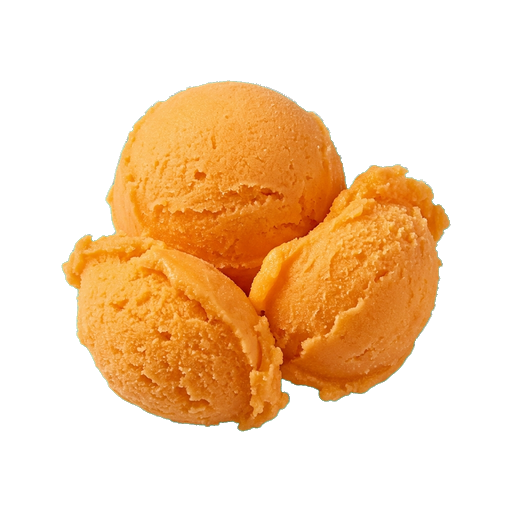
Orange Sherbet
Orange sherbet is a frozen dessert with a bright citrus flavor made from orange juice, sugar, and water. It is lighter than ice cream since it contains no cream, and has a refreshing texture with the characteristic tartness of ripe orange. It is used as a standalone dessert, an addition to fruit salads, or a component for creating layered frozen compositions, and pairs well with other citrus and berry sorbets.
Micronutrients
per 100 g
Minerals
Vitamins
About
What is orange sherbet and how to use it
Orange sherbet is a frozen dessert with an airy, almost icy texture that melts on your tongue. It is lighter than ice cream because it is made without cream: the base is only fruit puree or juice, sugar, and sometimes a little protein for fluffiness. The result is a bright, refreshing orange flavor without thickness or heaviness. Such sherbet is ideal when you want something cold and aromatic, but not too high in calories.
Taste and aroma
Orange sherbet delivers a vibrant citrus tartness with natural sweetness. The aroma is fresh and lively, reminiscent of a freshly peeled orange. A good sherbet maintains a balance between acidity and sweetness, without becoming cloying. If natural juice is used in the composition, the taste becomes more rich and complex than when using concentrate.
Where it is used in the kitchen
Orange sherbet plays several roles. First, it is a standalone dessert — simply serve it in a dessert bowl or waffle cone. Second, it becomes an excellent filling for pies, tarts, and pastries, adding freshness to them. Third, it can be used as a component in a cocktail or non-alcoholic beverage: melted sherbet creates the base for fruit punch.
Sherbet also complements light desserts like panna cotta or mousse well. Its tartness balances the sweetness of creamy sauces and helps refresh the palate after a heavy course. Try serving it between the main course and dessert as a sorbet — this is a classic restaurant technique for cleansing the palate.
Pairings and Harmonies
Orange sherbet pairs well with vanilla, caramel, and white chocolate. These components emphasize its freshness without overpowering the citrus flavor. It also harmonizes with light spices: cinnamon, cardamom, or ginger. If you're making a multi-layered dessert, combine it with cookies, sponge cake, or meringue — the contrast of textures will enhance the impression of coldness and airiness.
Selection and Storage
When choosing orange sherbet, pay attention to the ingredients: a good product should contain orange juice or puree, sugar, and minimal additives. Avoid options with a long list of stabilizers and food colorings — natural sherbet has a natural orange color. The texture should be smooth and uniform, with no ice crystals on the surface (this is a sign of refreezing).
Orange sherbet is stored in the freezer at a temperature no higher than minus 18 degrees. If you take it out of the freezer, don't put it back — refreezing will spoil the texture. It's better to take out the amount you need and serve it right away. If the sherbet is too hard, let it sit for a few minutes at room temperature so it softens slightly and the flavor opens up.
Nutrition
per 100 g
- Calories
- 90 kcal
- Protein
- 0.5 g
- Fat
- 0.1 g
- Carbs
- 22 g
Micronutrients
per 100 g
Macronutrients
- Fiber
- 1.3 g
- Sugars
- 24.32 g
- Saturated fat
- 1.16 g
- Monounsaturated fat
- 0.53 g
- Polyunsaturated fat
- 0.08 g
- Omega-3 (EPA + DHA)
- 0 g
- Cholesterol
- 1 mg
- Water
- 66.1 g
Minerals
- Sodium
- 46 mg
- Potassium
- 96 mg
- Calcium
- 54 mg
- Magnesium
- 8 mg
- Phosphorus
- 40 mg
- Iron
- 0.14 mg
- Zinc
- 0.48 mg
- Copper
- 0.03 mg
- Manganese
- 0.01 mg
- Selenium
- 1.5 mcg
Vitamins
- Vitamin A (RAE)
- 12 mcg
- Vitamin D
- 0 mcg
- Vitamin E
- 0.01 mg
- Vitamin K
- 0 mcg
- Vitamin C
- 2.3 mg
- Vitamin B1 (thiamin)
- 0.03 mg
- Vitamin B2 (riboflavin)
- 0.1 mg
- Vitamin B3 (niacin)
- 0.06 mg
- Vitamin B5 (pantothenic acid)
- 0.22 mg
- Vitamin B6
- 0.02 mg
- Vitamin B9 (folate, DFE)
- 4 mcg
- Vitamin B12
- 0.1 mcg
Measures and weight
- 1 tbsp
- 10.5 g
- 1 tsp
- 3.5 g
- 1 cup
- 175 g
Measure calculator
- Weight
- 100 g
- Calories
- 90 kcal