Usuba
Usuba
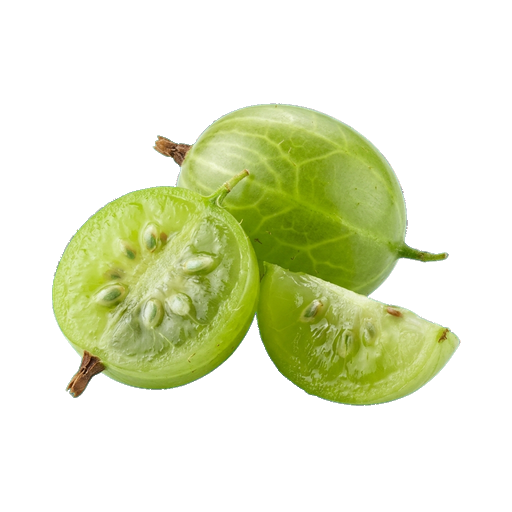
Gooseberry
Gooseberry is a berry with a firm skin and a tart-sweet flavor that can be green, yellow, or red depending on the variety and ripeness. In cooking, it is used for jams, compotes, sauces for meat and fish, and is also added to baked goods and desserts thanks to its natural pectin content and ability to hold its shape well during cooking. When selecting, prefer firm berries without damage, and when substituting, keep in mind that unripe gooseberry will provide more acidity, while ripe berries will offer more sweetness.
Micronutrients
per 100 g
Minerals
About
Gooseberry is a berry with character. It can be completely green and sour, ripe and sweet, or even almost black with a deep flavor. This versatility makes it indispensable in the kitchen: the same berry is suitable for spicy jam, desserts, and marinades for meat. The main thing is to know at what stage of ripeness to pick it and how to use it.
Taste and aroma depending on ripeness
Unripe gooseberry is a piercing acidity with herbaceous notes. Such berries are excellent for compotes where brightness is needed, and for jams with high pectin content. As the berry ripens, it becomes softer, floral notes appear, and acidity takes a back seat. Fully ripe gooseberry can be almost sweet, with honey and even spicy hints — this is already a dessert berry, which is good on its own or in fresh compotes.
Where and how to cook it
- Jams and preserves — a classic. Gooseberry is rich in pectin, so even without gelling additives you get a dense consistency.
- Sauces for meat and poultry — gooseberry's acidity cuts through richness and adds depth.
- Compotes and fruit drinks — a summer beverage that stores well and doesn't require excess sugar.
- Pies and tarts — gooseberry holds its shape during baking and doesn't get soggy.
- Marinades and preserving — the sharp flavor complements vegetables and fish.
Selection and Storage
When buying, look at the skin: it should be firm, without soft spots or dents. The color indicates the degree of ripeness — green gooseberries are sour, red and yellow ones are sweeter. Don't be afraid to choose different shades for different purposes. Fresh gooseberries are stored in the refrigerator for up to two weeks in a paper bag or plastic container. If you plan to cook, it's better to use them within a week — this way the taste is more vibrant.
Successful Combinations
- Mint — freshness enhances the summer drink.
- Ginger and cinnamon — spice highlights the depth of ripe gooseberry.
- White wine — for marinades and sauces.
- Black currant — a classic duo in compotes and jams.
- Almond and hazelnut — nutty notes pair well with sweet berries.
- Lamb and duck — gooseberry cuts through the richness of meat perfectly.
Gooseberries require minimal preparation: simply rinse and remove the tails. Do not peel the skin — it contains all the pectin and aroma.
Nutrition
per 100 g
- Calories
- 44 kcal
- Protein
- 0.7 g
- Fat
- 0.2 g
- Carbs
- 9.1 g
Micronutrients
per 100 g
Macronutrients
- Fiber
- 4.3 g
- Saturated fat
- 0.038 g
- Monounsaturated fat
- 0.051 g
- Polyunsaturated fat
- 0.317 g
- Omega-3 (EPA + DHA)
- 0 g
- Cholesterol
- 0 mg
- Water
- 87.87 g
Minerals
- Sodium
- 1 mg
- Potassium
- 198 mg
- Calcium
- 25 mg
- Magnesium
- 10 mg
- Phosphorus
- 27 mg
- Iron
- 0.31 mg
- Zinc
- 0.12 mg
- Copper
- 0.07 mg
- Manganese
- 0.14 mg
- Selenium
- 0.6 mcg
Vitamins
- Vitamin A (RAE)
- 15 mcg
- Vitamin E
- 0.37 mg
- Vitamin C
- 27.7 mg
- Vitamin B1 (thiamin)
- 0.04 mg
- Vitamin B2 (riboflavin)
- 0.03 mg
- Vitamin B3 (niacin)
- 0.3 mg
- Vitamin B5 (pantothenic acid)
- 0.29 mg
- Vitamin B6
- 0.08 mg
- Vitamin B9 (folate, DFE)
- 6 mcg
- Vitamin B12
- 0 mcg
Measures and weight
- 1 pcs
- 5 g
Measure calculator
- Weight
- 100 g
- Calories
- 44 kcal