 Usuba
Usuba
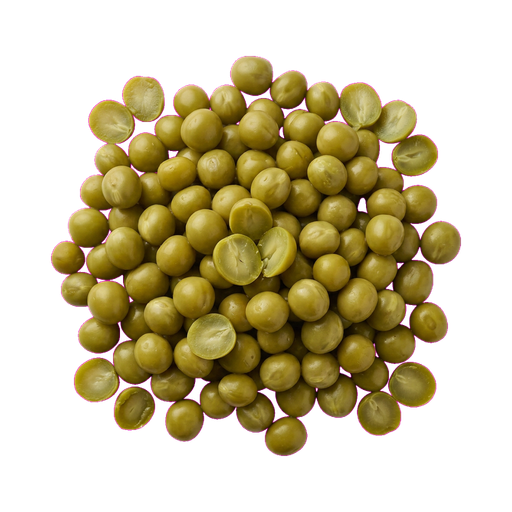
Canned green peas
Canned green peas are young pea kernels preserved in a sealed package with minimal processing. They have a tender texture and slightly sweet taste, though they lose some of the brightness of fresh peas due to heat treatment. Used in soups, side dishes, salads, and purees, reducing cooking time, but should be rinsed before use to remove excess liquid and reduce salt content.
Micronutrients
per 100 g
Minerals
About
Canned green peas are one of the most practical ingredients in the kitchen. They are always on hand, require no prior preparation, and retain decent taste and nutritional value. A can or package takes up minimal space in the cabinet, and peas can be used in dozens of dishes — from soups to salads and side dishes.
Taste, texture and aroma
Canned peas are softer than fresh or frozen ones — they have already been heat-treated and absorbed some of the brine. The taste is sweetish, delicate, without bright herbaceous notes. The aroma is delicate, barely perceptible. The texture allows the peas to mix easily with other ingredients without breaking down into mush, but also without leaving excess firmness.
It is precisely this softness and neutrality that make canned peas a universal helper. They don't dominate the flavor, but rather support and complement the main components of the dish. Before use, the peas are usually rinsed under cold water to remove excess brine and slightly refresh the taste.
Where and how to use
Canned peas work perfectly in soups. They don't require additional cooking time, so they are added at the end of preparation. They are especially good in cream soups, where peas become part of the base, and in light vegetable soups, where each ingredient remains recognizable.
Rice and pasta dishes get a bright pop of color and subtle sweetness from peas. Pilaf, risotto, pasta with vegetables, fried rice — peas find their place in all of them. They hold their shape well when stirred and don't get mushy, even if the dish sits in warmth.
In cold salads, canned peas add texture and a slightly sweet note. They pair well with potatoes, carrots, corn, eggs, and meat. Such salads come together in minutes and store well in the refrigerator.
- Fillings for pies and pastries
- Side dishes for meat and fish
- Ingredient in cutlets and meatballs
- Additive in omelets and fried eggs
- Part of vegetable mixes for freezing
Selection and Storage
When choosing, pay attention to the condition of the jar or packaging — it should be free from dents, rust, and leaks. Transparent packaging allows you to assess the appearance of the peas: the grains should be whole, approximately uniform in size, and bright green in color. If the peas are pale or darkened, this is a sign of prolonged storage or violation of storage conditions.
Check the ingredients: ideally, it should contain only peas, water, and salt. Some manufacturers add sugar, preservatives, or thickeners — this is not dangerous, but it affects the taste. If you care about natural products, choose the simplest composition.
Keep a closed jar or package in a cool, dark place at room temperature. The shelf life is usually 2–3 years. After opening, transfer the peas to a glass container, cover with a lid, and keep in the refrigerator for no more than 3–4 days. Frozen peas in the freezer will last longer — up to several months.
Practical Tips
Always rinse the peas before using if you want to control the saltiness of the dish. The brine from the jar can be quite salty, and this will change the flavor balance in the finished dish.
Canned peas work well in tandem with carrots, onions, and potatoes — this is a classic trio of vegetables found in kitchens around the world. Together they create a balanced flavor and an attractive appearance of the dish.
Keep it simple: canned peas are a helper for quick dinners and saving time. There's no need to cook them separately – just add them to the dish a few minutes before it's done, or even at the end if you want to preserve their shape and color.
Nutrition
per 100 g
- Calories
- 55 kcal
- Protein
- 3.4 g
- Fat
- 0.4 g
- Carbs
- 10.7 g
Micronutrients
per 100 g
Macronutrients
- Fiber
- 3.3 g
- Sugars
- 3.2 g
- Saturated fat
- 0.086 g
- Monounsaturated fat
- 0.043 g
- Polyunsaturated fat
- 0.226 g
- Omega-3 (EPA + DHA)
- 0 g
- Cholesterol
- 0 mg
- Water
- 85.13 g
Minerals
- Sodium
- 185 mg
- Potassium
- 106 mg
- Calcium
- 20 mg
- Magnesium
- 19 mg
- Phosphorus
- 63 mg
- Iron
- 1.29 mg
- Zinc
- 0.72 mg
- Copper
- 0.1 mg
- Manganese
- 0.21 mg
- Selenium
- 1.3 mcg
Vitamins
- Vitamin A (RAE)
- 76 mcg
- Vitamin D
- 0 mcg
- Vitamin E
- 0.02 mg
- Vitamin K
- 20.7 mcg
- Vitamin C
- 7.8 mg
- Vitamin B1 (thiamin)
- 0.08 mg
- Vitamin B2 (riboflavin)
- 0.02 mg
- Vitamin B3 (niacin)
- 1 mg
- Vitamin B5 (pantothenic acid)
- 0.09 mg
- Vitamin B6
- 0.07 mg
- Vitamin B9 (folate, DFE)
- 24 mcg
- Vitamin B12
- 0 mcg
Measure calculator
- Weight
- 100 g
- Calories
- 55 kcal
