Usuba
Usuba
Swiss cheese
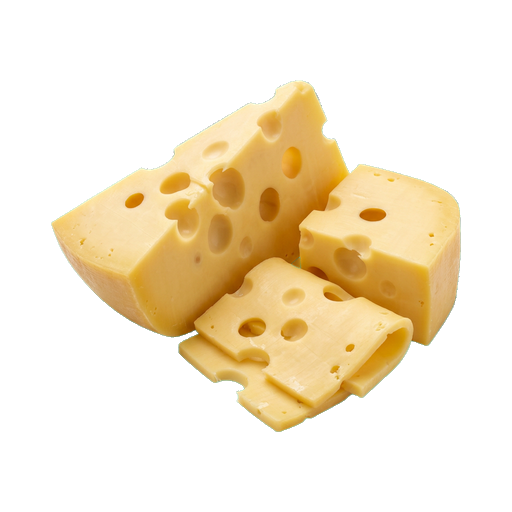
Swiss cheese is a hard cheese with a slightly sweet, nutty flavor and characteristic large holes that form during maturation. It melts well and is suitable for fondue, raclette, gratins, and sandwiches, and pairs excellently with wine and fruit. When selecting, pay attention to the uniformity of the holes and texture density — quality cheese should be firm and not crumbly.
Micronutrients
per 100 g
Minerals
About
Swiss cheese is not just a single product, but an entire category of hard cheeses with characteristic large "holes" and a slightly sweet nutty flavor. These openings appear naturally during maturation due to gases released by bacteria. The cheese has a dense, slightly elastic texture and a smooth surface of light yellow color. It can be found under different names depending on the production region, but they are all united by one recognizable feature — these very famous holes.
Aroma and Taste
Swiss cheese has a mild and delicate taste with pronounced nutty notes and a light sweetness. Young cheeses of this type are more tender and neutral, and with age the flavor becomes more intense and complex, with caramel undertones appearing. The aroma is pleasant, not sharp, with earthy and herbal hints. It is this harmony that makes it a versatile helper in the kitchen — it does not overpower, but complements.
Role in dishes
Swiss cheese melts well and holds its shape, making it ideal for hot dishes. It works wonderfully in classic cheeseburgers, adds depth to fondue and raclette. In the kitchen, it is valued for its ability to create a stretchy, creamy texture without excessive oiliness. When heated, the cheese doesn't become rubbery and maintains a pleasant taste.
- Hot sandwiches and subs
- Cheese sauces and cream soups
- Baked dishes and gratins
- Fondue and raclette
- Cheese boards and appetizers (sliced or diced)
Pairings and Harmony
Swiss cheese easily finds common ground with a wide variety of ingredients. Its nutty flavor is complemented well by honey, pear, and apple on a cheese board. In hot dishes, it pairs with bacon, ham, mushrooms, and caramelized onions. Piquant spices like mustard or horseradish highlight its flavor without overpowering it.
Selection and Storage
When purchasing, pay attention to the appearance: the cheese should be free of mold and dark spots, with evenly distributed holes. The surface should not be sticky or excessively moist. Fresh cheese has a pleasant aroma without off-flavors. Sliced cheese is best stored in the refrigerator in an airtight package or parchment paper — this way it won't absorb foreign odors and won't dry out. A whole piece can last several weeks if wrapped properly.
- Store in the refrigerator at a temperature of 4–8 degrees
- Use parchment paper or plastic wrap, avoiding polyethylene
- Before serving, allow the cheese 15–20 minutes to warm up to room temperature for full flavor
- Storage time for sliced cheese — up to two weeks, for a whole piece — up to one month
Swiss cheese is a reliable choice for those who appreciate predictable, pleasant flavor and versatility. It requires no experimentation and works well in both classic and modern recipes. Add it to your arsenal, and it will become one of your most frequent kitchen helpers.
Nutrition
per 100 g
- Calories
- 380 kcal
- Protein
- 27 g
- Fat
- 30 g
- Carbs
- 1 g
Micronutrients
per 100 g
Macronutrients
- Saturated fat
- 18.2 g
- Monounsaturated fat
- 7.26 g
- Polyunsaturated fat
- 1.14 g
- Omega-3 (EPA + DHA)
- 0.009 g
- Cholesterol
- 93 mg
- Water
- 37.6 g
Minerals
- Sodium
- 185 mg
- Potassium
- 71 mg
- Calcium
- 890 mg
- Magnesium
- 33.4 mg
- Phosphorus
- 574 mg
- Iron
- 0.13 mg
- Zinc
- 4.37 mg
- Copper
- 0.05 mg
- Manganese
- 0.03 mg
- Selenium
- 30.1 mcg
Vitamins
- Vitamin A (RAE)
- 292 mcg
- Vitamin D
- 0 mcg
- Vitamin E
- 0.6 mg
- Vitamin K
- 1.4 mcg
- Vitamin B1 (thiamin)
- 0.01 mg
- Vitamin B2 (riboflavin)
- 0.3 mg
- Vitamin B3 (niacin)
- 0.06 mg
- Vitamin B5 (pantothenic acid)
- 0.35 mg
- Vitamin B6
- 0.07 mg
- Vitamin B12
- 3 mcg
Measures and weight
- 1 slice
- 20 g
Measure calculator
- Weight
- 100 g
- Calories
- 380 kcal