Usuba
Usuba
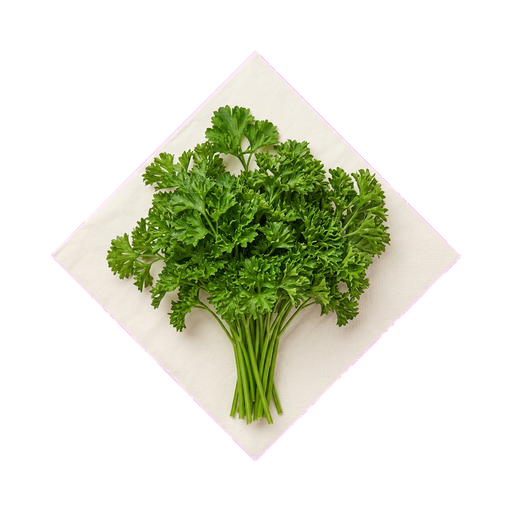
Curly parsley
Curly parsley is distinguished from flat-leaf varieties by its characteristic wavy-edged leaves and a more delicate, subtle flavor with a slight bitterness. It is primarily used as a garnish and fresh addition to salads, soups, and side dishes, as it loses its appealing appearance when exposed to heat. When selecting, pay attention to the firmness of the leaves and bright green color — wilted or darkened parsley will quickly lose its aroma.
Micronutrients
per 100 g
Minerals
Vitamins
About
Curly parsley is a green herb that works on several levels at once. It decorates the dish, adds freshness and a light peppery note, and its delicate foliage is so beautiful that it often becomes the main accent on the plate. But it's not just decoration: beneath the curly exterior lies a full-fledged ingredient with its own character and purpose in the kitchen.
Aroma and Taste
Curly parsley smells of freshness and greenery — that's the first thing you notice. The taste is milder than flat parsley: there's a slight bitterness, but it's delicate, not overpowering. The leaves crunch a little if you chill them well, and the stems, despite their thinness, provide a slight firmness when chewed. All of this makes it ideal for those who love greens but don't want sharpness.
Role in Dishes
In the kitchen, curly parsley works in three directions. First, it's a finishing touch: a pinch of finely chopped herbs on soup, fish, or potatoes adds freshness at the last moment. Second, it holds its shape better than flat parsley, so it can be used in salads and cold appetizers without fear that the greens will become wilted. Third, the leaves are ideal for garnish thanks to their beautiful appearance — they decorate without any extra effort.
Pairs well with
- Fish and seafood — parsley highlights their freshness and slightly masks the fishy smell
- Potatoes and root vegetables — a classic combination, herbs make a simple dish more interesting
- Eggs and cottage cheese — a good companion in omelets, casseroles and syrniki
- Lemon and vinegar — together they create a bright, refreshing flavor chord
- Garlic and onions — parsley softens their sharpness and adds volume
Selection and Storage
When choosing, pay attention to the color: it should be bright green, without any yellow or brown spots. The leaves should be firm and not wilted. If parsley is sold in a bunch, take it in your hand — a good bunch will not fall apart. Avoid greens with a slimy coating or unpleasant odor.
At home, parsley is best stored in the refrigerator, wrapped in a damp paper towel and placed in a plastic bag. This way it will last a week or even longer. If the greens start to wilt, place them in a glass of cold water for an hour — they will revive. Curly parsley can be frozen, but it's better to do this in the form of cubes with butter or in ice: this way it won't clump together and will be easier to portion.
Add curly parsley to hot dishes at the very last moment — this way it will retain its freshness, aroma, and beautiful appearance. If you need greens that have already been cooked in the dish, use flat-leaf parsley: it is more resistant to heat treatment.
Nutrition
per 100 g
- Calories
- 49 kcal
- Protein
- 3.7 g
- Fat
- 0.8 g
- Carbs
- 7.7 g
Micronutrients
per 100 g
Macronutrients
- Fiber
- 3.3 g
- Sugars
- 0.85 g
- Saturated fat
- 0.132 g
- Monounsaturated fat
- 0.295 g
- Polyunsaturated fat
- 0.124 g
- Omega-3 (EPA + DHA)
- 0 g
- Cholesterol
- 0 mg
- Water
- 87.71 g
Minerals
- Sodium
- 56 mg
- Potassium
- 554 mg
- Calcium
- 138 mg
- Magnesium
- 50 mg
- Phosphorus
- 58 mg
- Iron
- 6.2 mg
- Zinc
- 1.07 mg
- Copper
- 0.15 mg
- Manganese
- 0.16 mg
- Selenium
- 0.1 mcg
Vitamins
- Vitamin A (RAE)
- 421 mcg
- Vitamin D
- 0 mcg
- Vitamin E
- 0.75 mg
- Vitamin K
- 1640 mcg
- Vitamin C
- 133 mg
- Vitamin B1 (thiamin)
- 0.09 mg
- Vitamin B2 (riboflavin)
- 0.1 mg
- Vitamin B3 (niacin)
- 1.31 mg
- Vitamin B5 (pantothenic acid)
- 0.4 mg
- Vitamin B6
- 0.09 mg
- Vitamin B9 (folate, DFE)
- 152 mcg
- Vitamin B12
- 0 mcg
Measures and weight
- 1 bunch
- 30 g
- 1 sprig
- 3 g
Measure calculator
- Weight
- 100 g
- Calories
- 49 kcal