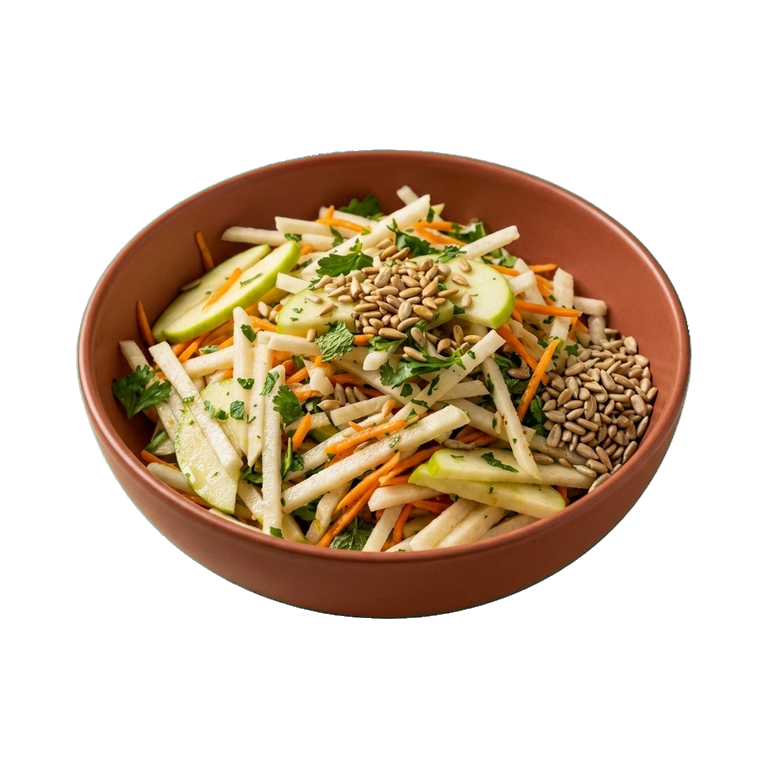
Usuba
Usuba
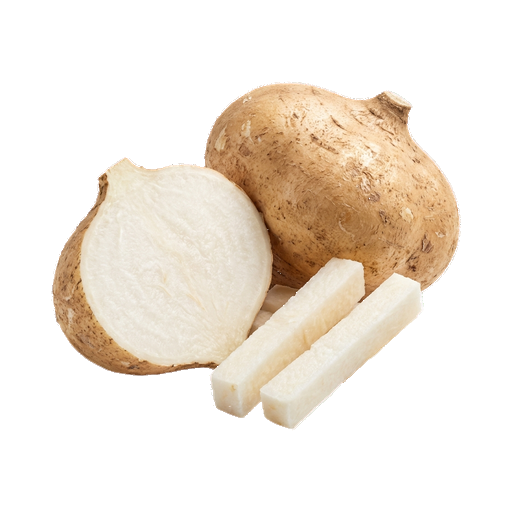
Jicama
Jicama is a root vegetable with thin brown skin and white crispy flesh that resembles water chestnuts or young turnips in texture. It has a sweet taste with a slightly starchy flavor and barely noticeable bitterness, making jicama excellent raw in salads or sliced as a snack. When cooked, it becomes softer but loses its characteristic crunch, so it's often added toward the end of cooking or used in stir-fried dishes over high heat to preserve the texture.
Micronutrients
per 100 g
Minerals
About
Jicama is a tuber with crispy white flesh and thin brown skin that tastes like something between an apple and a potato. Its main advantage in the kitchen is its ability to remain crispy for a long time even when cooked, and raw jicama simply melts in your mouth thanks to its high moisture content and subtle sweetness.
Aroma and taste
Jicama has almost no smell — this is its distinctive feature. The taste is delicate, slightly sweet, with a barely perceptible nutty note. The flesh is so juicy that it crunches like a fresh apple, but without its acidity. This neutrality makes jicama a versatile companion for both spicy and delicate dishes.
Role in Dishes
Raw jicama is cut into thin strips for salads, added to appetizers with spicy sauces, and served as a crispy snack with drinks. It is often used in Asian cuisine — in rolls, fresh spring rolls, salads with lime and fish sauce. When fried or stewed, the tuber retains its crunch, so it is added at the end of cooking or in a stir-fry to preserve its texture.
Pairings
- Spicy sauces: chili, lime, fish sauce, ginger
- Fresh herbs: cilantro, mint, basil
- Seafood: shrimp, squid, fish
- Vegetables: carrot, radish, cucumber
- Nut butters and coconut milk
Selection and Storage
When selecting jicama, look for tubers without soft spots and dents — they should be firm and heavy for their size. The skin may be rough, which is normal. Avoid very large specimens: they are often fibrous inside. Store jicama in a cool place or in the refrigerator — this way it will remain crispy for up to three weeks. Peeled tubers oxidize quickly, so slice them just before serving or store in water.
Preparation
- Rinse the tuber under cold water and pat dry
- Peel the skin with a sharp knife, removing a thick layer along with the fibrous part underneath
- Cut the flesh into matchsticks, cubes, or thin slices depending on the dish
- Use immediately or place in cold water to maintain crispness
Jicama is an ideal ingredient for those looking for a vegetable with guaranteed crunch and neutral flavor. It doesn't overpower other components, but gives the dish a pleasant texture and subtle sweetness.
Nutrition
per 100 g
- Calories
- 38 kcal
- Protein
- 0.7 g
- Fat
- 0.1 g
- Carbs
- 8.6 g
Micronutrients
per 100 g
Macronutrients
- Fiber
- 4.9 g
- Sugars
- 1.8 g
- Saturated fat
- 0.021 g
- Monounsaturated fat
- 0.005 g
- Polyunsaturated fat
- 0.043 g
- Omega-3 (EPA + DHA)
- 0 g
- Cholesterol
- 0 mg
- Water
- 90.07 g
Minerals
- Sodium
- 4 mg
- Potassium
- 150 mg
- Calcium
- 12 mg
- Magnesium
- 12 mg
- Phosphorus
- 18 mg
- Iron
- 0.6 mg
- Zinc
- 0.16 mg
- Copper
- 0.05 mg
- Manganese
- 0.06 mg
- Selenium
- 0.7 mcg
Vitamins
- Vitamin A (RAE)
- 1 mcg
- Vitamin D
- 0 mcg
- Vitamin E
- 0.46 mg
- Vitamin K
- 0.3 mcg
- Vitamin C
- 20.2 mg
- Vitamin B1 (thiamin)
- 0.02 mg
- Vitamin B2 (riboflavin)
- 0.03 mg
- Vitamin B3 (niacin)
- 0.2 mg
- Vitamin B5 (pantothenic acid)
- 0.14 mg
- Vitamin B6
- 0.04 mg
- Vitamin B9 (folate, DFE)
- 12 mcg
- Vitamin B12
- 0 mcg
Measures and weight
- 1 pcs
- 200 g
Measure calculator
- Weight
- 100 g
- Calories
- 38 kcal