Usuba
Usuba
Swiss chard
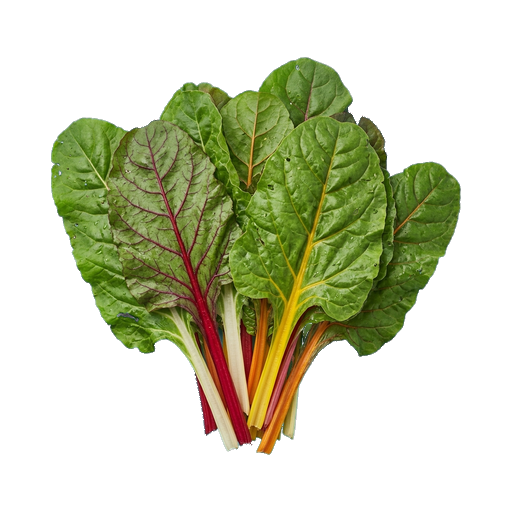
Chard is a leafy beet variety with broad, fleshy leaves and thick petioles that can be white, yellow, red, or orange. The taste is delicate, slightly sweet, without bitterness, with earthy notes. The leaves are used in salads and side dishes, while the petioles are stewed as a separate dish — they require slightly longer cooking than the leaf part, so they are often prepared separately or added to the pot earlier.
Micronutrients
per 100 g
Minerals
Vitamins
About
Chard is a leafy beet that looks like a hybrid of cabbage and spinach. It is grown not for its root vegetable, but for its large, fleshy leaves with bright veins. In the kitchen, it is valued for its versatility: the leaves are cooked as a standalone dish, added to soups, stews and salads, and the stalks can be braised separately, like asparagus.
Taste and Aroma
Mangold has a mild, slightly sweet taste with earthy notes — less intense than spinach. Young leaves are more tender and delicate, while mature leaves are denser and can be slightly bitter. The stems are sweet and crispy, with a subtle nutty undertone.
Role in dishes
Chard is excellent in hot dishes: it doesn't fall apart with heat like spinach does, and holds its shape. The leaves go into soups, stews, casseroles, and pasta. The stems require a bit more cooking time, so they are often added to the dish before the leaves.
Successful Pairings
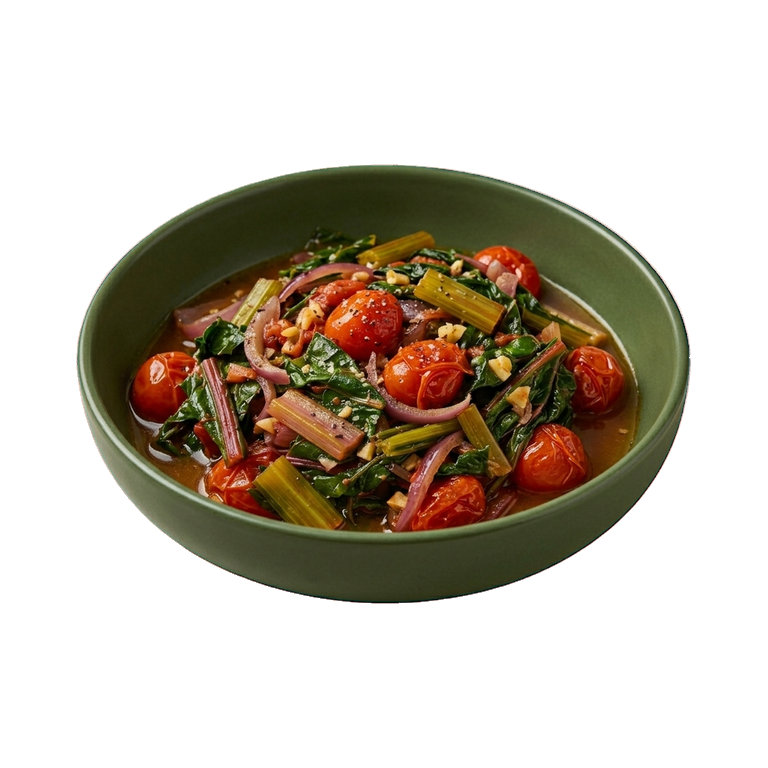
- Garlic, onion and olive oil — classic base for stewing
- Tomatoes, peppers and Mediterranean spices
- Cream, nutmeg and cheese for casseroles
- Lemon and pine nuts for salads with young leaves
- Potatoes and broth for soups
Selection and Storage
When buying, choose chard with firm, brightly colored leaves without spots or damage. Young plants are smaller and more tender — they are better for salads. Adult chard with large leaves is suitable for hot dishes. The stems should be crispy, without soft areas.
Store mangold in the refrigerator in a container or bag with a damp towel — this will keep it fresh for 3–5 days. Before cooking, rinse the leaves and stems thoroughly under running water to remove sand. You can separate the leaves from the stems and cook them separately if the recipe requires it.
Cooking Preparation
- Cut the stems into pieces 1–2 cm thick and cook them 2–3 minutes longer than the leaves
- Chop the leaves coarsely or leave them whole if they are young
- For salads, use only young leaves, blanch them in boiling water for a minute if you want to soften the flavor
- When cooking in soup, add the chard at the end to preserve the bright color and texture
Swiss chard is a simple way to add vibrant greens with interesting texture to your menu. It requires no complex preparation, withstands cooking well, and easily adapts to any cuisine style — from simple braising to refined side dishes.
Nutrition
per 100 g
- Calories
- 19 kcal
- Protein
- 1.8 g
- Fat
- 0.2 g
- Carbs
- 3.7 g
Micronutrients
per 100 g
Macronutrients
- Fiber
- 1.6 g
- Sugars
- 1.1 g
- Saturated fat
- 0.03 g
- Monounsaturated fat
- 0.04 g
- Polyunsaturated fat
- 0.07 g
- Omega-3 (EPA + DHA)
- 0 g
- Cholesterol
- 0 mg
- Water
- 92.66 g
Minerals
- Sodium
- 213 mg
- Potassium
- 379 mg
- Calcium
- 51 mg
- Magnesium
- 81 mg
- Phosphorus
- 46 mg
- Iron
- 1.8 mg
- Zinc
- 0.36 mg
- Copper
- 0.18 mg
- Manganese
- 0.37 mg
- Selenium
- 0.9 mcg
Vitamins
- Vitamin A (RAE)
- 306 mcg
- Vitamin D
- 0 mcg
- Vitamin E
- 1.89 mg
- Vitamin K
- 830 mcg
- Vitamin C
- 30 mg
- Vitamin B1 (thiamin)
- 0.04 mg
- Vitamin B2 (riboflavin)
- 0.09 mg
- Vitamin B3 (niacin)
- 0.4 mg
- Vitamin B5 (pantothenic acid)
- 0.17 mg
- Vitamin B6
- 0.1 mg
- Vitamin B9 (folate, DFE)
- 14 mcg
- Vitamin B12
- 0 mcg
Measures and weight
- 1 bunch
- 200 g
Measure calculator
- Weight
- 100 g
- Calories
- 19 kcal