Usuba
Usuba
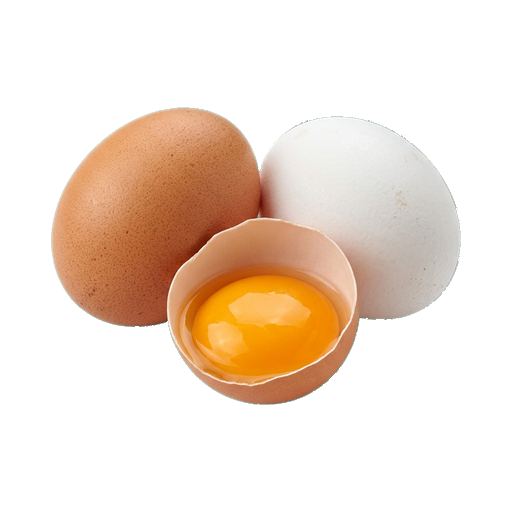
Egg
Chicken egg is a versatile ingredient that serves as a binder in dough, a leavening agent in baking, a thickener in sauces, and a base for countless dishes. The egg white coagulates when heated and provides structure, while the yolk enriches flavor and creates a creamy texture. When selecting eggs, pay attention to freshness: a fresh egg peels more easily when boiled, and for raw preparations, eggs from trusted sources are essential.
Micronutrients
per 100 g
Minerals
Vitamins
- AVitamin A (RAE)160mcg19% DV
- DVitamin D2mcg13% DV
- EVitamin E1.05mg7% DV
- KVitamin K0.3mcg0% DV
- B1Vitamin B1 (thiamin)0.04mg3% DV
- B2Vitamin B2 (riboflavin)0.46mg26% DV
- B3Vitamin B3 (niacin)0.08mg0% DV
- B5Vitamin B5 (pantothenic acid)1.53mg31% DV
- B6Vitamin B60.17mg9% DV
- B9Vitamin B9 (folate, DFE)47mcg12% DV
- B12Vitamin B120.9mcg30% DV
About
Egg is one of the most versatile ingredients in the kitchen. It works everywhere: in main dishes, baking, sauces, and even in beverages. Protein and yolk perform different functions, so understanding their properties helps you cook with confidence and achieve the desired result.
Taste and role in dishes
Egg is practically neutral in taste, but enriches a dish with softness and fullness. The yolk adds creaminess and binds ingredients, the white creates structure and helps whip air. In baking, egg retains moisture and adds fluffiness, in sauces — it emulsifies and thickens, in omelets and casseroles — it forms the foundation of the dish.
The taste of an egg depends on the bird's diet: grains, grass, and insects give a more pronounced, rich flavor. A fresh egg has a dense white and a convex yolk, whereas an old one becomes watery. This affects both the taste and the consistency of the finished dish.
Selection and Use
When buying, check the packaging date and shell integrity. A fresh egg does not make a sound when shaken, and the white coagulates quickly when boiled. Egg size affects baking recipes — a standard medium egg weighs about 50–55 grams, and recipes are usually calculated for this size.
- For omelets and fried eggs, choose the freshest eggs — they hold their shape better
- For baking, you can use older eggs (but not older than two weeks) — they mix better with the dough
- For sauces based on raw yolk (mayonnaise, hollandaise sauce) use only the freshest eggs
- Room temperature eggs give better emulsion when whipping and mixing with other ingredients
Store eggs in the refrigerator in a separate compartment or container — they absorb odors. Whole eggs keep for 3–4 weeks, separated egg whites for about a week, egg yolks in water for 2–3 days. Before using in cold sauces, allow eggs to come to room temperature.
Universal Combinations
Egg goes well with everything: with bacon and ham in breakfasts, with vegetables in casseroles, with butter in sauces, with milk in creams and puddings. In bread and dough, egg is invisible, but without it the texture is completely different. With herbs — parsley, tarragon, dill — egg reveals itself in a new way, especially in omelets and fillings.
If a recipe calls for room temperature, it's not just a suggestion. Cold eggs don't mix well with butter and batter, resulting in a lumpy texture. Let your eggs sit on the counter for 15–20 minutes before you start.
An egg is not just an ingredient, it's a kitchen helper. Learn to feel the difference between fresh and old, between raw and boiled, between whipped and simply stirred — and your dishes will become more stable and delicious.
Nutrition
per 100 g
- Calories
- 155 kcal
- Protein
- 13 g
- Fat
- 11 g
- Carbs
- 1.1 g
Micronutrients
per 100 g
Macronutrients
- Fiber
- 0 g
- Sugars
- 0.37 g
- Saturated fat
- 3.126 g
- Monounsaturated fat
- 3.658 g
- Polyunsaturated fat
- 1.911 g
- Omega-3 (EPA + DHA)
- 0.058 g
- Cholesterol
- 372 mg
- Water
- 76.15 g
Minerals
- Sodium
- 142 mg
- Potassium
- 138 mg
- Calcium
- 56 mg
- Magnesium
- 12 mg
- Phosphorus
- 198 mg
- Iron
- 1.75 mg
- Zinc
- 1.29 mg
- Copper
- 0.07 mg
- Manganese
- 0.03 mg
- Selenium
- 30.7 mcg
Vitamins
- Vitamin A (RAE)
- 160 mcg
- Vitamin D
- 2 mcg
- Vitamin E
- 1.05 mg
- Vitamin K
- 0.3 mcg
- Vitamin C
- 0 mg
- Vitamin B1 (thiamin)
- 0.04 mg
- Vitamin B2 (riboflavin)
- 0.46 mg
- Vitamin B3 (niacin)
- 0.08 mg
- Vitamin B5 (pantothenic acid)
- 1.53 mg
- Vitamin B6
- 0.17 mg
- Vitamin B9 (folate, DFE)
- 47 mcg
- Vitamin B12
- 0.9 mcg
Measures and weight
- 1 pcs
- 50 g
Measure calculator
- Weight
- 100 g
- Calories
- 155 kcal