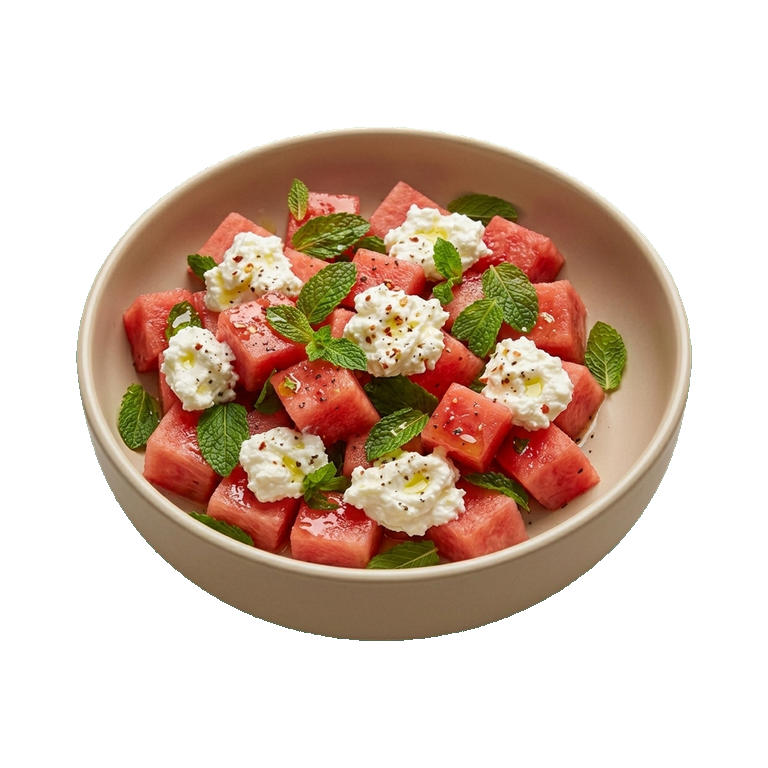
Usuba
Usuba
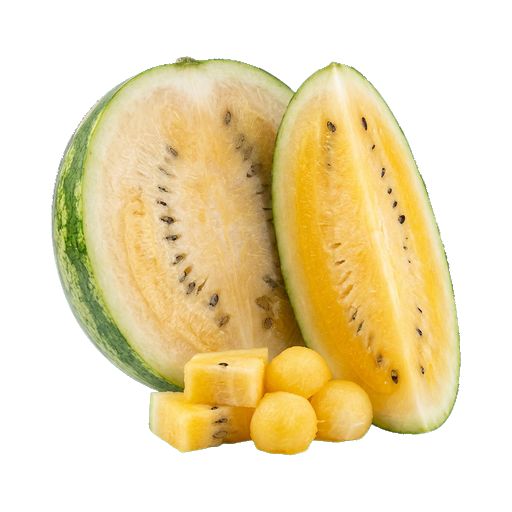
Yellow Watermelon
Yellow watermelon differs from the traditional red variety with its tender, sweet flesh featuring a subtle vanilla aroma and more delicate texture. A ripe fruit has pale yellow or creamy-colored flesh that is more easily damaged when sliced, therefore requiring careful handling. In cooking, it is used the same way as regular watermelon — for fresh cuts, smoothies, and desserts, but thanks to its delicate flavor, it is better suited for standalone consumption without additives rather than being masked by other ingredients.
Micronutrients
per 100 g
Minerals
About
What distinguishes yellow watermelon from the familiar red one
Yellow watermelon is not a hybrid or the result of chemical treatment, but simply a different variety with a natural flesh color. Externally, it looks like a regular watermelon: striped or solid green skin, the same size and weight. The main difference is hidden inside: the flesh has a bright yellow or golden hue, sometimes with reddish veins. This color is due to increased carotene content — the same substance that makes carrots orange.
Taste and Aroma
Yellow watermelons often taste sweeter and more aromatic than their red counterparts. The flesh is more tender and juicy, with honey and fruity notes. Taste differences depend on the variety and growing conditions, but overall yellow varieties are considered more delicate. The seeds are usually the same as in regular watermelons, although seedless varieties also exist.
How to use in the kitchen
Yellow watermelon is prepared in exactly the same way as red watermelon. It is eaten fresh, sliced into wedges or cubes, added to fruit salads, smoothies, and cocktails. Thanks to its sweetness and tender texture, it works well for desserts and side dishes to spicy dishes. Its bright yellow color makes it particularly attractive for plating — it contrasts beautifully with red tomatoes, green vegetables, or white feta.
- In salads with mint, lime and chili pepper
- In cold soups and gazpacho
- As a filling for sorbet or granita
- In combination with seafood and white cheeses
How to Choose and Store
When choosing a yellow watermelon, use the same criteria as for a red one. Tap on the skin — the sound should be dull and resonant, indicating ripeness. Check for cracks and soft spots. The watermelon should be heavy for its size. If possible, look at the cut — the flesh should be evenly colored, without white streaks in the center.
A whole uncut watermelon is stored in a cool place at room temperature for several weeks. In the refrigerator it will last longer, but the taste may suffer a bit. Sliced watermelon is wrapped in film and placed in the refrigerator for 3–4 days. Yellow watermelon can be frozen by cutting it into cubes — later it is used in drinks and desserts, although the texture will change.
Nutritional Value
Yellow watermelon consists of 90 percent water, making it an ideal summer fruit for hydrating the body. Thanks to carotene, it contains more vitamin A than the red variety. It also contains vitamins C and B, potassium, and magnesium. The calorie content is low — about 30–40 kilocalories per 100 grams, so watermelon is suitable for light summer menus and diets.
Nutrition
per 100 g
- Calories
- 38 kcal
- Protein
- 0.6 g
- Fat
- 0.4 g
- Carbs
- 8.1 g
Micronutrients
per 100 g
Macronutrients
- Fiber
- 0.4 g
- Sugars
- 6.2 g
- Saturated fat
- 0.016 g
- Monounsaturated fat
- 0.037 g
- Polyunsaturated fat
- 0.05 g
- Omega-3 (EPA + DHA)
- 0 g
- Cholesterol
- 0 mg
- Water
- 91.45 g
Minerals
- Sodium
- 1 mg
- Potassium
- 112 mg
- Calcium
- 7 mg
- Magnesium
- 10 mg
- Phosphorus
- 11 mg
- Iron
- 0.24 mg
- Zinc
- 0.1 mg
- Copper
- 0.04 mg
- Manganese
- 0.04 mg
- Selenium
- 0.4 mcg
Vitamins
- Vitamin A (RAE)
- 28 mcg
- Vitamin D
- 0 mcg
- Vitamin E
- 0.05 mg
- Vitamin K
- 0.1 mcg
- Vitamin C
- 8.1 mg
- Vitamin B1 (thiamin)
- 0.03 mg
- Vitamin B2 (riboflavin)
- 0.02 mg
- Vitamin B3 (niacin)
- 0.18 mg
- Vitamin B5 (pantothenic acid)
- 0.22 mg
- Vitamin B6
- 0.05 mg
- Vitamin B9 (folate, DFE)
- 3 mcg
- Vitamin B12
- 0 mcg
Measures and weight
- 1 pcs
- 5000 g
Measure calculator
- Weight
- 100 g
- Calories
- 38 kcal