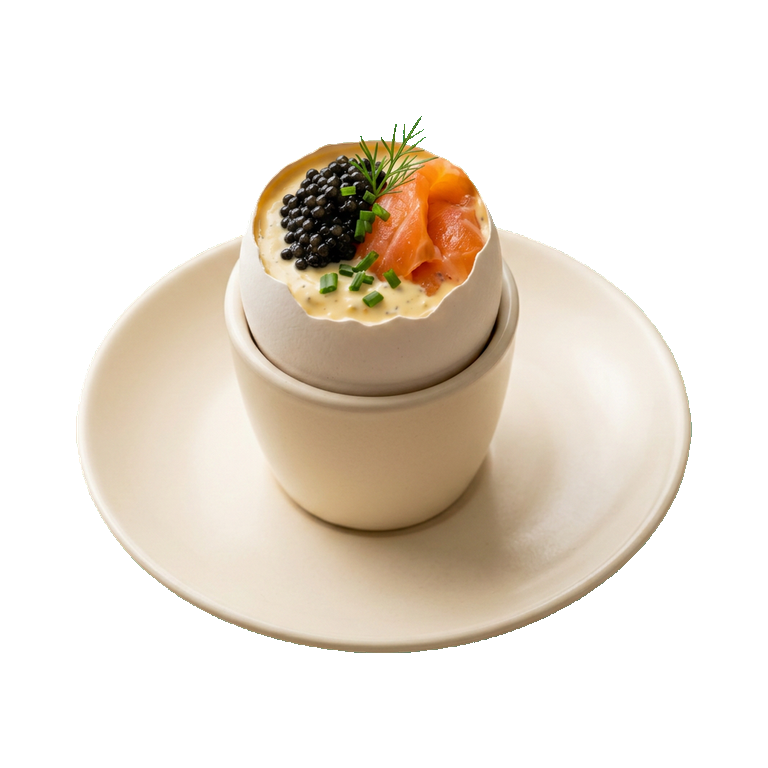
Usuba
Usuba
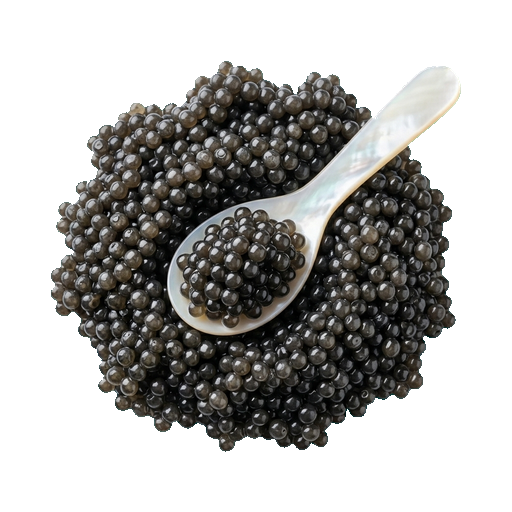
Black caviar
Black caviar is sturgeon roe distinguished by large grains of black or dark grey color and a delicate, slightly salted taste with a subtle fish aroma. In culinary arts, it is used as a delicacy appetizer, served chilled on ice, added to sushi, canapés, and festive dishes. When choosing, pay attention to the integrity of the grains, shine, and smell — caviar should smell of the sea, not fish, and should not contain excess liquid in the jar.
Micronutrients
per 100 g
Minerals
Vitamins
- AVitamin A (RAE)271mcg32% DV
- DVitamin D2.9mcg19% DV
- EVitamin E1.89mg13% DV
- KVitamin K0.6mcg1% DV
- B1Vitamin B1 (thiamin)0.19mg13% DV
- B2Vitamin B2 (riboflavin)0.62mg34% DV
- B3Vitamin B3 (niacin)0.12mg1% DV
- B5Vitamin B5 (pantothenic acid)3.5mg70% DV
- B6Vitamin B60.32mg16% DV
- B9Vitamin B9 (folate, DFE)50mcg13% DV
- B12Vitamin B1220mcg667% DV
About
Black caviar consists of roe from sturgeon fish, valued for its delicate taste, tender texture, and ability to elevate even the simplest dish. Each caviar bead is a small pouch filled with oily contents that melts on the tongue. In culinary arts, caviar works as an accent: a few beads on a plate transform the perception of an entire dish.
When choosing caviar for your kitchen, it's important to understand that it's not just a decoration. It's an ingredient with its own character — slightly salty, with a sea aroma and a noble bitterness. Caviar demands respect: proper storage, delicate handling, and smart use will reveal its finest qualities.
Taste and Aroma
The taste of black caviar is a complex bouquet. Light saltiness and delicate bitterness that appears at the end come to the forefront. They are followed by marine notes: iodine, seaweed, freshness. Each type of sturgeon caviar has its own character: beluga produces larger eggs with a mild flavor, ossetra — medium-sized with a more pronounced bitterness, sevruga — small and piquant.
The texture of caviar is its main virtue. Quality caviar doesn't burst between your teeth, but bursts in your mouth, releasing oily contents. It's a sensation of tenderness and luxury that's hard to describe in words, but easy to remember.
Where and how to use
Black caviar works in two modes: as a standalone dish and as a final touch. On toast with butter and a pinch of salt, it reveals itself fully. On a cold appetizer — smoked fish, cream cheese, or avocado — caviar adds contrast and sophistication. On a hot dish, caviar is added at the last moment so it doesn't heat up and lose its texture.
- Caviar on bread with butter — a classic way that doesn't distract from the taste
- Caviar on pancakes or thin crêpes with sour cream — a traditional and foolproof option
- Caviar on oysters or scallops — a seafood combination where each component enhances the other
- Caviar on avocado or cream cheese — a contrast of tenderness and saltiness
- Caviar as a garnish for soups and cold appetizers — just a few caviar eggs transform the dish
The main rule: don't overcomplicate. Caviar doesn't need competitors on the plate. The simpler the accompaniments, the brighter its flavor. Avoid sharp sauces, acidic marinades, and harsh spices — they overpower the delicate aroma.
Selection and Storage
When choosing caviar, pay attention to its appearance: the eggs should be whole, shiny, and uniform in size. If you notice burst eggs or cloudy contents, this is a sign of improper storage. The smell should be of the sea, without mustiness or foreign odors.
Caviar is a delicate product that requires proper storage conditions. In a refrigerator at a temperature between 0 and 4 degrees Celsius, a closed jar can be stored for several months. After opening, caviar should be used within a few days. Do not freeze caviar — it will lose its texture. Remove caviar from the refrigerator 10–15 minutes before serving so it warms slightly and releases its aroma.
- Store caviar in the coldest part of the refrigerator
- Use a clean spoon (preferably mother-of-pearl or plastic, not metal) each time you take some
- Do not keep caviar in an open container — it oxidizes quickly
- If caviar was purchased in bulk, transfer it to a glass container with a hermetic lid
Black caviar is not an everyday product, and that is its virtue. It reminds us of the importance of quality over quantity, that sometimes a few grams of an excellent ingredient bring more pleasure than a plate of ordinary food. Use caviar for special moments, for experimenting with flavors, and to treat yourself and your loved ones.
Nutrition
per 100 g
- Calories
- 235 kcal
- Protein
- 24.6 g
- Fat
- 14.2 g
- Carbs
- 0 g
Micronutrients
per 100 g
Macronutrients
- Fiber
- 0 g
- Sugars
- 0 g
- Saturated fat
- 4.06 g
- Monounsaturated fat
- 4.631 g
- Polyunsaturated fat
- 7.405 g
- Omega-3 (EPA + DHA)
- 6.541 g
- Cholesterol
- 588 mg
- Water
- 47.5 g
Minerals
- Sodium
- 1500 mg
- Potassium
- 181 mg
- Calcium
- 275 mg
- Magnesium
- 300 mg
- Phosphorus
- 356 mg
- Iron
- 11.88 mg
- Zinc
- 0.95 mg
- Copper
- 0.11 mg
- Manganese
- 0.05 mg
- Selenium
- 65.5 mcg
Vitamins
- Vitamin A (RAE)
- 271 mcg
- Vitamin D
- 2.9 mcg
- Vitamin E
- 1.89 mg
- Vitamin K
- 0.6 mcg
- Vitamin C
- 0 mg
- Vitamin B1 (thiamin)
- 0.19 mg
- Vitamin B2 (riboflavin)
- 0.62 mg
- Vitamin B3 (niacin)
- 0.12 mg
- Vitamin B5 (pantothenic acid)
- 3.5 mg
- Vitamin B6
- 0.32 mg
- Vitamin B9 (folate, DFE)
- 50 mcg
- Vitamin B12
- 20 mcg
Measures and weight
- 1 tbsp
- 15.8 g
- 1 tsp
- 5.3 g
- 1 cup
- 262.5 g
Measure calculator
- Weight
- 100 g
- Calories
- 235 kcal